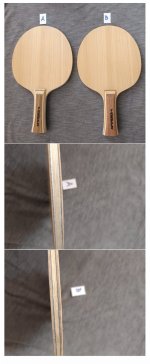







Hi all, new here but long time lurker (mainly to look at the gorgeous stuff SDC makes and to gain inspiration xD).
I have a question related to blade making and specifically relating to the frequency of blades with balsa cores. I started making some blades for my own / my son's use a few months ago as he has just started out and I played a long time ago at a decent level (in the smaller ball / speed glue days!) and wanted to start playing again. Seems like a lot has changed since then but the last blade I used "in anger" back then is my trusty TSP Balsa 6.5.
Anyway, I've made up a few blades with different compositions using lightweight balsa (ie. semi-competition stuff) which allowed me to use some more interesting heavier woods for the outer layers. I started with 5/7 ply all-wood construction but feedback from the better players in the club was that they had amazing feel but were a little on the slow side so I've mucked around with CF and Kevlar-CF mix a little bit also with a more "traditional" core material - namely Kiri and those have been better received.
What I've noticed from measuring the "blade frequency" using Audacity is that for the latest Kiri cored, inner CF blades I've made, the figures "make sense" in line with what is reported in the various threads on here - in the 1360 - 1520hz range depending on the outer layers, however for the original 7 or so balsa cored blades I made, the numbers are ridiculous. The ones that people said were "too slow" are coming out in the 1660 - 1800hz range. The one I've loaned out to a fairly highly rated UK player is measuring at around 2000hz and I wouldn't say it's "too fast" (or too stiff for that matter) with nice feel and all wood 7-ply construction. For comparison, my TSP balsa 6.5 measures at around 1920hz and it's listed as OFF speed (by TSP).
Does this make sense? Does this measurement simply not "work" for balsa cored blades - clearly you can measure them against each other and get an idea as to the relative stiffness of them but I guess you can't compare these against more "normally" constructed blades?
I have a question related to blade making and specifically relating to the frequency of blades with balsa cores. I started making some blades for my own / my son's use a few months ago as he has just started out and I played a long time ago at a decent level (in the smaller ball / speed glue days!) and wanted to start playing again. Seems like a lot has changed since then but the last blade I used "in anger" back then is my trusty TSP Balsa 6.5.
Anyway, I've made up a few blades with different compositions using lightweight balsa (ie. semi-competition stuff) which allowed me to use some more interesting heavier woods for the outer layers. I started with 5/7 ply all-wood construction but feedback from the better players in the club was that they had amazing feel but were a little on the slow side so I've mucked around with CF and Kevlar-CF mix a little bit also with a more "traditional" core material - namely Kiri and those have been better received.
What I've noticed from measuring the "blade frequency" using Audacity is that for the latest Kiri cored, inner CF blades I've made, the figures "make sense" in line with what is reported in the various threads on here - in the 1360 - 1520hz range depending on the outer layers, however for the original 7 or so balsa cored blades I made, the numbers are ridiculous. The ones that people said were "too slow" are coming out in the 1660 - 1800hz range. The one I've loaned out to a fairly highly rated UK player is measuring at around 2000hz and I wouldn't say it's "too fast" (or too stiff for that matter) with nice feel and all wood 7-ply construction. For comparison, my TSP balsa 6.5 measures at around 1920hz and it's listed as OFF speed (by TSP).
Does this make sense? Does this measurement simply not "work" for balsa cored blades - clearly you can measure them against each other and get an idea as to the relative stiffness of them but I guess you can't compare these against more "normally" constructed blades?