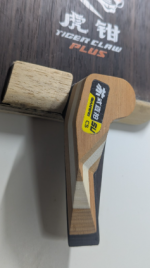
Handle Material

SDC

This user has no status.

SDC

This user has no status.
🏆 Top 1% Commenter
Well-Known Member
Dec 2011
1,789
3,532
5,922
I just made an addition to the "Nerdy Stuff" section on my website about the most commonly used handle materials and their characteristics. Dealing with a lot of customers over the years, I found that there's a general lack of knowledge/confusion about this subject, probably because there isn't much information out there. So, instead of giving the same information over and over again, I just made something that everyone can access. Feel free to comment with any questions or missing information that I can add.

Link to the full post: https://www.sdcttblades.com/nerdy-stuff/handle-material
 
This user has no status.
Member
Dec 2013
48
71
171
Great article, as always! :D

I have a question regarding the fineline, out of curiosity.
In photos of those handles, there are many "lines" visible, for example
1000046459.jpg

Here white parts have 4 lines.

1000046463.jpg

And here the pink part has plenty of them.

Are those the thin wood veneers that you need to dye one by one and glue one by one to each other?
 
  • Like
Reactions: victormanriquey

SDC

This user has no status.

SDC

This user has no status.
🏆 Top 1% Commenter
Well-Known Member
Dec 2011
1,789
3,532
5,922
Great article, as always! :D

I have a question regarding the fineline, out of curiosity.
In photos of those handles, there are many "lines" visible, for example
View attachment 40855
Here white parts have 4 lines.

View attachment 40856
And here the pink part has plenty of them.

Are those the thin wood veneers that you need to dye one by one and glue one by one to each other?
Correct. Every thin line you see is the glue interface between two veneers. You can see this in almost every commercial handle nowadays. Fineline can also be stacked horizontally, creating a different look. This can be seen for example in the old Viscarias vs the new ones.

By the way, I don't dye the veneers myself, it's still a very specialized procedure and a lot of them are needed just to make one handle, so it's a large quantity to diy. I buy the veneers in bulk and do the rest myself, but they are expensive, another reason why I ask more for these types of handles.
 

K.K

This user has no status.

K.K

This user has no status.
Member
Aug 2024
368
378
1,011
wow thanks again for that very detailed blog section of yours! with my friends we solved a lot if internal discussion about wood and fibers with your website and now can clear the next thing about handles! you doing great work

two questions:
about the pvc, timo boll said in his channel that he uses this foam on his handle because he sweats so much and it helps with slipping. so the opposite what you wrote, what do you think?

regarding fineline, i have the problem that i sweat a lot too and the fineline handles actually solved that problem for me, so the old viscaria was worse for me then the new one (the blade i played before HAL) but i have a problem with the discoloration and would like to know if there is anything to prevent that, without loosing the absorption properties? it is something aesthetic, i think it looks ugly when black handle become grey and the colors fade with some blades
 
This user has no status.
Member
Dec 2013
48
71
171
Correct. Every thin line you see is the glue interface between two veneers. You can see this in almost every commercial handle nowadays. Fineline can also be stacked horizontally, creating a different look. This can be seen for example in the old Viscarias vs the new ones.

By the way, I don't dye the veneers myself, it's still a very specialized procedure and a lot of them are needed just to make one handle, so it's a large quantity to diy. I buy the veneers in bulk and do the rest myself, but they are expensive, another reason why I ask more for these types of handles.
Thank you very much! :D Today I learned...

That sounds super painful, tiresome and time-consuming...
So if for exaple one asks for a handle with "smooth rainbow gradient", then you would need to buy a lot of them and glue them in order one by one...

Maybe I'll ask for some simpler handle designs in that case...
 
  • Like
Reactions: victormanriquey

SDC

This user has no status.

SDC

This user has no status.
🏆 Top 1% Commenter
Well-Known Member
Dec 2011
1,789
3,532
5,922
wow thanks again for that very detailed blog section of yours! with my friends we solved a lot if internal discussion about wood and fibers with your website and now can clear the next thing about handles! you doing great work

two questions:
about the pvc, timo boll said in his channel that he uses this foam on his handle because he sweats so much and it helps with slipping. so the opposite what you wrote, what do you think?

regarding fineline, i have the problem that i sweat a lot too and the fineline handles actually solved that problem for me, so the old viscaria was worse for me then the new one (the blade i played before HAL) but i have a problem with the discoloration and would like to know if there is anything to prevent that, without loosing the absorption properties? it is something aesthetic, i think it looks ugly when black handle become grey and the colors fade with some blades
Two different things happening here, absorption and texture. It is a plastic so it does not absorb sweat, that's a given. However, they leave the material with some texture, not completely smooth, and that gives some security in the grip. With the tools I have it's not possible for me to do it with that kind of texture, another reason why I don't use it for complete handles.

Discoloration is inevitable. If you protect the handle to prevent this, you will lose the absorption properties, there is no way around it.

Thank you very much! :D Today I learned...

That sounds super painful, tiresome and time-consuming...
So if for exaple one asks for a handle with "smooth rainbow gradient", then you would need to buy a lot of them and glue them in order one by one...

Maybe I'll ask for some simpler handle designs in that case...
It's not one by one, but it does take me a few days just to prepare the material, before I can actually begin making the handle. For such a case I would have to prepare each color separately, and then bring them all together.
 
This user has no status.
Member
Mar 2022
420
677
2,038
That's some really great content Sergio - honestly can't think of anything of note which you haven't already covered . :):)

Extra kudos for mentioning stabilized wood by the way :cool: (y) I don't use the stuff much either, largely due to its weight (and also due to the fact I have far too many super-dense regular timbers to choose from already :ROFLMAO: Living in a state chock full of axe-breakers, means accessing super-dense counterweight timber is never a problem.

(Incidentally, did you know you can stabilize wood using just tung oil?? :D:D I only found that one out recently -- would love to give it a go at some point, as it might create some great colour shifts in the grain, while also help to keep the weight down).

One very minor (and largely insignificant) technical point that might be worth adding to your post, is that ( (putting compression, tension and canopy timbers aside) wood density usually correlates to its physical location on the tree (i.e.: the higher up the trunk a section of timber is located, the lower its average density becomes.

While the delta of wood density to physical height varies between tree species, the rate of density variation within trees from a single species seems to be a lot more consistent (or at least it is with several Aussie species I work with).

Therefore, if you know the species and height of the tree (and/or the length and weight of the timber board) you can occasionally predict with reasonable certainty which section of its length should contain wood of the desired density.

Personally, I think the reasons why large manufacturers don't offer different handle weights based on wood density however, are largely financial, as opposed to technical.

Larger manufacturers conceivably could offer custom-weighted all wood handles if they really wanted to, but they choose not to simply because they all mass manufacture and its not really an efficient use of material for them. Smaller, niche blade builders however aren't lumbered with such limitations, and can offer a lot more diversity in this regard (pun definitely intended ;))

Great post again Sergio, hope they're keeping you busy. Respect! :cool: (y)
 
Last edited:
  • Love
  • Like
Reactions: Egon and SDC
says This status has no user
Member
Sep 2013
251
295
591
I asked Sergio to make me a handle incorporating some stabilized wood and couldn't be happier about it. It's beautiful, near impossible to get dirty from sweat, and essentially have the same benefits as the plastic parts inside the Viscaria Golden handle. Couldn't recommend it enough.
 
  • Love
  • Like
Reactions: Wakkibatty and SDC

SDC

This user has no status.

SDC

This user has no status.
🏆 Top 1% Commenter
Well-Known Member
Dec 2011
1,789
3,532
5,922
What kind of handle has the #1270 - Asymmetric Inner - All-∕Off- ?? Do you remember?


It has one of the nicest I ever used!
It's natural wood, Padauk to be precise. But in that case the end grain is facing up, which is not usual, normally the grain runs parallel to the wood plies. Putting the wood in that position has some benefits, visually it's much more beautiful, it provides greater sweat absorption because the pores are literally in contact with the hand, and it has a nice texture as well. The problem is that wood is much harder to work with in that position, it's harder to machine because the chances of tearout are much higher, and it's harder to finish by hand as well.
 

SDC

This user has no status.

SDC

This user has no status.
🏆 Top 1% Commenter
Well-Known Member
Dec 2011
1,789
3,532
5,922
(Incidentally, did you know you can stabilize wood using just tung oil?? :D:D I only found that one out recently -- would love to give it a go at some point, as it might create some great colour shifts in the grain, while also help to keep the weight down).

Yes, I have heard of it. I also just learned about metalized wood, a lot of interesting stuff out there.

One very minor (and largely insignificant) technical point that might be worth adding to your post, is that ( (putting compression, tension and canopy timbers aside) wood density usually correlates to its physical location on the tree (i.e.: the higher up the trunk a section of timber is located, the lower its average density becomes.
True, of course, but a bit too detailed for the kind of info I wanted to present here. Honestly, I just wanted to give a broad view of the different handle options I offer. If I ever write a more detailed post about this, especially natural wood, there will be a lot more to talk about. But if that happens I will ask for your help, you have much more knowledge than me when it comes to wood 😅.

Personally, I think the reasons why large manufacturers don't offer different handle weights based on wood density however, are largely financial, as opposed to technical.
Of course this is the main reason, it always is in business. Simplifying the process means more savings, and eventually they can even charge more for something that costs them less to make.
 
  • Love
Reactions: Wakkibatty
Top