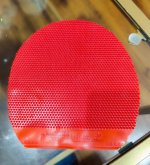
Proideal Mallican II no es una goma rápida ni lenta, la clasificaría con una velocidad media,son unos pips no muy blandos (algo rígidos) que se doblan y generan una disrupción no muy pronunciada, no es una goma para jugar y cortar desde atrás de la mesa, me atrevería a decir que es para jugar cerca y quizá a media distancia la mesa, tiene un ángulo bajo y es muy insensible a los efectos entrantes, el corte se mantiene estable y bajo se puede golpear incluso un poco con ella, pero desde mi mirada es perfecta para ser combinada con Blades más lentos puesto que se escapa un poquito por su velocidad, es una goma que tiene propiedades bastante interesantes y en las versiones normales me atreveria a decirReview)
The Proideal Mallican II isn't a fast or slow rubber; I'd rate its speed as medium. These pips aren't super soft—they're a bit stiff—so they bend and create a decent but not overly dramatic disruption.
This isn't a rubber for playing and chopping far away from the table. I'd venture to say it's best for playing close to the table, maybe mid-distance at most. It has a low throw angle and is very insensitive to incoming spin. The chop stays stable and low, and you can even hit the ball a little with it.
In my view, though, it's perfect to pair with slower Blades because its speed can get away from you a bit.
The rubber has some pretty interesting properties, and in its normal versions, I'd say it's an average rubber. The one everyone knows and loved at the South American championships is the cured version that some players use. The cured version is horribly toxic and dangerous, but that rubber isn't legal for championships or ITTF play if used in that state.
Therefore, the normal versions aren't nearly as damaging as the cured version, which has like 10 or 15 different curing types. That one is the most dangerous and the most expensive due to the treatments they apply, costing $30 to $199 USD











 very expensive, but some people are saying that this rubber produces more reverse spin than Grass.