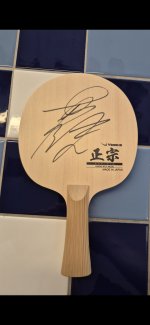
Is there a subjectively perfect weight to every blade?

This user has no status.
🏆 Top 1% Commenter
Well-Known Member
Oct 2018
1,686
2,055
4,224
I noticed it many times now that I have changed only the forehand rubber on my blade. If my racket is 191-2g totally it feels very elastic and I feel the wood and carbon working more. I feel it deforming and then regaining it's natural state (I feel the blade elasticity). If my racket is only 188g I don't feel this, instead I feel my racket to be stiff as a rock. So it got me wondering is there an optimal or even perfect weight for every blade where it's more elastic.
I'm not even sure if this is due to the weight but I have no other explanation in the lack of testing I and variables I can achieve.
Maybe blade makers like @SDC can chime in since he's churning out all kinds of blades and probably has more objective knowledge than me my relying on my senses.
I'm not really debating that heavier blades are faster, it's not relevant, I just wonder how weight is influencing the elasticity of the blade. If there is too light there must be too heavy as well and an optimum range.
Also based on the stiffness of the blade the weight has to be matched, surely a flexible all wood blade will feel different than a ZLC blade etc etc.

On a sidenote which really bugs me, why is it that if I go to a hall which is medium big, maybe like 12 tables, 2x6, so quite long but not too wide and I have this nice elastic feeling, then I literally walk over to a smaller hall (2 tables) and this feeling is totally gone. I'm not even saying I go one day to the medium sized hall then next day to the small one. I literally walk over 40 meters in a minute and I notice this.
 
  • Like
Reactions: latej
says Leave the righteousness to me.
🏆 Top 1% Commenter
Well-Known Member
Nov 2020
1,611
1,467
6,999
A thread where we could ask @SDC questions and not pollute his thread, is a good idea...

EDIT: Well, perhaps not.... If he answers, we'll have to wait more for the blades ;-)

EDIT2: F... tradeoffs... Can't we do without tradeoffs?
 
Last edited:
  • Like
Reactions: ttarc
This user has no status.
🏆 Top 1% Commenter
Well-Known Member
Jan 2021
3,918
2,871
8,092
Read 1 reviews
I think so, I am suffering from tennis elbow and I tried lighter blades… they simply don’t work so now I try to ignore it. And behold it’s getting better.

Yes I thing for every player there is a perfect weight and balance…

Cheers
L-zr
 
This user has no status.
Member
Aug 2022
223
340
566
On a sidenote which really bugs me, why is it that if I go to a hall which is medium big, maybe like 12 tables, 2x6, so quite long but not too wide and I have this nice elastic feeling, then I literally walk over to a smaller hall (2 tables) and this feeling is totally gone. I'm not even saying I go one day to the medium sized hall then next day to the small one. I literally walk over 40 meters in a minute and I notice this.


There is a ZJK video where he states he will vary the layers of booster and glue depending on the size of the playing venue.
 
  • Like
Reactions: Zwill
This user has no status.
🏆 Top 1% Commenter
Well-Known Member
Oct 2018
1,686
2,055
4,224
There is a ZJK video where he states he will vary the layers of booster and glue depending on the size of the playing venue.
Right, and for sure that is a good way to deal with the issue to add more weight. I have heard this from several CNT players be it male or female. Heck I even heard Dima talk about this, but other than feeling why does this happen? What is the physics behind it, surely there must be something.

If I don't know the root cause how can anyone deal with it? More layers? 10 layers? 15 layers? I'm skeptical about that solution.
 
This user has no status.
🏆 Top 1% Commenter
Well-Known Member
Oct 2018
1,686
2,055
4,224
I think it is all down to the psychedelic drugs you guys are smoking sniffing and swallowing. They make you very sensitive to all kind of parameters that are actually pretty irrelevant.
So ! Stop it !!! 😂 😂 😂
Just because your emotional range is equal to a teaspoon don't say we smoke shit. I never even smoked tobacco, sniffed glue or swallowed more than Cataflam which is a very weak morphine dose.
 
  • Haha
  • Like
Reactions: lodro and sebi
This user has no status.
Active Member
May 2023
641
931
2,069
I mainly used XIOM and BTY blades. for me personally, optimal weight for blades was 90g +-2
overall weight felt best around 190-195g

if the blade is too low weight, the vibrations are too strong, and feeling of the blade was empty
if the overall weight is too low, it is harder to make a powerful ball
 
says Shoo...nothing to see here. - zeio
🏆 Top 1% Commenter
Well-Known Member
Jan 2018
12,914
12,857
28,945
There is this phenomenon called "mass loading" where the mass of the rubbers causes the natural frequency of the blade to shift downwards, resulting in a lower overall natural frequency of the racket (rubbers + blade). You feel it as a reduction of stiffness.

As for bigger halls vs smaller halls, it may have to do with vibratory/auditory perception.
 
This user has no status.
Member
Aug 2024
218
124
426
My guess on the big vs small venue is that bigger, modern venues usually have a HVAC system designed to keep the pressure inside slightly higher than on the outside, as it's easier to control the temperature in a large space when you don't have outside air leaking in to the venue. At least this should be a contributing factor.
 
This user has no status.
🏆 Top 1% Commenter
Well-Known Member
Moderator
Oct 2014
19,973
26,531
70,870
Read 17 reviews
I have tried setups as light as 170g as heavy as 216g. Nowadays, with my arthritis issues , I consistently go for blades weighing 83‐86g and aim to have the whole setup under 190g though that depends on rubber weight and blade head size. I find for me that being comfortable i don't have to squeeze the racket hard to control it with more power helps a lot so I try to get fast outer carbon blades with lower weights to facilitate this. So Viscaria Super ALC has been at 84tg has been a favorite of mine.
 
  • Like
Reactions: TT Lover

SDC

This user has no status.

SDC

This user has no status.
🏆 Top 1% Commenter
Well-Known Member
Dec 2011
1,789
3,532
5,922
There is this phenomenon called "mass loading" where the mass of the rubbers causes the natural frequency of the blade to shift downwards, resulting in a lower overall natural frequency of the racket (rubbers + blade). You feel it as a reduction of stiffness.

As for bigger halls vs smaller halls, it may have to do with vibratory/auditory perception.
I think Zeio is right on point with his answer, when it comes to the rubber+blade combination.

For the bigger/smaller halls question, I would also say it's due to auditory/sensory perception. I play very badly when I cannot hear the ball correctly, and even the racket doesn't feel the same. It was not the racket that changed, but my own perception.

In terms of the main question itself: Is there a subjectively perfect weight to every blade? The short answer is: yes.

Every composition has a weight it likes to have. What do I mean by this? We all know (or perhaps we don't, judging by some questions I've been getting lately 😅), that wood has variable density, even within the same species. For example, we can find Ayous ranging from 250-450 kg/m2, that's a huge difference! In a blade with an Ayous core, that can easily mean a 10g difference, but the difference is not only in weight, the grain structure is also different and consequently, how the blade feels. A light piece of Ayous may feels closer to Kiri, while a heavy piece of Ayous may feel closer to Limba. However, these are the extremes, and we'll mostly find Ayous in the 370 kg/m2 range, and that's where Ayous will fell the most like Ayous (of course that grain direction also matters, but that's another story).

Sometimes, the variation of the mechanical properties does not accompany the variation in weight. For example, the weight decreases but the stiffness remains mostly the same, that's why blades with a lower mass core will often show higher frequency values (for the same exact model). The pitch will be higher but the blade will feel less lively and elastic. The opposite reasoning also applies.
 
Last edited:
This user has no status.
Since I changed to OX long pips, I found the overall set up weight effects how they play quite a lot.

If I try out a different inverted rubber on my spare set up, if it is the same weight as on my main blade, then the pips play the same and I can get on with evaluating the inverted rubber.

A couple of grams difference and I have to make some quite big adjustments.

I thought it was probably because the difference in weight was causing me to hold the blade at a slightly different angle, but it must be a very small difference as I can't visually see any change when looking at video footage.
 
  • Like
Reactions: Scarfed Garchomp
This user has no status.
🏆 Top 1% Commenter
Well-Known Member
Oct 2018
1,686
2,055
4,224
There is this phenomenon called "mass loading" where the mass of the rubbers causes the natural frequency of the blade to shift downwards, resulting in a lower overall natural frequency of the racket (rubbers + blade). You feel it as a reduction of stiffness.

As for bigger halls vs smaller halls, it may have to do with vibratory/auditory perception.
I think Zeio is right on point with his answer, when it comes to the rubber+blade combination.

For the bigger/smaller halls question, I would also say it's due to auditory/sensory perception. I play very badly when I cannot hear the ball correctly, and even the racket doesn't feel the same. It was not the racket that changed, but my own perception.

In terms of the main question itself: Is there a subjectively perfect weight to every blade? The short answer is: yes.

Every composition has a weight it likes to have. What do I mean by this? We all know (or perhaps we don't, judging by some questions I've been getting lately 😅), that wood has variable density, even within the same species. For example, we can find Ayous ranging from 250-450 kg/m2, that's a huge difference! In a blade with an Ayous core, that can easily mean a 10g difference, but the difference is not only in weight, the grain structure is also different and consequently, how the blade feels. A light piece of Ayous may feels closer to Kiri, while a heavy piece of Ayous may feel closer to Limba. However, these are the extremes, and we'll mostly find Ayous in the 370 kg/m2 range, and that's where Ayous will fell the most like Ayous (of course that grain direction also matters, but that's another story).

Sometimes, the variation of the mechanical properties does not accompany the variation in weight. For example, the weight decreases but the stiffness remains mostly the same, that's why blades with a lower mass core will often show higher frequency values (for the same exact model). The pitch will be higher but the blade will feel less lively and elastic. The opposite reasoning also applies.
Thanks guys, for the explanation.
Glad it's not just my imagination😅

For sure some halls sound so bad, like my racket sounds disgusting and other place it sings with high pitch sounds.
And usually the shitty sounding places play bad too, but I just can't accept it's because I perceive it differently. Those places feel like the ball isn't flying prolerly, I can't put spin on the ball.
Can't be just auditory perception alone 🤕🤕🤕
 
  • Like
Reactions: latej and zeio
This user has no status.
Hello, I think it is correct to compare the weights of the blades, and not the entire racket. Because a blade weighing ... 86 grams - viscaria, inverted rubber ... tenergy hard - 50 grams and long pips - 20 grams. Total weight 156 grams can make a super power forehand stroke despite the low total weight. :)
 
Last edited:
This user has no status.
Member
Mar 2024
135
148
322
Thanks guys, for the explanation.
Glad it's not just my imagination😅

For sure some halls sound so bad, like my racket sounds disgusting and other place it sings with high pitch sounds.
And usually the shitty sounding places play bad too, but I just can't accept it's because I perceive it differently. Those places feel like the ball isn't flying prolerly, I can't put spin on the ball.
Can't be just auditory perception alone 🤕🤕🤕
it might have to do with sound cues that you use in the neural circuitry you developed for table tennis. https://pubmed.ncbi.nlm.nih.gov/34870563/

humidity is a big factor too. in both spin generation and venue acoustics.

i can't think of any explanation(that is not an april fools joke one) of why the size or shape of a venue would measurably affect a racket's performance.
 
says Leave the righteousness to me.
🏆 Top 1% Commenter
Well-Known Member
Nov 2020
1,611
1,467
6,999
Dear @SDC, I can't resist asking following two questions. I know it is taking time, but I think other people will also enjoy your answer. My next blade will be very very similar to the current one, I want the same composition, same woods, i.e Limba, Ayous, Fiber, Ayous (core). And the same size 159x150, or perhaps 158x150. I would also (I hope it's OK) request 2 blades, the 2nd one in 157x150, for my best friend, with the same composition, or very very close. (My nr. is 188, I'm not in a hurry.)

Currently the fiber is AC-#. There is also S-AC and ALC. I only consider these 3 fibers, I don't want any other. I studied your page about the fibers, but I think it would be great, if you'd shortly try to describe the differences of those 3 fibers in my current blade. How would you describe the differences in feeling. E.g. in ALC you mention "crisp" feeling. Would you say AC-# has less crisp feeling? Also, if you would mention the weight difference, if there is any.

Second question is about the middle layer, which in my current blade, as you say, is very dense Ayous (almost as dense) as Limba. Let's say, this layer is less dense. Then again, how would you describe the difference in feeling? Would you feel the fiber (AC-#, or S-AC, or ALC) more? Would it feel more crisp?

The reason why I'm asking. Well I don't want to over-do it. As I said, the difference to my current blade will be very small anyway. The thing is, you can hear slightly different sound when you watch WCQ vs FZD. FZD is outer Viscaria like, it sounds more crisp, but at the same time kind of more shallow. I'd not really want that. Simply your thoughts on this would be nice to hear.
 
I am sure there is an optimal weight for each blade, but I also think there are optimal weights for the player and the rubber set-up.
Having recently gone from LP on one side with max sponge inverted on the other (total weights of 170-175 grams) I am now double inverted with 2.0 sponge on my former LP side. So 181 to 185 grams is optimal for me and 190 g and up I loose my snap.
EJing is a full time endeavor-I have gone to the falck carbon blade both because I want more power, but it is also lighter than the falck W7.
 
This user has no status.
Member
Mar 2022
420
677
2,038
Re: the OP:

Other posters have covered off all the main points (ie: yes, there is an ideal weight for a blade), but one thing I will also add is that there can also be a minimum threshold weight to unlock flex.

A couple of blades in my personal collection are on the flexy side. For a lark, I once tried switching the BH rubber on my most flexy blade with a layer of OX long pips, purely on an experimental EJ-driven whim.

What fascinated me was the massive drop in flex with the blade -- far more than I otherwise would have expected. The flex basically disappeared altogether, except during really hard smashes, and even then the flex wasn't much to speak of.

When I took off the OX, I replaced it with a Rigan Spin on the BH, yet again as a suck-it-and-see experiment. The Rigan Spin was only a few grams lighter than my regular BH rubber, and while most of of the flex came back right away, I could still easily notice the difference the respectively lighter BH rubber made.

Long story short, some blades out there have an ideal weight threshold for maximum flex. If your combined rubber weight falls *below* that threshold, then the flex can either diminish considerably or can even disappear entirely (with dwell time diminishing proportionately in the process).

Blades like these in my experience are best with a heavier set of rubbers on them to really reach their full spin potential (or at least this seems to be the case in my own game). It's yet another factor to keep in mind whenever you're fine tuning a new set-up.

Hope this helps 🙂
 
Last edited:
Top