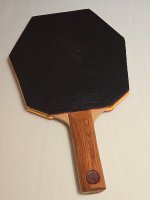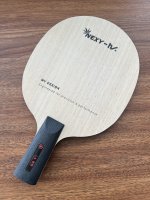

[DIY] The "Stradivarius": A 1300Hz Cybershape made with True Violin Woods (Maple/Spruce) & Hide Glue

Hi everyone!

I’m Corey, a designer by trade, and I had some high-quality Sugar Maple and Walnut furniture veneers (0.5mm tangential cut) lying around the workshop. I looked at them and thought: "Why not build a blade?". I wanna share with you guys and maybe inspire a blade making community.

20260109_115301.jpg

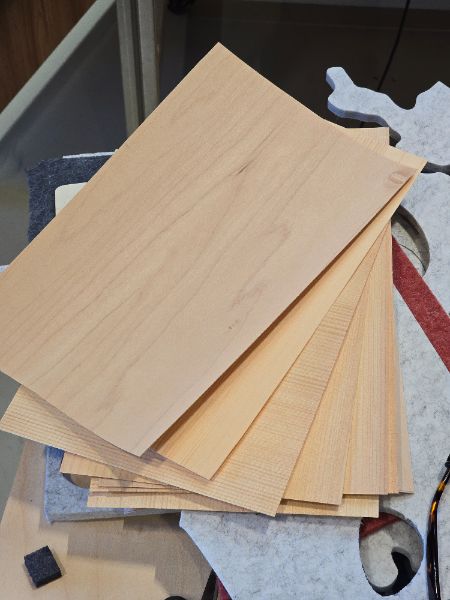
materials that will go into the blade got stacked first and measure the thickness.

I wanted something that didn't exist: The shape of a Cybershape (reusable rubber across all my blades, the speed of a modern 7-ply, but the authentic soul of an instrument.)

The "True Luthier" Concept: Nittaku Violin is a legend, but as a woodworker, I always found it funny that it uses White Ash and Ayous—woods you rarely find in a real orchestra. I wanted to build a blade using the actual construction of a violin:

  • Maple (Used for the back of a violin).
  • Spruce (Used for the soundboard/top of a violin).
  • Hide Glue (The only glue allowed in high-end luthiery).

The Build Specs

  • Adhesive: titebond hide glue
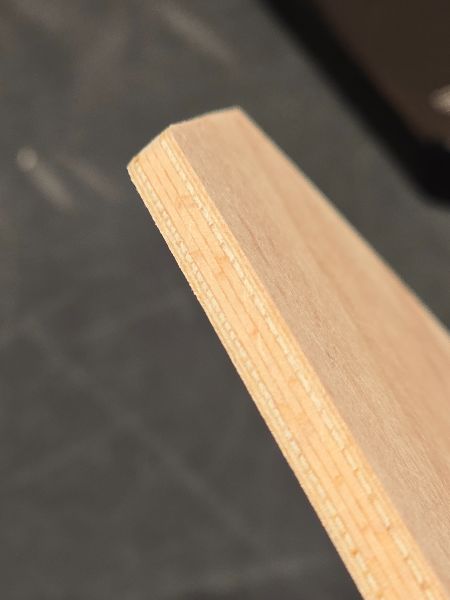
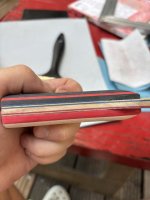
  • Outer: Sugar Maple (tangential cut, all opthers are quarter saw). I sanded this down to 0.2mm to retain the wood feel and touch.
  • Force Layers: Spruce 0.6mm + Horizontal Spruce 0.7mm.
  • Core: 1mm Hinoki stacked 3 times (3mm total).
  • Structure: It is essentially a structural hybrid of a Darker 7P-2A (Hinoki soul) and a Stradivarius Cello (Maple/Spruce body).

20260109_122420.jpg

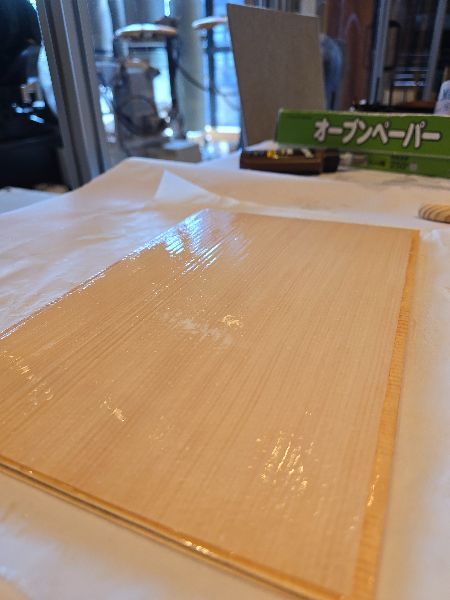
hide glue before putting layer on

20260109_133046.jpg

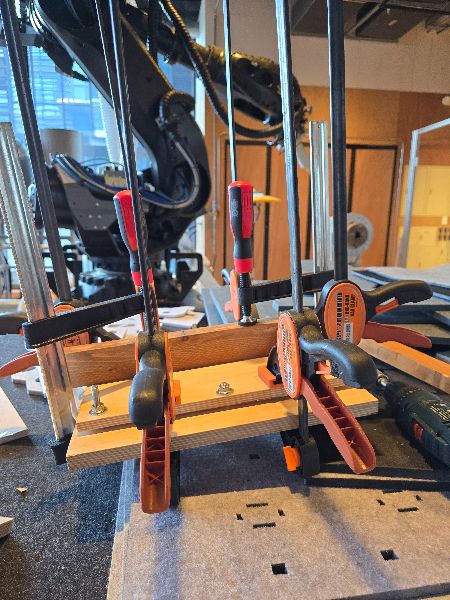
a rough caul i made

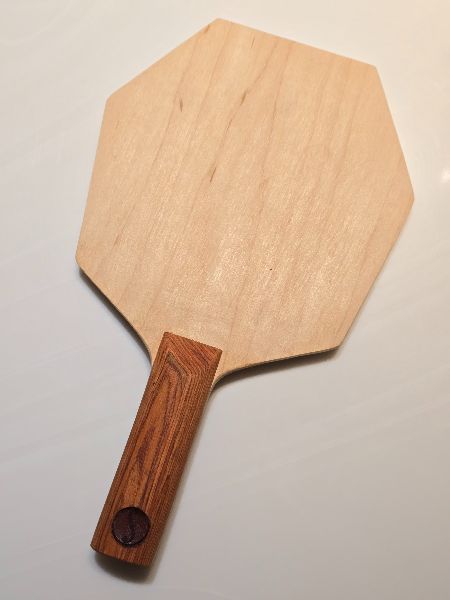
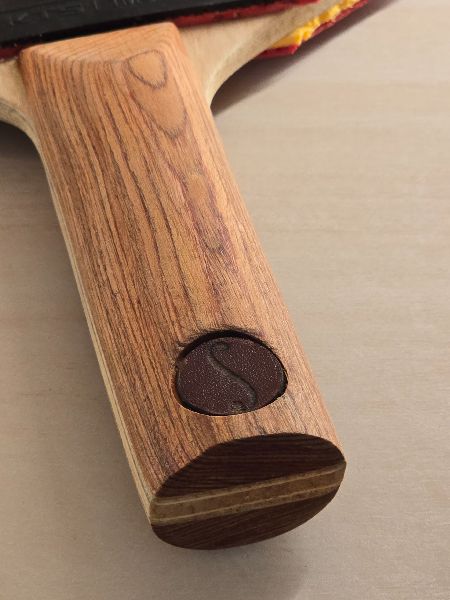
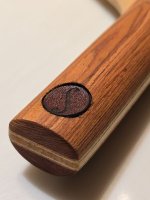
The Handle: "Soulspin Style" I made an ST (Straight) handle, but shaped it asymmetrically (inspired by Soulspin handles) to fit the natural curve of the palm.

  • The Detail: The "f-hole" logo isn't ink or wood—it’s Laser-Cut Leather.
  • Why Leather? It matches the Hide Glue (animal protein) theme perfectly!
20260113_212955.jpg
20260115_215439.jpg
20260112_184854.jpg


The Performance

  • Speed: It’s not as fast as a Cybershape Carbon. But it has much Higher Arc (higher than clipper). It is more controlled than a Stiga Clipper on soft touches, but when you hit hard, it engages the Hinoki core and becomes faster than a Clipper with a distinct "Clicky" sound.
  • Feel: Because the outer Maple is sanded so thin (0.2mm), the touch is amazing. I can chop and push with precision, but the ball "jumps" up powerfully on loops with a high arc. It feels like "Automatic Aiming", very forgiving.

The Setup

  • Weight: 94g (Blade) / 186g (Total).
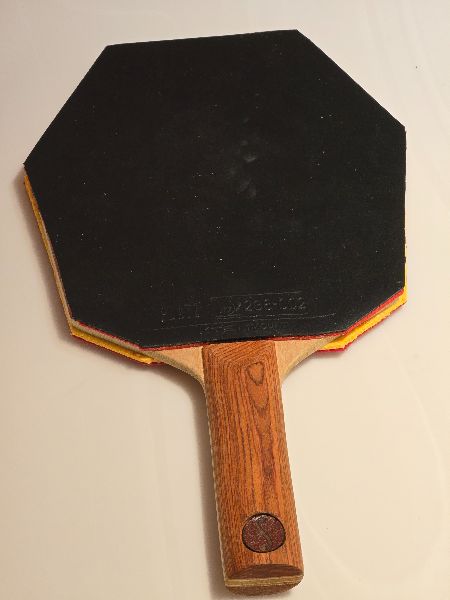
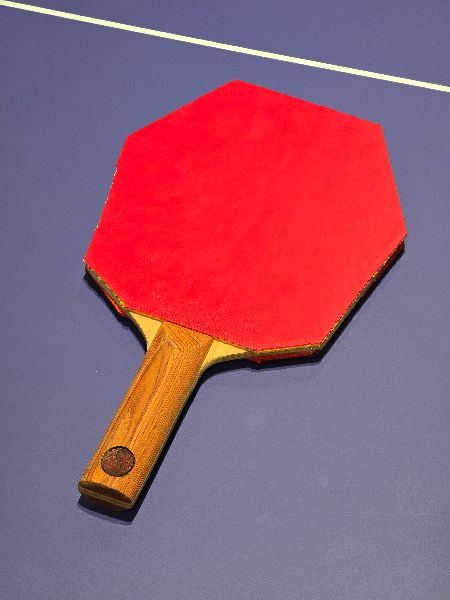
  • Rubbers: I raided my spare parts drawer! T-Mount KTS Platz (Forehand) and AK47 Yellow (Backhand).
(Please ignore the rubber gap... I was too excited to test it to cut fresh sheets!)

20260113_223343.jpg
20260115_215532.jpg


What's Next? I’m currently experimenting with synthesizing my own glue. My goal is to dissolve Fish Bladder Pellets into a TEMPO Cellulose Nanofiber (CNF) solution. Theoretically, this "Bio-Nanocomposite" should provide the stiffness and speed of Carbon, but with the natural touch of wood.

I’ve made quite a few blades before this one. If you guys are interested, I can share more of my builds!
 

Attachments

  • 20260113_213010.jpg
    20260113_213010.jpg
    35.7 KB · Views: 53
  • 20260113_223321.jpg
    20260113_223321.jpg
    19.1 KB · Views: 59
Last edited:
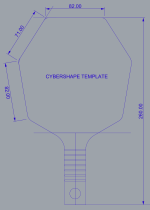
Very nice! What dimensions is the head on those puppies?
I traced it off of my cybershape carbon head. but it's hand sanded, so i guess it might be off by a few mm. haha. But the rubber generally fits, which is the most important part for me.
 

Attachments

  • Screenshot 2026-01-16 165404.png
    Screenshot 2026-01-16 165404.png
    52.4 KB · Views: 75
Last edited:
  • Like
Reactions: Tyce
Amazing, thanks for sharing! I would love to hear more about your thought processes and what is important regarding design in general and table tennis blades in particular.
Thanks! That is a big question, but I’ll try to break down my chaotic process.

Basically, my design journey started with frustration.

I played with Grubba All+ blade with Driver EL, when I am truly good. With new plastic ball, I am trying to look for "soul" and touch of blades like the Nittaku Acoustic and Soulspin roots, but they lacked the modern power I needed. When I looked at the market (especially the Cybershapes), I felt like innovation had stalled, everyone was using the same cores and plies as variations of viscaria and just changing the handle colors.

So I started experimenting with a few core principles:

1. The "Acoustic" Standard
I use Liquid Hide Glue (Titebond) and Fish Glue. It’s expensive maybe to a factory, but for me, when my girlfriend screams I ruined the apartment, I can wipe the messy spot off with warm water. It also creates a crystallized bond that lets the wood "sing" rather than thud. But later to use dyneema carbon and alc. I had to use epoxy, which resulted some domestic disputes.

2. The Orientation Puzzle

I spend a lot of time calculating ply direction.

Vertical Plies: Give you raw speed and direct power. And the blade will bend more, giving more dwell, but the sweetspot will be narrower if it's all vertical

Horizontal (Cross) Plies: Widen the sweet spot and add rigidity.

Finding the balance is the hardest part. Too many vertical plies and the blade becomes a rocket launcher with narrow sweetspot; too many cross plies and it feels stiff or like a noodle, depends on where the cross ply is.

3. The Enemy is Weight
This is my biggest struggle right now.
Unlike a factory, I can't do "Pre-Preg" carbon or high-pressure heat treatments. My early experiments with ALC/Dyneema + Hide Glue hybrids resulted in heavy blades (103g–105g) because the glue lines were too thick. The manual lamination process adds grams fast!

What's Next?

Since I can't beat the factories at making lightweight Carbon, I’m going the other way.

My next experiment is to dissolve Fish Bladder Glue pellets into a TEMPO Cellulose Nanofiber (CNF) solution. The goal is to create a "Bio-Composite" layer that is lighter than carbon but stronger than wood.

It’s a lot of trial and error (and talking to AI to double-check my chemistry), but that’s the fun of it!

Hope that answers your question.
 
This user has no status.
Very nice work!

Weight was also my biggest thing to struggle at first.
My rule of thumb working with fibers now is to use as much epoxy as the weight of the fiber is.
A sheet of 180g/m2 ALC is around 6g for the raw plate, so I use 6g of epoxy for this layer.
I have thin carbon with 3-4g per sheet so I use that amount of epoxy.
Works well for me.

Then I made an excel sheet with the weight of every single layer for the raw plate (around 18x28cm) add the weight of the glue and in the end you can fill in the actual blade size (around 0,0235m2 for standard 150x157 head size).
Then you have an idea for the weight of the finished blade (without handle). Of course you have to add the glue using a fine scale but over the time you will come very close to what the excel sheet tells.
 
  • Like
Reactions: TampaBayTableTennis
Very nice work!

Weight was also my biggest thing to struggle at first.
My rule of thumb working with fibers now is to use as much epoxy as the weight of the fiber is.
A sheet of 180g/m2 ALC is around 6g for the raw plate, so I use 6g of epoxy for this layer.
I have thin carbon with 3-4g per sheet so I use that amount of epoxy.
Works well for me.

Then I made an excel sheet with the weight of every single layer for the raw plate (around 18x28cm) add the weight of the glue and in the end you can fill in the actual blade size (around 0,0235m2 for standard 150x157 head size).
Then you have an idea for the weight of the finished blade (without handle). Of course you have to add the glue using a fine scale but over the time you will come very close to what the excel sheet tells.
Omg that is amazing! Great to find a fellow blade maker here! Thank you for the advice. I have two questions

1 I always feared the epoxy will not be enough to covered all the area and it will delaminate later. How do you keep the even spread?

2 I see people on YouTube sometimes use an intermediate plate for soaking the fiber to epoxy and then squeegee it before putting on a layup. Do you think it’s a viable option?

Thank you!
 
This user has no status.
1
I use any old credit card to spread it evenly.
At the beginning I also had the feeling it might not be enough but when you put on the pressure it will squeeze out here and there

2.
I am not sure if I understand what you say. They put the fiber on an extra plate or table, saturate it with epoxy and then put it between the wooden layers?

I think you can do so but I cant imagine how to control the amount of epoxy that way.
But if you work out your own routine- why not.
I think you should keep in mind that epoxy is quite expensive and you will lose some of it every time.
 
  • Like
Reactions: coreywong
1
I use any old credit card to spread it evenly.
At the beginning I also had the feeling it might not be enough but when you put on the pressure it will squeeze out here and there

2.
I am not sure if I understand what you say. They put the fiber on an extra plate or table, saturate it with epoxy and then put it between the wooden layers?

I think you can do so but I cant imagine how to control the amount of epoxy that way.
But if you work out your own routine- why not.
I think you should keep in mind that epoxy is quite expensive and you will lose some of it every time.
That is extreme insightful!!!! Let me try that next time. Just bought some SALC sheets after you showed me that is possible! Have you tried cnf solution mixed with hide or fish bladder? Love what you did with your blades! They have a lot of interesting wood species and they are all beautiful!
 
This user has no status.
Coreywong I have used silk in between the veneer sheets. I use a procedure that is used in concrete reinforcement they pretension the steel reo bars and use less cement to get the same strength i stretch the silk similar to a needle point hoop . Silk is strong enough to handle the forces we apply to the ball and would follow your Luthier concept. You mentioned fish pellets I use the skin off our leather jacket fish to make handle grips. Your blades are wonderfull and reading hear i appreciate the research time and commitment you put into each blade .I did not know you could buy hide glue so i have learnt something new. A new trend you may not have seen people are using their left over rubbers instead of edge tape it looks good and your blades deserve the Best.
 
Coreywong I have used silk in between the veneer sheets. I use a procedure that is used in concrete reinforcement they pretension the steel reo bars and use less cement to get the same strength i stretch the silk similar to a needle point hoop . Silk is strong enough to handle the forces we apply to the ball and would follow your Luthier concept. You mentioned fish pellets I use the skin off our leather jacket fish to make handle grips. Your blades are wonderfull and reading hear i appreciate the research time and commitment you put into each blade .I did not know you could buy hide glue so i have learnt something new. A new trend you may not have seen people are using their left over rubbers instead of edge tape it looks good and your blades deserve the Best.
You just unlocked a massive mental block for me with that 'Pre-Tensioned Concrete' analogy. 🤯

I was always worried that Silk would just act like a soft cushion (absorbing energy), but you are absolutely right—if you stretch it on a hoop like a drum skin before laminating, you are mechanically storing that potential energy. It turns the fiber from a dampener into a spring.

I have to ask: How does it actually play?
Does that pre-tensioned silk give it a sharp 'kick' (catapult) like a ZLC, or does it still feel softer/more controlled than carbon?

the Silk idea is so smart that it is a protein fiber and Hide Glue is a protein adhesive, they technically form a chemical bond (hydrogen bonding) that I just can't get with Epoxy on plastic/carbon. It’s basically how ancient composite bows were made.

I am definitely trying this 'Hoop Tension' method along with cnf glue variations on my next batch. Thanks for the inspiration!
 
This user has no status.
You just unlocked a massive mental block for me with that 'Pre-Tensioned Concrete' analogy. 🤯

I was always worried that Silk would just act like a soft cushion (absorbing energy), but you are absolutely right—if you stretch it on a hoop like a drum skin before laminating, you are mechanically storing that potential energy. It turns the fiber from a dampener into a spring.

I have to ask: How does it actually play?
Does that pre-tensioned silk give it a sharp 'kick' (catapult) like a ZLC, or does it still feel softer/more controlled than carbon?

the Silk idea is so smart that it is a protein fiber and Hide Glue is a protein adhesive, they technically form a chemical bond (hydrogen bonding) that I just can't get with Epoxy on plastic/carbon. It’s basically how ancient composite bows were made.

I am definitely trying this 'Hoop Tension' method along with cnf glue variations on my next batch. Thanks for the inspiration!
Hi Coreywong happy to help with your mental block.i have always made my own paddles when young i could not afford to buy when older the first paddles i purchased were not as good as the one's i made my self. My favourite store paddles Wang liqin dhs hurricane king 5ply 2 inner carbon around $150us when new and Xi Enting Apachie X969 7ply 2 carbon 2 aryl $20us when new Both were fun to play with. Coreywong we both work from opposite poles on timber selection and availability with different hurdles. Your trying to increase frequency and i try to decrease. HInoki 800lbf walnut 1010lbf Sugar maple 1450lbf My woods Buloke 5060lbf Iron bark 3600lbf Turpenrine 2697lbf My timbers are very dense with power to burn i don't have orientation decisions i use solid wood and when i have to layer up different veneers i just use compass points for for a balanced board. I can not give you a personal comparison of silk VS zlc because i could never buy carbon fibre here that i thought was fine enough to use on paddles so the bond build up did not become an issue . The silk paddles i made had more speed and control then identical paddles with no silk and the sound was sharper and had less volume that gave opponents that use sound less to work with. Hydrogen bonding is very strong and if repairing a joint you can wet it up and disassemble with less damage. The original clipper blades had a reputation for getting faster as they aged so i assumed they used they used a hide glue and the glue slowly dried out. If you want to eliminate bonding materials altogether look at ELECTROSTATICLY joining veneers if you crack that one you can choose rubbers and swap out veneers between games.
 
  • Like
Reactions: andymagata
This user has no status.
You just unlocked a massive mental block for me with that 'Pre-Tensioned Concrete' analogy. 🤯

I was always worried that Silk would just act like a soft cushion (absorbing energy), but you are absolutely right—if you stretch it on a hoop like a drum skin before laminating, you are mechanically storing that potential energy. It turns the fiber from a dampener into a spring.

I have to ask: How does it actually play?
Does that pre-tensioned silk give it a sharp 'kick' (catapult) like a ZLC, or does it still feel softer/more controlled than carbon?

the Silk idea is so smart that it is a protein fiber and Hide Glue is a protein adhesive, they technically form a chemical bond (hydrogen bonding) that I just can't get with Epoxy on plastic/carbon. It’s basically how ancient composite bows were made.

I am definitely trying this 'Hoop Tension' method along with cnf glue variations on my next batch. Thanks for the inspiration!
Coreywong use weight to your advantage. Newtons 2nd Law Force =Mass x Acceleration marshal artist use this when breaking things. A slower swing and a heavier paddle gives better control and more time to play your shot and a shorter return to your ready position and if you get the formula correct the same spin and speed.
 

SDC

This user has no status.

SDC

This user has no status.
🏆 Top 1% Commenter
Well-Known Member
Dec 2011
1,789
3,532
5,922
The pre-stressed concrete analogy doesn't really apply here. In a pre-stressed beam the tendons run inside of sleeves. Their are tensioned before the concrete is poured, then capped at the ends and released after the concrete has cured. This creates compression, making the concrete stronger against tension caused by external loads. In a layered glue up you will not achieve the same effect because the strands will be fixed at every point of their length. Essentially you will just be slightly decreasing the thickness of the fabric by pulling it and then fixing that position. If that will have any significant effect, I'm not sure, but is not pre-stress.

Tension and compression are usually things to avoid when using wood. In a 5+2 structure for example, if forces aren't fully balanced, the blade can easily warp.
 
This user has no status.
The pre-stressed concrete analogy doesn't really apply here. In a pre-stressed beam the tendons run inside of sleeves. Their are tensioned before the concrete is poured, then capped at the ends and released after the concrete has cured. This creates compression, making the concrete stronger against tension caused by external loads. In a layered glue up you will not achieve the same effect because the strands will be fixed at every point of their length. Essentially you will just be slightly decreasing the thickness of the fabric by pulling it and then fixing that position. If that will have any significant effect, I'm not sure, but is not pre-stress.

Tension and compression are usually things to avoid when using wood. In a 5+2 structure for example, if forces aren't: fully balanced, the blade can easily warp.
SDC Pre- tensioning : steel strands are tensioned before concrete is poured;they are cut after the con croncrete hardens, transferring compression by Bond. Post -tensioning : Ducts are cast into the concrete ; strands are threaded through after curing, tensioned against the hardened concrete,and then anchored. You are correct about the blades warping i had a blade cup like a half eaten orange peel but i assumed it was from the force stored in the silk.
 
Top