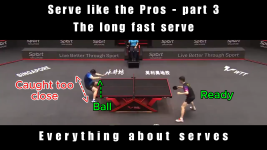
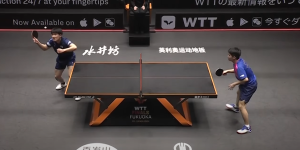
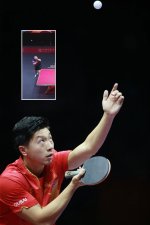
I really like that you are training all placements and from different spots on the table on your side.
And the forehand shots are nice. I like the right leg pointing to the right to be able to create rotation for the body.
For the serves, backspin and a lot of side spin makes them slower. So you lose part of the surprise.
Quality of the shot means placement, spin and power. 2 out of 3 is really good mad they don't look easy to receive at all.
If you'd like more speed, don't throw the ball so much backwards to the bat, this reduces the distance you accelerate with the bat. Have the bat move fast into the ball. It needs a bit of space to accelerate.
Try it with topspin aiming more into the table and trust the topspin to get it over the net.
Dear everyone,
I may not have the best technical explanation for this subject. However, in lieu of that, I shall offer an anecdotal story. Here goes.
I have a mentor, a veteran table-tennis player who is now in his early 80s. During his heydays, he was a local league champion. He once told me something about serving that has stayed with me ever since.
He said:
"A good serve is not necessarily the fastest serve, nor is it the spinniest.
If your serve, no matter how fast or how spinny, always goes to the same spot, at the same speed, with the same length and depth, it is not a particularly good serve.
Why? Because a good opponent will eventually anticipate it and adjust accordingly. That is simply human nature."
So, what then constitutes a good serve?
In my mentor's view, a good serve is one where your serving gesture, pre-serve routine, facial expression and demeanour remain consistent. You give your opponent nothing obvious to read, anticipate or use to prepare for the incoming ball.
Imagine being able to execute the same serving gesture and motion, yet deliver the ball to different areas of the table, varying its length and placement.
Better still, imagine being able to produce topspin, underspin and sidespin using essentially the same serving motion.
To me, that is a far more valuable serve than one which merely relies on exceptional speed or spin.
The essence of the matter is this: do not give your opponent the opportunity to anticipate, prepare or preconceive where the ball is going to land.
If you can achieve that, even without having the fastest or spinniest serve, you already possess a very effective serving weapon.
And perhaps that is what makes a good serve a great serve.
His advice has stayed with me all this while.