This user has no status.

This user has no status.
🏆 Top 1% Commenter
Well-Known Member
Well-Known Member




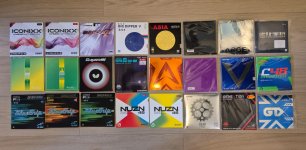
Happy New Year everybody! Hope everyone reaches their goals, table tennis or not, for this year. I know what mine is already: stick to my current setup for the whole year! Nonetheless, since I bought my first “professional” setup in April 2023, I probably spent nearly $1000 CAD in blades and rubbers! EJ is fun but hard on the wallet, and in order to help other new and experienced players not lose all their money on testing for the right equipment, I thought I’d write a guide on buying and choosing equipment so that you can stick with what you have and never change so you can spend less money and improve your game better. My guide is based on much experience of trying out different blades and rubbers and analyzing what the majority of the best non pros play. Please note, this guide is meant for attacking double inverted rubber players as this is the most common play style and what I know most about.
Choosing a blade
My recommendation for choosing a blade: whatever you learn on, stick with it. Trying to change between different compositions of blades is what leads to EJ and a lot of money wasted, as blades are the most expensive part of TT by far! That being said, if someone is buying their first blade and doesn’t know where to start, an inner carbon blade would work best. This is because with the plastic ball and modern game, the ball travels with less speed and rotation than before with celluloid balls. You need a bit more speed and with all wood blades, those are not the quickest and you will be at a disadvantage in my opinion once you get to a higher level. Outer carbon may be good for some players but are generally too quick and bouncy for those just starting out and even many intermediate players. But an inner carbon blade, which many professionals play, will be slow enough to control the short game and fast enough for deadly attacks. I would recommend a good quality blade like DHS Hurricane series (Long 5, WCQ, Sha, acB) or a Butterfly innerforce blade (Layer ALC, Harimoto ALC). Generally ALC blades are better than ZLC blades because of the softness of the ALC makes it easier to control.
Choosing a Forehand rubber
For this day and age of playing, you need to have a sticky or at least a semi sticky rubber on your forehand. The forehand is always going to be the most powerful stroke in table tennis due to swing space and with a tensor, non sticky rubber, it is just too fast and not spinny enough. Short game will also be challenging with these rubbers and they are typically more spin sensitive. So Chinese sticky rubbers or the masters Hybrid rubbers will work best for the increased spin and good control in short game. I would recommend a rubber in the hardness range of 50-53 degrees ESN because anything softer than that will feel mushy and slow and anything harder will be out of control for most players. Rubbers I would recommend include DHS Hurricane 3 Neo Provincial Blue Sponge (39 degrees on DHS scale), Dignics/Glayzer 09C, Joola Dynaryz ZGX, or Tibhar Hybrid K3.
Choosing a Backhand rubber
For most backhands, we don’t have enough swing speed in games to fully utilize hybrids and Chinese rubbers on our backhands like the pros. This means a grippy, tensor rubber works best for backhand for the speed and safety, with certain rubbers being very good for spin as well. Most intermediate players tend to block quite a bit in matches, which hybrid and Chinese rubbers are not good at. Tensors will block the ball with speed and quality, and while tensors are not as good at topspin shots as the other two, it is hard and tiring to consistently topspin on backhand with hybrid and Chinese, and tensors do the job pretty well. I would recommend softer backhand rubbers due to the increased safety and bounce from soft sponges, maybe around 45 degrees ESN for beginners, 47.5 degrees ESN for the majority of players, and if your technique is sound, 50 degrees ESN. Rubbers that I would recommend include Xiom Omega 7 Pro, Xiom Vega Korea, Dignics 05, Tenergy 19, and Joola Dynaryz Inferno.
Conclusion
I hope my guide helps people pick the equipment right for them and hopefully stick with for the rest of their TT careers! My rubbers recommendation are only just my opinion on what are the best rubbers based on performance and especially durability so that you can spend less money replacing the rubber per year. There are other plenty good rubbers to try out, but just remember to stick to the rubber hardness i recommend on each side in order to feel most comfortable and to stick with the modern play. I hope everyone has a wonderful 2025 and please feel free to comment on my guide for any questions or thoughts!
Choosing a blade
My recommendation for choosing a blade: whatever you learn on, stick with it. Trying to change between different compositions of blades is what leads to EJ and a lot of money wasted, as blades are the most expensive part of TT by far! That being said, if someone is buying their first blade and doesn’t know where to start, an inner carbon blade would work best. This is because with the plastic ball and modern game, the ball travels with less speed and rotation than before with celluloid balls. You need a bit more speed and with all wood blades, those are not the quickest and you will be at a disadvantage in my opinion once you get to a higher level. Outer carbon may be good for some players but are generally too quick and bouncy for those just starting out and even many intermediate players. But an inner carbon blade, which many professionals play, will be slow enough to control the short game and fast enough for deadly attacks. I would recommend a good quality blade like DHS Hurricane series (Long 5, WCQ, Sha, acB) or a Butterfly innerforce blade (Layer ALC, Harimoto ALC). Generally ALC blades are better than ZLC blades because of the softness of the ALC makes it easier to control.
Choosing a Forehand rubber
For this day and age of playing, you need to have a sticky or at least a semi sticky rubber on your forehand. The forehand is always going to be the most powerful stroke in table tennis due to swing space and with a tensor, non sticky rubber, it is just too fast and not spinny enough. Short game will also be challenging with these rubbers and they are typically more spin sensitive. So Chinese sticky rubbers or the masters Hybrid rubbers will work best for the increased spin and good control in short game. I would recommend a rubber in the hardness range of 50-53 degrees ESN because anything softer than that will feel mushy and slow and anything harder will be out of control for most players. Rubbers I would recommend include DHS Hurricane 3 Neo Provincial Blue Sponge (39 degrees on DHS scale), Dignics/Glayzer 09C, Joola Dynaryz ZGX, or Tibhar Hybrid K3.
Choosing a Backhand rubber
For most backhands, we don’t have enough swing speed in games to fully utilize hybrids and Chinese rubbers on our backhands like the pros. This means a grippy, tensor rubber works best for backhand for the speed and safety, with certain rubbers being very good for spin as well. Most intermediate players tend to block quite a bit in matches, which hybrid and Chinese rubbers are not good at. Tensors will block the ball with speed and quality, and while tensors are not as good at topspin shots as the other two, it is hard and tiring to consistently topspin on backhand with hybrid and Chinese, and tensors do the job pretty well. I would recommend softer backhand rubbers due to the increased safety and bounce from soft sponges, maybe around 45 degrees ESN for beginners, 47.5 degrees ESN for the majority of players, and if your technique is sound, 50 degrees ESN. Rubbers that I would recommend include Xiom Omega 7 Pro, Xiom Vega Korea, Dignics 05, Tenergy 19, and Joola Dynaryz Inferno.
Conclusion
I hope my guide helps people pick the equipment right for them and hopefully stick with for the rest of their TT careers! My rubbers recommendation are only just my opinion on what are the best rubbers based on performance and especially durability so that you can spend less money replacing the rubber per year. There are other plenty good rubbers to try out, but just remember to stick to the rubber hardness i recommend on each side in order to feel most comfortable and to stick with the modern play. I hope everyone has a wonderful 2025 and please feel free to comment on my guide for any questions or thoughts!