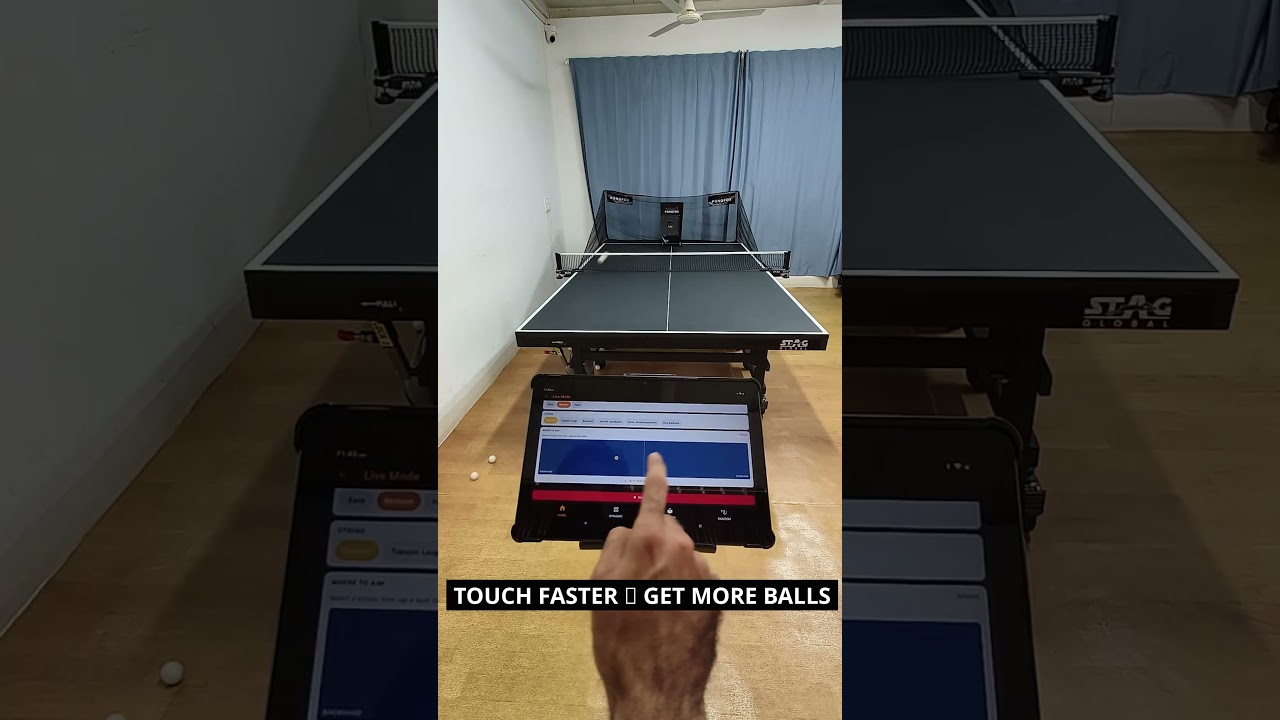
@plunder I would leave my PowerPong up permanently
I've been using my new Omega unit a lot this month and I'm really getting the hang of it. Indeed i leave my PP up permanently but usually do unhinge the side flaps (for obvious reasons), then fold them up (after i've removed the diy mini ramp), while keeping the bunch of balls in the plastic base. I counted the balls, it's a total of 53. The minimum number of balls required for uninterrupted feeding is 14, so for easy drills (no mishits) one could play with a bunch of 14 balls only. I play with a little bit more than 3.0x this number. For now, my drills have a duration of 50sec (only) mas 15sec break; during every break i run around the table picking up the mishit balls and throw them back to the bunch of 53. Time flies this way. The other day when i looked at the intentionally hidden stopwatch for the first time, already 3.0h+ had passed, shocking!
The app, multiball training, spin amount, etc everything works great. I quickly understood and, most importantly, quickly
accepted that the table/balls illustration in the app rather serves as a schematic than a precise placement plan of where exactly the ball would land on its first bounce (physics is complicated and ... etc). Best procedure: One fixes the spin quantity (e.g. "-3") first, then sets the throw angle ("trajectory"; to get a rather high thrown or low thrown ball), and finally samples the throw speed in order to check the desired placement as
result of the settings triplet <spin, angle, speed>. Very fast and easy setup, if you know what kind of incoming ball you want to face!
To Mr. Ignoramus, the app suggests that the three quantities <angle, speed, placement> were independent, while they are
not IRL, especially not the resulting placement (physics!
In elementary physics, the pupil learns that the flight path (trajectory) of a point mass on Earth, without the influence of the surrounding air (i.e. in a vacuum), is fully determined by the throw angle and throw speed. These 2 quantities only. Not even mass plays a role.). Yet the illustration of placement doesn't change when the user adjusts any of the three quantities <angle, speed, spin>; technically, that'd be an illustration drawing error. We're all well aware of that and understand why the illustration of placement caht reflect reality. So, personally, i doht focus on the soso placement illustration but on the
settings pair <angle, speed> what kind of incoming ball (incl. its placement) i want to make the bot produce.
It's also true that the bot can produce very fast balls, but not very fast balls which also carry the max possible topspin. I.e. if you set the max possible topspin, then the max speed will be somewhat fast but not very fast. (I'll continue testing this phenomenon and report back again)
Why i am posting today (and others might have noted as well):
The difference between "
spin -2" (= minimal/almost zero backspin after the bounce) and "
spin -3" (= high/very high backspin, even after the bounce) is too harsh.
Imho the "-3" setting should have considerably less backspin. Obviously this aspect is purely a matter of firmware (not Android app software), i am sure.
If you Powerpong (and Amicus?) users agree with my
opinion, then we should try to get the firmware developer to make this particular change, asap. 🤝 👀