


This user has no status.
This user has no status.
New Member



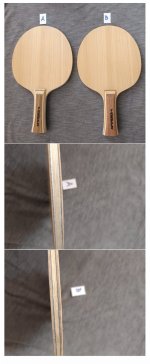
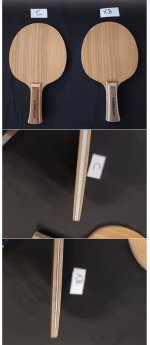
These four paddles — A, B, C, and XB — are designed to deliver both high dwell and excellent pace. Commercial blades force a choice between the two: carbon gives you pace and stability but a hollow, deadened touch, while wood gives you deep dwell but surrenders the top-end. These combine both — something not currently available in the commercial market. They take two approaches.
B is the first approach: a thick, linear blade, 89 grams with a 22-gram handle. "Linear" means it responds in proportion to the stroke — no on/off surprises, just clean, consistent pace with real feel behind it. With no balsa at all, it's the most linear of the four — a straightforward driver that rewards a committed swing.
The other three — A, C, and XB — take advantage of balsa, and they work because of one idea worth explaining.
Balsa is unmatched at one thing: it's soft and light, so it compresses under the ball and gives a long, cushioned dwell that harder woods can't. The trouble with balsa has always been that a thick balsa core does two jobs at once — it provides that compression and it carries the blade's stiffness. Those two jobs fight each other: the ball sinks in and deadens on a soft touch, then the core springs back hard and catapults on a firm hit. That push-pull is why balsa blades tend to feel unpredictable — nonlinear.
These designs separate the two jobs. The balsa is kept thin — an accent, not the whole core — so it still supplies the compression and the deep dwell, but the stiffness and bending are carried by a thin carbon layer and the surrounding wood. The balsa carries the feel; the carbon carries the pace and control. And because the balsa no longer has to carry the stiffness, how thin you make it becomes a design dial: the thinner the balsa, the more linear and predictable the blade; leave it a little thicker and it keeps some of that deaden-on-touch, spring-on-drive character — which, deliberate and controlled, is exactly what you want in a close-table feel blade.
A takes this furthest, with a medial balsa layer — balsa set inside the blade rather than at the core. At 89 grams with a 22-gram handle, it's very fast and holds the highest dwell of the group; it loads spin the deepest, and it's the closest thing here to a pure spin weapon.
C and XB are the two balsa-core blades, both 84–87 grams, and they sit at different points on that dial. C uses a thicker core, so it keeps a little of that nonlinearity on purpose — it settles into a soft, deep touch on the slow ball and springs forward when you drive through. That's what makes it a deep-feel, close-to-the-table blade built for control and heavy spin. XB uses a thinner core, which minimizes the nonlinearity and gives it a clean, predictable, do-everything all-court character — comfortable anywhere on the table and the most versatile of the set.
If you're interested, these are custom-made, and I can provide them at $220–250 per paddle depending on the build.
B is the first approach: a thick, linear blade, 89 grams with a 22-gram handle. "Linear" means it responds in proportion to the stroke — no on/off surprises, just clean, consistent pace with real feel behind it. With no balsa at all, it's the most linear of the four — a straightforward driver that rewards a committed swing.
The other three — A, C, and XB — take advantage of balsa, and they work because of one idea worth explaining.
Balsa is unmatched at one thing: it's soft and light, so it compresses under the ball and gives a long, cushioned dwell that harder woods can't. The trouble with balsa has always been that a thick balsa core does two jobs at once — it provides that compression and it carries the blade's stiffness. Those two jobs fight each other: the ball sinks in and deadens on a soft touch, then the core springs back hard and catapults on a firm hit. That push-pull is why balsa blades tend to feel unpredictable — nonlinear.
These designs separate the two jobs. The balsa is kept thin — an accent, not the whole core — so it still supplies the compression and the deep dwell, but the stiffness and bending are carried by a thin carbon layer and the surrounding wood. The balsa carries the feel; the carbon carries the pace and control. And because the balsa no longer has to carry the stiffness, how thin you make it becomes a design dial: the thinner the balsa, the more linear and predictable the blade; leave it a little thicker and it keeps some of that deaden-on-touch, spring-on-drive character — which, deliberate and controlled, is exactly what you want in a close-table feel blade.
A takes this furthest, with a medial balsa layer — balsa set inside the blade rather than at the core. At 89 grams with a 22-gram handle, it's very fast and holds the highest dwell of the group; it loads spin the deepest, and it's the closest thing here to a pure spin weapon.
C and XB are the two balsa-core blades, both 84–87 grams, and they sit at different points on that dial. C uses a thicker core, so it keeps a little of that nonlinearity on purpose — it settles into a soft, deep touch on the slow ball and springs forward when you drive through. That's what makes it a deep-feel, close-to-the-table blade built for control and heavy spin. XB uses a thinner core, which minimizes the nonlinearity and gives it a clean, predictable, do-everything all-court character — comfortable anywhere on the table and the most versatile of the set.
If you're interested, these are custom-made, and I can provide them at $220–250 per paddle depending on the build.