Okay -- finally had a chance to try the boosted R9 but before I talk about the rubbers, I should talk a bit more about the blade I mounted it to.
On reflection, changing the blade had far more of a beneficial effect in bringing out the best in these rubbers, than the boosting did.
Turns out mounting these particular runners on my Dante was simply not an ideal paring.
The Dante is a really lovely semi-bouncy blade that has great control and good speed in the short game, but also finds an extra gear or three when hitting harder during open play.
I went with this blade as I thought that the new R9 OS (being unboosted) could use a bit of extra blade effect to make it easier to access its higher gears.
Turns out however this was probably a mistake, as on reflection, the blade just felt like what you get when you usually team hard chinese sponge with a bouncy hinoki-like blade -- i.e.: I'm the whole effect was just kinda weird.
The blade and rubber's individual impact responses interfered with each other and cancelled each other out *just enough* to be really annoying.... but also not quite out of synch nough to make the problem easy to identify. On a different blade however, it was a whole different story.
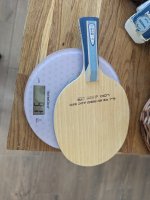
The blade I chose to substitute with the Dante was a Chuditch -- another outer composite attacking blade of my own design.
The Dante's extra top gears and speed boost make it a bit more of a counter hitting blade, whereas the Chuditch by comparison is a looper's delight. It's speed / impact response is extremely linear and controlled regardless of the ball's impact speed, and it flexes a fair bit more than your average looping blade by design, which gives it a lot of spin potential.
(Best description I can offer of the playing feel of a Chuditch is to imagine it as a very slightly slower Hugo HAL Original, but with a bit more flex and a softer more wood like playing feel).
The Chuditch was a FAR better teaming for the R9 OS across the board as it actually allowed me to access speed reserves in the unboosted red R9 that I just couldn't feel or find before. (Both rubbers felt much better on the Chuditch really, but for the red R9 the difference was chalk and cheese.... it felt -- quite frankly -- bloody delightful. 🥰🥰)
There's a strong two speed effect with these new R9s that the R9N didn't have. They are rather slow whdn playing over the table, and surprisingly fast when driving/looping. But it' not like that traditional H3 two-speed feeling however, where the slower speeds over the table are created by the top sheet's high tack levels.
With the R9 OS, that two speed feeling seemed driven by the sponge itself: it's slow and unresponsive over the table, but comes alive when hitting hard. This tells me the OS sponge probably has two different density zones or layers to it, created by welding two different densities of sponge together. This in turn creates two different COR scores for the rubber (ie: by design, its a dead sponge during gentle impacts, and a far more bouncy one during hard impacts).
In order to find, feel and exploit this property of the rubbers, I first needed to use a far more linear blade. As the Dante is designed to behave the exact same way as the R9's sponge layer, they were trying to do the same job, at the same time, but to different degrees and in different ways. The end result was just a tangled mess of conflicting touch messaging. The chuditch however allowed the rubber to manage its own rebound control unhindered, which made the rubber far more manageable and responsive.
If you're going to try out an R9 OS, I strongly recommend using a more linear blade than an overly bouncy one. These new two speed sponges you find in rubbers like these new R9s, and the Xiom Jeckyl and Hide before it really team best with more linear rubbers. These rubbers have distinct gears of their own and need a more linear blade beneath them to work properly.
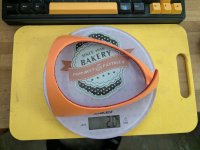
As for my rubber boosting of the black R9, it worked as expected, and to the degree I wanted: it was a bit softer and faster without being mushy, so I'm calling that a win. Spin and control was the same (excellent on both) while speed improved by between about 5-9%, depending on whether the rubber was in bottom gear or top gear at the time.).
I can see the appeal of these rubbers, and can now appreciate what Loki were trying to acchieve with this new sponge... and with the right blade, it works beautifully. The two speed gearbox on the OS version takes some getting used to, but this is a minor quibble really.
As for boosting these rubbers.... well while it improved the black rubber and made it faster, I won't be boosting these rubbers again, as for me and my game, it's not necessary. All the light boasting did was give the black R9 a fully played-in feeling. It *didnt* make the rubber feel much like a R9N, which was what I was hoping for....
...THAT job was (surprisigly) more than ably provided by the stock Red 37.5 rubber itself.
Putting the red R9 on my FH, and the boosted black one on my BH, felt far better than vice versa. Once fitted to my Chuditch, the unboosted, factory stock red rubber felt sufficiently similar to the R9N for me to be willing to call it an acceptable substitute for playing feel, and a slight improvement for performance.
Really enjoyed using both these new R9s today, and will happily buy the 37.5 Red again and use it on my FH.
I'll still miss the R9N going forwards, but I'll also miss it a lot less in future, given the brilliant performance of its replacements.