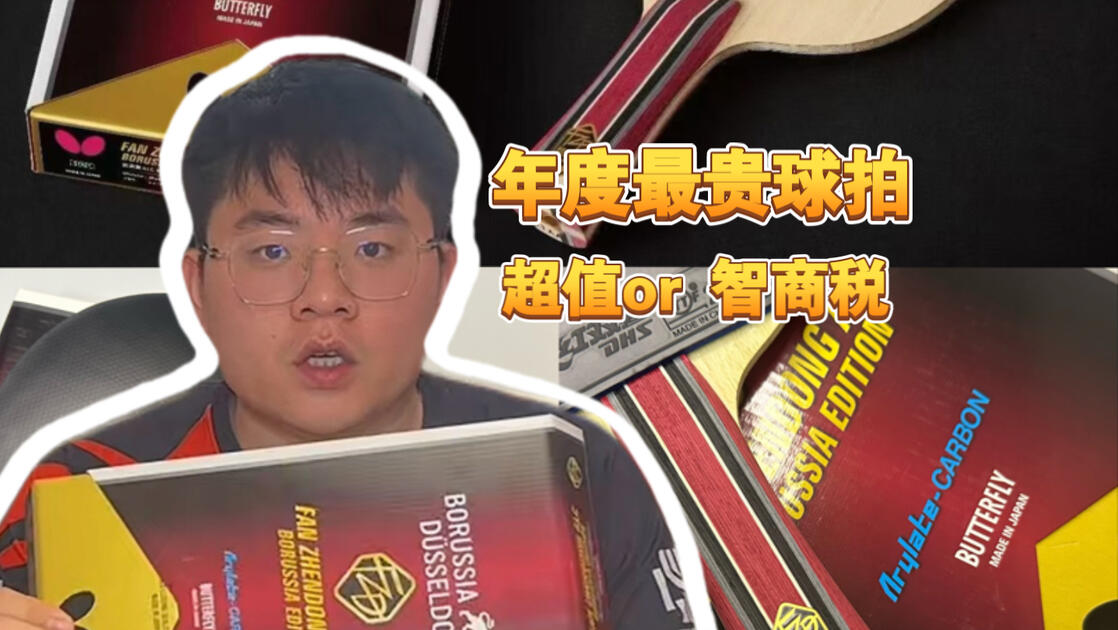

Gan released his review on the FZD ALC Borussia Edition, plus did a small benchmark with other blades:
器材选购wx:xggpp001, 视频播放量 13948、弹幕量 36、点赞数 291、投硬币枚数 74、收藏人数 81、转发人数 172, 视频作者 小甘哥体育, 作者简介 器材咨询搭配解答选购:xggpp001,相关视频:试打樊振东金标,第二天,樊振东金标,跟樊A真的不一样,2026.8.8樊振东金标测评...
www.bilibili.com
Here's an AI-translated transcript, plus the benchmark board:
Fan Zhendong Gold Label Blade — Full Review
This is the most expensive blade we’ve tested in 2026 — bar none. At the moment, the commercially available Fan Zhendong Gold Label has already been driven up to around ¥13,000 on the market, so today we’re going to see what this blade can actually do and whether its performance lives up to that kind of price.
The detailed specifications are already readily available online. In terms of construction, it is an outer-ALC blade using the blue Arylate-Carbon fiber.
We’d also like to thank the fellow table-tennis player who sent us this blade so that we could test it.
For the first part of the test, we mounted Dignics 09C on both sides. Later, we changed the forehand to a National blue-sponge Chinese rubber. We also carried out a direct comparison against the Gold Label Viscaria and the standard Fan Zhendong ALC.
Initial feel and forehand performance
With Dignics 09C on the forehand, the first thing you notice is how clear and crisp the blade feels at low power.
The blade face has a distinctly hard and rigid character. During contact, you get a sharp, snappy impact sensation, accompanied by that characteristic crisp “pop-pop” sound.
At low input, its stability is very good, and the blade also has a strong first-speed response. The initial ball speed is good, and the trajectory at that first-speed level is nicely shaped and quite attractive.
However, as you progressively increase your input toward a medium-power stroke, its character begins to change.
At medium power, the overall quality of the resulting ball is still reasonably good, but you can already feel the trajectory beginning to become lower and flatter.
As you continue to increase the power, the arc starts to lose forward extension. It feels as though the ball no longer carries through the table properly. After the ball lands on the opponent’s side, there is also an obvious drop-off in momentum.
This is where you begin to understand how the blade needs to be used: you really have to get around the ball and create a fuller, rounder looping contact.
If you do not consciously shape the stroke in that way, the resulting shot quality is actually not particularly high.
Only when you really wrap around the ball and produce a more complete, spin-oriented loop does the trajectory begin to project forward more effectively. You have to put noticeable effort into creating that fuller contact before the arc really begins to extend deep toward the opponent’s end line.
Otherwise, the trajectory becomes very short and very flat.
On many balls, if you simply accelerate hard into a power loop, the ball travels almost glued to the top of the net, yet still fails to carry deeply toward the opponent’s baseline.
That kind of shot is relatively easy for the opponent to defend against. It simply does not create enough pressure or threat.
Even when we deliberately try to increase the brushing action and add more acceleration through contact, the spin still does not come out particularly well. You can put more effort into friction and acceleration, but the blade does not reward you with a proportionate increase in rotation.
And bear in mind that this was already being tested with a rubber such as D09C, which is relatively accessible to engage compared with many harder traditional Chinese setups.
From mid-distance and farther away from the table, the performance can frankly be described as disastrous.
In that sense, the blade essentially feels like a harder, more rigid version of the Viscaria.
Because the trajectory does not naturally rise enough, it is also very easy to put balls into the net. When using this blade, you have to consciously pay attention to lifting and creating the arc yourself.
Even when the shot does go through, the resulting ball quality is honestly not especially high. From the opponent’s side of the table, the incoming ball does not feel particularly heavy or powerful.
Interestingly, the opposite problem can appear when the opponent attacks you. When the opponent loops strongly toward you, it is quite easy to feel jammed or overwhelmed by the incoming ball.
So although the blade feels hard and crisp in the hand, the ball you send to the opponent does not necessarily carry the same sense of weight or power.
First-speed versus deeper power
One of the blade’s clearest strengths is its first speed.
The initial response as the ball leaves the racket is very good. On lighter and more compact strokes, it feels crisp, fast and clean.
But that does not translate into an equally strong deeper gear.
As you increase the force of the stroke, you do not get the kind of naturally increasing arc, depth and post-bounce penetration that you might expect. Instead, the trajectory tends to flatten, the ball becomes shorter, and the energy begins to decay.
This is an important distinction with this blade: it can feel very impressive in the first instant of contact, but the quality of the ball does not necessarily continue to rise as you hit harder.
Backhand performance
The backhand is a different story.
Because the blade has such a hard and firm contact character, the ball tends to leave the racket relatively quickly on the backhand.
Compared with the standard Fan Zhendong ALC, the feedback is also somewhat clearer and more defined.
In the hand, the blade encourages a more impact-based backhand contact. You feel that you need to hit into and through the ball rather than relying entirely on a thin brushing action.
Despite that hard and relatively direct character, I think the blade’s overall forgiveness on the backhand is actually quite good.
Spin is also noticeably easier to generate on the backhand than it is on the forehand. When actively trying to add rotation, it responds more readily from that wing.
Overall, I would say that its backhand performance can basically be placed in the same tier as the Viscaria.
That said, the backhand trajectory itself is still not especially outstanding. The arc is not one of the blade’s great strengths.
What improves on the backhand is the speed with which the ball travels through to the opponent’s side.
The blade’s directional precision is particularly good. In fact, I would say the directional accuracy on the backhand is slightly better than that of the Viscaria.
You can aim the ball very precisely and the blade follows the intended direction extremely well.
However, once you really accelerate into a backhand loop, the trajectory still remains somewhat short. It does not naturally extend very deeply into the table.
As a result, the overall pressure placed on the opponent is still not especially high.
Forehand pivot and spin production
The same fundamental issue appears when you pivot around and play a powerful forehand loop.
The resulting ball feels very safe, predictable and steady — but also somewhat tame.
The main problem is the spin output.
The blade’s overall ability to generate spin is honestly very ordinary. Even when paired with D09C, I had the same feeling: the rotation simply does not come out particularly strongly.
You can swing hard and play aggressively, but the resulting ball does not have the sort of spin, depth and pressure that makes the opponent uncomfortable.
Comparison with the Gold Label Viscaria
Among the blades in this comparison, the Gold Label Viscaria produces the most threatening ball.
With the Gold Label Viscaria, you get this sensation that you are almost throwing or launching the ball forward off the racket.
Once the ball lands on the opponent’s side, its post-bounce kick is extremely pronounced. The ball really jumps forward after contact with the table.
And it is also very spinny.
The trajectory rises noticeably higher and then carries naturally deep toward the opponent’s end line. It is very easy to get the ball all the way onto or near the white baseline.
Personally, I find looping with the Gold Label Viscaria extremely natural and effortless. You do not have to consciously manufacture the trajectory in the same way.
Compared directly with the Fan Zhendong Gold Label, the Gold Label Viscaria is also much more forgiving.
Its one disadvantage is feedback: in the hand, the Gold Label Viscaria feels like the mushiest and most muted of the blades being compared. It is less crisp and less sharply defined in contact.
So the tradeoff is quite clear.
The Gold Label Viscaria gives you much more natural spin, trajectory, depth, post-bounce kick and forgiveness, but its feedback is comparatively softer and more muted.
The Fan Zhendong Gold Label gives you a harder, crisper and more defined sensation in the hand, but the resulting attacking ball is much less naturally threatening.
Short-game control
There is, however, one area where the Fan Zhendong Gold Label is genuinely exceptional: short-game control.
Among all the Butterfly blades I have played with so far, this is probably the one I have felt most comfortable with when controlling the short game.
That may be largely due to the relatively hard and firm feel of the blade face.
That hard surface response gives the blade excellent precision and control over the table.
Whether you are playing a short touch/push, a banana flick, or a more direct attacking flick, the blade gives you a very strong sense of control.
Across the entire short-game phase, its response feels extremely predictable.
The blade as a whole gives you a very high level of confidence and precision in this area.
Overall assessment
The Fan Zhendong Gold Label has a very distinctive character.
At low power, it feels hard, crisp, clean and stable, with excellent first-speed response and very clear feedback.
Its backhand is considerably more convincing than its forehand. The backhand offers good forgiveness, relatively easy spin generation, excellent directional precision and a quick, defined response. In that respect, it can compete with the Viscaria.
Its short-game control is outstanding — perhaps the best I have experienced among Butterfly blades.
But the problems appear once you ask the blade to produce a genuinely high-quality attacking ball.
On the forehand, the trajectory becomes low and flat as power increases. It lacks natural forward extension, and the ball loses momentum after the bounce. The spin output is ordinary, and the resulting shot does not put enough pressure on the opponent.
You have to deliberately create a fuller, rounder looping action just to produce enough arc and depth. Even then, the ball does not necessarily feel especially heavy to the opponent.
Away from the table, those weaknesses become even more pronounced.
By contrast, the Gold Label Viscaria produces a much more natural attacking ball: higher arc, greater spin, easier depth, stronger post-bounce kick and significantly more forgiveness.
So the Fan Zhendong Gold Label is an unusual blade.
It offers exceptional short-game precision, hard and clear feedback, strong first-speed response and a very competent backhand, but in terms of forehand looping quality, spin, depth, pressure and mid-distance performance, it is surprisingly ordinary — especially considering its extraordinary market price.
In simple terms, it feels like a harder, crisper Viscaria with better short-game control, but with substantially less natural arc, spin, depth and attacking pressure.
View attachment 42884