Penhold Straight vs Curved Fingers

This user has no status.
Member
Jan 2024
13
6
26
Hi,

I am seeking advice due to a lack of a coach. Currently, I play penhold with a grip similar to Felix Lebrun's, though slightly extended but not as much as Dang Qiu. For the most part it looks like this:
lebrun-penhold-grip-is-the-future-v0-bghkbvu97t1d1.jpeg


However, yesterday while playing I decided to try the Xu Xin grip with the straight fingers and found that it had pros and cons that might be useful to me. For context, my current setup is the Palio Energy 03 which lacks rebound and I have been having trouble with blocks. I also have been struggling with consistent forehand loops in rallies, though one-off forehands are fine. The Xu Xin grip solves this problem by supporting the forehand, amongst other benefits and drawbacks:

Straight Fingers
Pros:

Powerful Forehand
Stable forehand loops
Consistent blocks

Cons:
Less wrist mobility for serves
Chance of hitting the finger on backhand loop
Less flexibility of shots, specifically near to the body (need to compensate with footwork)

I find that this way of playing quite appealing, though I can't say much after a few hours of playing. The surprising aspect is that it did not negatively affect the quality of my RPB, but it does increase the chances of the fingers getting in the way. I'm not sure what to focus on in the future, so here are some of my strengths and weaknesses with my usual grip for reference:

My Strengths:
RPB
Service

My Weaknesses:
Blocks
Forehand consistency

As you can see, this grip change does exactly what it promises based on many people's personal experience - trading backhand for forehand. However, an added disadvantage is my service quality which is a huge strength of mine, and I am not sure that is a fair tradeoff. Any advice?
 
says nothing
says nothing
🏆 Top 1% Commenter
Well-Known Member
Apr 2021
1,105
1,277
3,973
Read 1 reviews
my video was a bit old but I think can answer your concern:

For short: you have to choose a grip which strengthens your playstyle because changing grip in the middle of the rally is almost impossible. I suggest a neutral grip slightly prefer BH (curved 2 fingers, slightly deeper thumb) - which is my current grip, it allows me to do RPB and blocks well but still be able to FH power loop

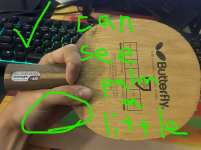
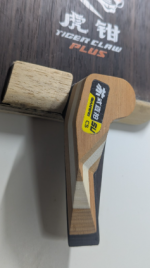
1000072697.jpg
1000072696.jpg
 
says penhold dreamer
Down to personal preference, only you can decide what's best for you and your playstyle. I personally don't like the curled fingers on the back, it just doesn't fit naturally to me, however straight finger is better so I kinda settled on that.

Also, notice how relaxed your grip is, it's pretty crucial to have relaxed grip. Some finger alignment doesn't allow me to relax the grip, some does.
 
This user has no status.
Member
Jan 2024
13
6
26
Down to personal preference, only you can decide what's best for you and your playstyle. I personally don't like the curled fingers on the back, it just doesn't fit naturally to me, however straight finger is better so I kinda settled on that.

Also, notice how relaxed your grip is, it's pretty crucial to have relaxed grip. Some finger alignment doesn't allow me to relax the grip, some does.
I usually do have relaxed back fingers. Though, throughout the course of a game, as my fingers get sweatier, a straight finger approach helps with gripping the racket better.
 
This user has no status.
Member
Jan 2024
13
6
26
I've been trying this grip for quite some time now, and it does help with the forehand consistency. One thing that it does not solve is the blocks, which still lacks the proper support for the kinetic energy to be fully transferred for the ball to rebound. I still need a lot of practice to get it right without straight fingers. Or maybe it is time to change the blade:unsure:
 
says nothing
says nothing
🏆 Top 1% Commenter
Well-Known Member
Apr 2021
1,105
1,277
3,973
Read 1 reviews
I've been trying this grip for quite some time now, and it does help with the forehand consistency. One thing that it does not solve is the blocks, which still lacks the proper support for the kinetic energy to be fully transferred for the ball to rebound. I still need a lot of practice to get it right without straight fingers. Or maybe it is time to change the blade:unsure:
I think you can try to focus on the thumb - it plays a big role in blocking and RPB
 
This user has no status.
Member

Sep 2025
33
43
97
You could totally adjust the grip just for service. For example, I lift my thumb and only grip the blade between my index and middle fingers for flexibility in pendulum serve. Or I put my thumb on the BH side of the racket if I'm serving with BH rubber (when using the palm upward way, thumb support is necessary when using the palm outward way).

As for the other fingers on the back, I like longle's picture: distal joint straight but proximal joint bent. Personally, I recently also put my pinky tip on the rubber rather than loosely curved to the side. It's not exerting much force, but I do find it more stable and helps with fine-tuning racket angle.

Felix's way has only 1 finger in contact with BH rubber, but he basically maximizes the surface area for RPB (by maybe 1cm). I don't feel that's worth it. Or maybe he's doing it for other reasons. At the end of the day, he's obviously better than all of us. I remember there was an interview with 1857 where he shows his grip, but I don't recall that he explained much in terms of reasons for it.

On the front, how deep you grip should depend on how often you use TPB. The deeper the grip for both thumb and index finger, the harder it is to do TPB. For RPB, having the tip of the thumb on the rubber is great for me both in terms of leverage for support but also because otherwise gripping only the wood part can be slippery. My FH rubber gap is narrow for this reason. Maybe still 2mm wider than longle's picture though, because I actually tuck the tip of my index finger under my thumb. This serves 2 purposes: it moves my index finger callus to a comfortable position over the blade shoulder, and it "locks" my index finger by securely looping it around the the whole handle. It's like buckling in a seat belt; I find that it helps during acceleration.
 
This user has no status.
Member

Jan 2024
13
6
26
You could totally adjust the grip just for service. For example, I lift my thumb and only grip the blade between my index and middle fingers for flexibility in pendulum serve. Or I put my thumb on the BH side of the racket if I'm serving with BH rubber (when using the palm upward way, thumb support is necessary when using the palm outward way).

As for the other fingers on the back, I like longle's picture: distal joint straight but proximal joint bent. Personally, I recently also put my pinky tip on the rubber rather than loosely curved to the side. It's not exerting much force, but I do find it more stable and helps with fine-tuning racket angle.

Felix's way has only 1 finger in contact with BH rubber, but he basically maximizes the surface area for RPB (by maybe 1cm). I don't feel that's worth it. Or maybe he's doing it for other reasons. At the end of the day, he's obviously better than all of us. I remember there was an interview with 1857 where he shows his grip, but I don't recall that he explained much in terms of reasons for it.

On the front, how deep you grip should depend on how often you use TPB. The deeper the grip for both thumb and index finger, the harder it is to do TPB. For RPB, having the tip of the thumb on the rubber is great for me both in terms of leverage for support but also because otherwise gripping only the wood part can be slippery. My FH rubber gap is narrow for this reason. Maybe still 2mm wider than longle's picture though, because I actually tuck the tip of my index finger under my thumb. This serves 2 purposes: it moves my index finger callus to a comfortable position over the blade shoulder, and it "locks" my index finger by securely looping it around the the whole handle. It's like buckling in a seat belt; I find that it helps during acceleration.
Thanks for the advice. Can you tell a bit about how the choices you've made personally affected your game and playstyle? Do you TPB more often, are you more FH or BH oriented, how does it affect your recovery after serving, etc.?
 
This user has no status.
Member
Sep 2025
33
43
97
Thanks for the advice. Can you tell a bit about how the choices you've made personally affected your game and playstyle? Do you TPB more often, are you more FH or BH oriented, how does it affect your recovery after serving, etc.?
Personally, this grip has given me more confidence with RPB. Being able to grip the racket firmly when going from relaxed during wind-up to locked-in during the final acceleration gives me better energy transfer.

I have a bit of an outdated playstyle like Ma Lin: frequent chop blocks and TPB blocks when on the defensive. RPB for attacking backspin, slow balls, or away from the table.

I'm probably slightly more FH dominant though not by much.

Recovery after service should never be an issue since grip adjustment is done before the ball even crosses the net.
 
  • Like
Reactions: raihandmu
This user has no status.
Active Member
Jan 2016
569
999
1,869
I play with curved fingers.
personally i never deeply looked into this topic, until i figured something out just now (thanks guys).
I'll share with you guys

//////////////

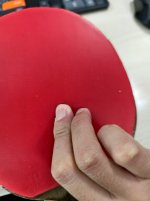
holding with curved fingers is a lot closer to a "fist", which I can grip with a LOT of power (and so can you). If you didn't know that, now you know.
The side of your middle finger is touching the rubber.

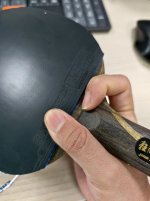
holding with straight fingers puts the palm closer to the racket. And a lot of more area of your finger pads are touching the rubber.

//////////////

Why does this matter?

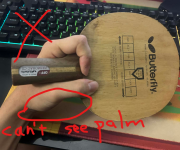
I was always jealous of how shakehand players have their palm's angle closely aligned with their racket angle.
For penhold, the palm angle isn't even close, especially with curved fingers.

I would compensate by raising my elbow to close the angle further.

//////////////

It's hilarious that I missed this. Even casuals that spread their fingers out incorrectly are instinctively trying to get their palm and racket angles aligned.
Now I know I can (and should) push my palm angle to be closer, even with curved fingers. Get more of the finger pads on the rubber too.

1766454984101.png

1766455144675.png

Even funnier, there is this korean video on youtube (thank you youtube auto-dub) that mentions this specifically, but I didn't know how to do it until took this ttd thread more seriously.

 
  • Like
Reactions: Azku
I play with curved fingers.
personally i never deeply looked into this topic, until i figured something out just now (thanks guys).
I'll share with you guys

//////////////

holding with curved fingers is a lot closer to a "fist", which I can grip with a LOT of power (and so can you). If you didn't know that, now you know.
The side of your middle finger is touching the rubber.

holding with straight fingers puts the palm closer to the racket. And a lot of more area of your finger pads are touching the rubber.

//////////////

Why does this matter?

I was always jealous of how shakehand players have their palm's angle closely aligned with their racket angle.
For penhold, the palm angle isn't even close, especially with curved fingers.

I would compensate by raising my elbow to close the angle further.

//////////////

It's hilarious that I missed this. Even casuals that spread their fingers out incorrectly are instinctively trying to get their palm and racket angles aligned.
Now I know I can (and should) push my palm angle to be closer, even with curved fingers. Get more of the finger pads on the rubber too.

View attachment 39598

View attachment 39599

Even funnier, there is this korean video on youtube (thank you youtube auto-dub) that mentions this specifically, but I didn't know how to do it until took this ttd thread more seriously.

Yes this is a great video.

Took me a while too to get the correct grip.

I don't hook my index finger as much as you do though.
 
This user has no status.
Member
Sep 2025
33
43
97
I play with curved fingers.
personally i never deeply looked into this topic, until i figured something out just now (thanks guys).
I'll share with you guys

//////////////

holding with curved fingers is a lot closer to a "fist", which I can grip with a LOT of power (and so can you). If you didn't know that, now you know.
The side of your middle finger is touching the rubber.

holding with straight fingers puts the palm closer to the racket. And a lot of more area of your finger pads are touching the rubber.

//////////////

Why does this matter?

I was always jealous of how shakehand players have their palm's angle closely aligned with their racket angle.
For penhold, the palm angle isn't even close, especially with curved fingers.

I would compensate by raising my elbow to close the angle further.

//////////////

It's hilarious that I missed this. Even casuals that spread their fingers out incorrectly are instinctively trying to get their palm and racket angles aligned.
Now I know I can (and should) push my palm angle to be closer, even with curved fingers. Get more of the finger pads on the rubber too.

View attachment 39598

View attachment 39599

Even funnier, there is this korean video on youtube (thank you youtube auto-dub) that mentions this specifically, but I didn't know how to do it until took this ttd thread more seriously.


The wrist has much greater range of motion in extension/flexion vs ulnar/radial deviation. Wrist flexibility is the main advantage of penhold. This translates into better serves and control inside the table.

So, no, I'm not
jealous of how shakehand players have their palm's angle closely aligned with their racket angle.
 
Top