

says
rejoicing in rbpon 🆚 robipon

says
rejoicing in rbpon 🆚 robipon
Member



Hi, thanks for your quick answer. The above quote is concise (and prolly contains all logical info to be inferred from it) but for a quick read/understand, it is not clear imho. From what i understand, lemme explain the Shuffle in my own words and please correct me if wrong:
- Shuffle: The machine generates a random sequence of balls. For a 4-ball drill (A, B, C, D), Nova will pick any combination of those four, such as AABB or ABDD.
Shuffle. The machine generates a "random" sequence of balls. Random how, random in what way? Well, the total number of balls will remain the same for the drill. And no, "shuffle" does not mean permutation as in the mixing of a deck of cards. Even the "order sequence" will be the same, i.e. A is followed by B is followed by C is followed by D etc. For example, define a 4-ball drill (each ball with Reps=1): A, B, C, D. Then running the drill with "Shuffle balls = ON (not OFF)" might result in 1 of 35 possible outcomes, where each outcome has a different probability to erh come out:
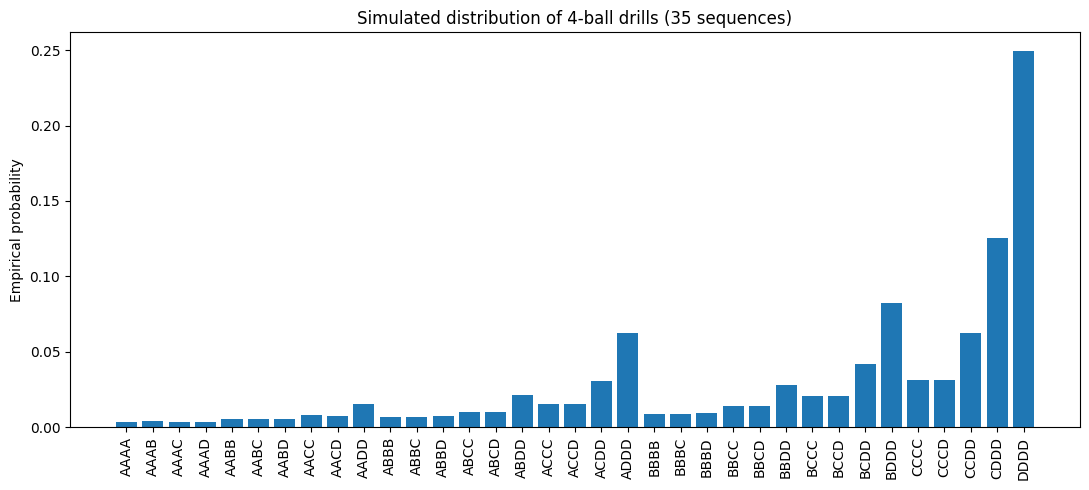
In other words, it is very unlikely that you'll get a AAAA sequence but rather common that you'll get a DDDD sequence (see gpt link).
So the Shuffle function is based on the k-Multiset (see attached pdf).
If my above explanation of the implementation of Shuffle was correct, then i'd rather disagree with the implementation of the function. Imho Shuffle shouldn't be based on k-Multiset. In Stochastik/Kombinatorik (as important part of probability theory, or randomization theory), there are exactly 6 basic cases. Imho the n-Permutation would make more sense, as in shuffling a deck of n cards. Then each of the n! outcomes would have equal probability of 1/n!, which is fair/nice. The only practical problem with that approach is that, if the first ball (ball A) was a cerve. (((That's why robi1 has a sophisticated triple implementation of randomization called "Random" "Shuffle" "Scatter" which takes cerves into account ... but which i find even more confusing because of lack of explanation lol)))
In practice, n-Permutation might be boring/too predictable too (because once you get B,D,A, you'll know that the last ball will be C). To me, Random should mean that each ball is random at equal probability .. which points to the k-Tupel case. Anyway, this post shall serve as food for thought only. (((in the original app, they had misimplemented the Randomization function; in the robi1 app, they tried harder but the implementation turned into a mess which nobody can explain what the robi1 does there conceptually)))
Attachments
Last edited: