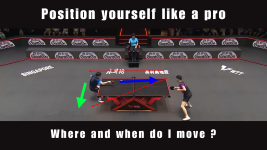

Positioning on 3rd ball/reaction - how to?

This user has no status.
Member
May 2025
24
5
46
Good morning everyone

I’m a very beginner and since a couple of months I’m training with a coach.
My biggest issue is positioning on 3rd balls but also in general.

Every time that I return the ball and have to position myself for the next one, I feel completely lost.

I admit that I still focus on where my ball lands rather than “planning” where to move for the next one, so I found myself late or wrong positioned.

My response time is perhaps slow (and so is my confidence on my capabilities) but I haven’t still figured out what or where I should look at and don’t know how to improve.

So far my coach couldn’t gave any helpful pointers..rather than saying to “move”.

Can you give me some suggestions or exercises that I can do on this topic?

I hope I explained myself correctly and would be grateful for any tips.
 
  • Like
Reactions: TampaBayTableTennis
This user has no status.
Member
Sep 2025
15
23
52
I would say once you make contact with the ball on your serve or any shot, immediately look to your opponent’s racket instead of ball watching like you mentioned. For me, this started getting my in the right position somewhat automatically. This along with being ready —low, bodyweight forward, weight on balls of feet or toes, tightened core. Focus on being in a constant state of motion even if hard at first. You don’t want to get planted to the ground and just start reacting after the ball crosses the net. That is too late. Hopefully it will all come together for you after continual coaching/practice.
 
This user has no status.
🏆 Top 1% Commenter
Well-Known Member
Jan 2023
1,060
1,356
5,896
to me, biggest keys to think of are be ready/attentive as soon as possible after each serve. also consider where you are serving from and if it forces you to move too much for certain shots that you will face often. for example, beginners with poor movement should not serve from such a severe corner position like many pros, but rather a little more inside the table to reduce distance to cover wide forehand. also helps with serving fast down the line.

mainly, your 3rd ball shot needs to reach a consistent level in a more fixed drill. you serve here, they return here, then you play 3rd ball. with some days/time periods focusing on only opening to one spot on the table so you have something to lock in on. over time, you will have built up the ability to play the shot to different areas when you know where to expect it. little by little you will be able to deal with the various placements and get more consistent.

better serves will also create more predictable/weaker returns which helps improve 3rd ball consistency.

If you are not getting to the ball, need to move better. if you are missing the shot a lot, need to figure out if you have to play softer/spinnier/safer until you improve.

if you serve very extreme short forehand then it creates a return angle that can be to your extreme wide forehand. if you serve a little more short middle forehand, the angle is lessened to wide side (but then angle opens up a bit more if they return to your bh, if you have enough sidespin, they would be taking a risk though and miss more).

practice the movements without a ball at all (even without the table), then do your serve and visualize the next shot. etc. some days just go for the shots and other days try to be safer with choices. more practice and you'll get it!
 
says Fighting the EJ bug again...
Member
Mar 2025
340
456
2,117
Read 1 reviews
Good morning everyone

I’m a very beginner and since a couple of months I’m training with a coach.
My biggest issue is positioning on 3rd balls but also in general.

Every time that I return the ball and have to position myself for the next one, I feel completely lost.

I admit that I still focus on where my ball lands rather than “planning” where to move for the next one, so I found myself late or wrong positioned.

My response time is perhaps slow (and so is my confidence on my capabilities) but I haven’t still figured out what or where I should look at and don’t know how to improve.

So far my coach couldn’t gave any helpful pointers..rather than saying to “move”.

Can you give me some suggestions or exercises that I can do on this topic?

I hope I explained myself correctly and would be grateful for any tips.
Sounds like you need a better coach :cautious:...

What @Chrono pointed out is good advice. You can also anticipate some returns based on where you serve the ball as certain serve placement makes a particular return more likely. This is something you will pick up with more time and training. You can ask your coach to work with you on a couple of serve-third ball combinations. A fairly easy one is the fast, deep topspin serve. At the beginner level this is a serve that can win a point if your opponent doesn't read the level of spin correctly (they may block it off the table), and it otherwise gets you into the type of comfortable topspin rallies you're probably practicing in training.
 
This user has no status.
First of all, do not feel stressed, and don’t compare your own progress with someone else’s. You are on your own journey and will automatically improve with time and repetition. You are already one step ahead since you give these things a thought!

Fill your brain with a lot of info, repeatedly look for YouTube coaching and compare with your in person coaching sessions. But - don’t try to improve many things at the same time. Take small steps figuratively and literally. Yes, all of your strokes need three basic things, stance where you put your feet on the ground, hitting the ball and getting back to ready position. When these basics are firmly engraved in you you will realize that you have the time and awareness to look at the actions of your oppo.
 
This user has no status.
Active Member
Jan 2016
569
999
1,870
Just play more.

Since you are a beginner and everyone is better than you, you have trouble figuring out what will happen next. That's really normal when you play against a better player.

//////////////

What happens if you play with another beginner? I have a feeling that your positioning and 3rd ball reaction is actually ok against them.
 
  • Love
Reactions: NextLevel
This user has no status.
I hope you are also doing exercises that get you moving? Okay, the third ball is important in a match, but I don't think you're ready for that yet after just a few months. A really fun exercise to do now to improve your ball control, get you moving and improve your reaction time is the M/W exercise. In the first case, you serve straight and then play all subsequent balls parallel. Your opponent only plays diagonally. In the second part of the exercise, you play everything diagonally and your opponent plays everything parallel.
Great succes!
 
This user has no status.
I think your third ball attack is one of several actions you should perform together as part of your tactical approach. You should have good control of your service so that you can anticipate where your opponent's return could land on the table. You should also have good footwork because the third ball attack often requires you to change position after serving. You need to play and watch as many games as you can. You will then realise that you can apply certain "statistics" to your own game and to your level of play. For example, if you serve short to your opponent's forehand and they perform a forehand flick, 80-90% of the time the shot will be cross rather than parallel. If you consider players at a lower level, they won't make the flick. If your second and third services are short and the fourth is fast and long, 90% of the time your opponent's return will be long and you can attack it.
To develop a strong third-ball attack, you should be at a level higher than very beginner. Your coach may want to focus on basic techniques first, because if you can't master some basic strokes, adding footwork and service placement could confuse your game.
 
This user has no status.
Member
May 2025
24
5
46
I would like to thank you all for the pointers.
Took me “a while” to answer because I tried to pick something from each suggestions you wrote.

What I found out is for sure that I don’t trust my shots and spend way much time looking at how I contact the ball and where it lands.
That’s skill issue on basic technique imo.
This happens not only on the third ball…almost in every exchange.

I find really hard to “not look”, with the result that I am late for the return ball.
I also can’t “relax” but that is for sure a confidence issue.


It’s like when you drive or ride a motorcycle through a curve; you have to keep the chin “up” and not few metres away from the front wheel (if you know what I mean).

I would like to try to train alone, even against a wall…could that be something?
 
This user has no status.
🏆 Top 1% Commenter
Well-Known Member
Feb 2019
1,238
369
1,992
I don't know if will be useful for you, when I hit the ball with my blade I know if the ball will land or not the table, also if the ball goes high and where will be the placement, it's a way to anticipate what will do the opponent, also you have to see how is placed the opponent in the moment he is hitting the 3rd ball attack that's together his body position give you an idea where goes his attack so you can be ready to counter, block, chop, chop-block, etc. Also have always in mind that cross court attacks are more speedy than paral-lel attacks.
 
  • Like
Reactions: .simo.
This user has no status.
Member

May 2025
24
5
46
I would say once you make contact with the ball on your serve or any shot, immediately look to your opponent’s racket instead of ball watching like you mentioned. For me, this started getting my in the right position somewhat automatically. This along with being ready —low, bodyweight forward, weight on balls of feet or toes, tightened core. Focus on being in a constant state of motion even if hard at first. You don’t want to get planted to the ground and just start reacting after the ball crosses the net. That is too late. Hopefully it will all come together for you after continual coaching/practice.
These are (among others, but these are top 3) issues.
do you have an exercise to suggest to help me focus on the opponent’s blade? Or anyway not on the ball once I hit it…like chin-up !
I find myself planted like you perfectly explained, and therefore late or uncoordinated. I’m pretty sure that if I improve this aspect, my game will become 10x more consistent.
 
This user has no status.
I'm going to try and simplify it as much as possible for, but remember these are simplified generalizations, and as you advance in skills, your higher level opponents will be able to do more unexpected things.

I like to think of table tennis in terms of probabilities:

Concept 1: if you serve long, the return has a higher chance of coming back long
Concept 2; if you serve short, the return has a higher chance of coming back short
Concept 3: It's much easier, and higher probability of of returning the ball back across the table DIAGONALLY

So how are these concepts applied in table tennis? Lets look at these scenarios:

1)If you serve a long to your opponents backhand, the return has a high chance of coming back, long and diagonal, which would be to your backhand
2) If you serve long to your opponent's forehand, the return has a high chance of being returned long to your forehand
3) if you serve short to your opponents backhand, they have a high chance of returning it short (push) back to your backhand short
4) if you serve short to your opponents forehand, they have a high chance of returning it short to your forehand

So now you can start preparing for your third ball better because you know where the return will MOST likely land. If you serve long, your first footwork might be to take half a step back (in anticipation of a long return). If you serve short, you first footwork could be 1/4 step foreword (in anticipation of a short return).

Another important thing to understand is that you have MORE time to return a ball hit to your forehand than you do to one hit to your backhand. That is because you can still hit a quality forehand, even if the ball has gotten behind your body, you just have to rotate your torso to the right, and you've given yourself to strike your forehand shot with quality. However, if you're late on a backhand, its much harder to hit a quality shot. So what does this mean? Prepare MORE for a backhand shot. If you are prepared for a backhand shot, but you see it coming to your forehand, you have time to adjust and still make a quality ball.

But remember, these are all PROBABILITIES. If you do a particular serve two times, and your opponent returns the serve the same way both times, what do you think will happen if you do that serve the third time? low skill opponents will do the same thing. High skill opponents will adjust. The higher the level, the faster the adjustment. Since you are a beginner, you will be facing opponents who are not going to quickly adjust. When you find a serve and a pattern that works, you exploit that weakness of your opponent until they prove to you they can handle it.
 
This user has no status.
Member
Nov 2025
71
109
278
Setting up 3rd ball attack starts with the type of serve you make, poster above did a good job explaining the most likely scenarios.

Depending on what serve you do, you should already moving to the most likely best possible attacking position even before they have hit the ball back.

Assuming both players are right-handed, my most common serves are long to backhand, or short to forehand. In both situations I am already moving to step around and attack. Good players will be able to attack down the line against long serves to their backhand sometimes, but because I am aware of this I can confidently make one big step into a fast counter if I need to.

The more you can try to simplify your serve-move-attack, the more you will start to get the hang of it and get used to adapting on the fly to variations. You are still very new, so don't worry too much about the outcome - trust the process and you will slowly notice that you get more consistent over time and it starts to become automatic.
 
  • Like
Reactions: .simo.
This user has no status.
Member
May 2025
24
5
46
Setting up 3rd ball attack starts with the type of serve you make, poster above did a good job explaining the most likely scenarios.

Depending on what serve you do, you should already moving to the most likely best possible attacking position even before they have hit the ball back.

Assuming both players are right-handed, my most common serves are long to backhand, or short to forehand. In both situations I am already moving to step around and attack. Good players will be able to attack down the line against long serves to their backhand sometimes, but because I am aware of this I can confidently make one big step into a fast counter if I need to.

The more you can try to simplify your serve-move-attack, the more you will start to get the hang of it and get used to adapting on the fly to variations. You are still very new, so don't worry too much about the outcome - trust the process and you will slowly notice that you get more consistent over time and it starts to become automatic.
thanks for the tips, I will try to “calculate” these aspects before serving.
I believe my issue is somehow more mental than practical.

I can’t help but focus only on where my ball lands, with the result that I find myself wrongly positioned.
would you suggest an exercise for it?
 
says Making a beautiful shot is most important; winning is...
🏆 Top 1% Commenter
Well-Known Member
Mar 2021
4,848
5,737
12,094
Good morning everyone

I’m a very beginner and since a couple of months I’m training with a coach.
My biggest issue is positioning on 3rd balls but also in general.

Every time that I return the ball and have to position myself for the next one, I feel completely lost.

I admit that I still focus on where my ball lands rather than “planning” where to move for the next one, so I found myself late or wrong positioned.

My response time is perhaps slow (and so is my confidence on my capabilities) but I haven’t still figured out what or where I should look at and don’t know how to improve.

So far my coach couldn’t gave any helpful pointers..rather than saying to “move”.

Can you give me some suggestions or exercises that I can do on this topic?

I hope I explained myself correctly and would be grateful for any tips.
for fh dominant player; after serve move back half a step, body diagonally face the opponent's bh side.

it is easier to step in than step out.
It is also easier to lunge cross-over to the far fh than move bh which is easier to get jammed up.
Hence protect your bh side first and foremost.
 
Top