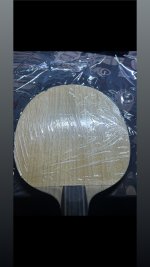

why wait to dry the glue?

This user has no status.
🏆 Top 1% Commenter
Well-Known Member
Mar 2023
1,100
1,067
7,565
Sometimes, when I'm playing, the rubber touches the table and it peels off a little from the edge of the blade. I don't want to completely re-glue the rubber, so I glue that area with water-based glue. Then, after a while, when I change the rubber, I notice a change in the color of the wood in that area. Not all types of wood change color; for example, eucalyptus and mahogany darken, while koto doesn't.
 
  • Like
Reactions: jonol
This user has no status.
Member
Nov 2017
34
26
66
I usually seal all my blades with a thin layer, and sand it slightly with 400grid, so wet glueing shouldn’t be a problem. Sometimes I use to little glue and or force and after time the rubber became detached so I had to reglue. Sometimes I didn’t cover 100% of the blade with small cut rubbers, to avoid re-glueing I decided to use this wet glueing press.
 
This user has no status.
🏆 Top 1% Commenter
Well-Known Member
Oct 2018
1,699
2,076
4,257
I tried wet glue with Sueke no2 and while it's a strong glue with this method the bond on my blade was extremely weak. Granted I didn't use these tools but I have home made "clicky" press, which actually used bolts and nuts to tighten, so not all that different to these tools.

I can imagine a Butterfly freechack pro glue to be better suited since that is very strong glue, stronger than Sueke no2.
 
This user has no status.
Member
Nov 2025
85
129
330
Of course the bond is weak when you wet glue. Table tennis glue is a type of contact glue and is designed specifically to be used on two separate dry surfaces.

When the two surfaces with the dried glue come in contact, they chemically bond with the matching chemicals on the other surface.

Wet gluing with contact glue is ridiculous.
 
Top