
Latest reviews


You are using an out of date browser. It may not display this or other websites correctly.
You should upgrade or use an alternative browser.
You should upgrade or use an alternative browser.

For Milky Way Mercury II in Rubbers
- Tyce
- 4.00 star(s)
Pros
- Tackiness
- Easy to use
- Dirt cheap
- Different hardnesses available
Cons
- Variations in quality
- Old v new versions
This rubber is (usually) half the price of the next best "cheap, tacky rubber" I can get, with some additional advantages!
For €5 a piece on my latest Ali order (sometimes goes up to €10), I didn't expect much the first time I ordered it. I just added it to an existing order to mess around with.
I have used 729 Super FX several times in the past, and given the low price point of that rubber I will be comparing these two a lot.
Both of these rubbers need breaking in. It takes a couple of sessions to take the stiffness out of the M2 (Mercury 2) especially the topsheet seems to really need to warm up before it will start to give a little bit more.
Booster doesn't help much, on either rubber tbh. Don't waste your time and money boosting them. Mercury 2 comes with a cream coloured sponge that actually reminds me of older tensors like Rakza 7, rather than the high density orange/blue sponges found on Super FX and H3.
The sponge just makes this rubber (eventually) a bit more lively, while the Super FX keeps on playing like a brick, just a softer brick. After a while you could even say there's a little bit of a bounce going on despite the tack. If maintained and covered, the sheet keeps its tack rather well. I have had one for months and it hasn't really changed much at all. I imagine the sponge will eventually give out from under the topsheet but so far it has been in good shape.
The Soft version of this rubber is even easier to pull a ball with, but has a significant power tradeoff. I would not recommend it on FH at all unless you are a complete beginner without power generation experience.
On the BH, it's easy to access its spin capabilities and let the ball sink in a little bit.
The Medium sponge also has a ceiling that's not overly hard to reach, but there is a purpose in having that ceiling, too, because it will basically teach you to not overhit the ball since there's no benefit to be had. I would also opt to use Medium on BH if you have a harder, faster blade. You could probably use the Soft, too, but you'd reach the ceiling so quickly that there's not much of a point to it.
Both sponge hardness versions are just really meant to be stable, spin-oriented rubbers, and that's what they do. Controlling the ball is easy both passively and actively. Serves can be surprisingly heavy on the spin department. Straight up blocking is a bit harder to get right but for a tacky rubber it's actually quite OK.
Looping is easy as you can literally grab and pull the ball. It feels like there's seconds of time to execute your shot. Saving a wide short FH by pulling it over the net is just good fun. In a way, that doesn't really promote good footwork, does it, but still.
Going back to the Super FX comparison, the 729 rubber basically is, and feels like, a classic Chinese rubber, whereas M2 feels like a bit of a modern take on it. It's designed to be thicker, to have the ball sunk into it. 729's version has been updated at some point to offer a blue sponge on the black rubber, but that's all. It also oxidizes like nothing else so it looks like crap within a session.
There's a couple of caveats to M2 though. The quality between sheets can vary quite a bit. We're talking weight, topsheet quality, sponge density, basically every element. For this price point that's completely understandable, but it needs to be said.
Second, and this *can* be important: the old version of M2 is not on the LARC, so it is not allowed to be played in official matches in most countries. The new version, with the spiraling Yinhe logo, is on the approved list, but Ali sellers often don't clearly show which one you're getting.
I am under the impression that old stocks are dwindling, so your chances are getting better all the time. I just bought a stack where the seller didn't show the logo at all and only got new ones. YMMV!
Conclusion: I have said it before in the forums, but if I had to pick one single rubber to use, and pay for, for the rest of my life, M2 would be at least in my top 3. Heck I could use a new sheet every month and be off cheaper than changing most rubbers twice a year.
For €5 a piece on my latest Ali order (sometimes goes up to €10), I didn't expect much the first time I ordered it. I just added it to an existing order to mess around with.
I have used 729 Super FX several times in the past, and given the low price point of that rubber I will be comparing these two a lot.
Both of these rubbers need breaking in. It takes a couple of sessions to take the stiffness out of the M2 (Mercury 2) especially the topsheet seems to really need to warm up before it will start to give a little bit more.
Booster doesn't help much, on either rubber tbh. Don't waste your time and money boosting them. Mercury 2 comes with a cream coloured sponge that actually reminds me of older tensors like Rakza 7, rather than the high density orange/blue sponges found on Super FX and H3.
The sponge just makes this rubber (eventually) a bit more lively, while the Super FX keeps on playing like a brick, just a softer brick. After a while you could even say there's a little bit of a bounce going on despite the tack. If maintained and covered, the sheet keeps its tack rather well. I have had one for months and it hasn't really changed much at all. I imagine the sponge will eventually give out from under the topsheet but so far it has been in good shape.
The Soft version of this rubber is even easier to pull a ball with, but has a significant power tradeoff. I would not recommend it on FH at all unless you are a complete beginner without power generation experience.
On the BH, it's easy to access its spin capabilities and let the ball sink in a little bit.
The Medium sponge also has a ceiling that's not overly hard to reach, but there is a purpose in having that ceiling, too, because it will basically teach you to not overhit the ball since there's no benefit to be had. I would also opt to use Medium on BH if you have a harder, faster blade. You could probably use the Soft, too, but you'd reach the ceiling so quickly that there's not much of a point to it.
Both sponge hardness versions are just really meant to be stable, spin-oriented rubbers, and that's what they do. Controlling the ball is easy both passively and actively. Serves can be surprisingly heavy on the spin department. Straight up blocking is a bit harder to get right but for a tacky rubber it's actually quite OK.
Looping is easy as you can literally grab and pull the ball. It feels like there's seconds of time to execute your shot. Saving a wide short FH by pulling it over the net is just good fun. In a way, that doesn't really promote good footwork, does it, but still.
Going back to the Super FX comparison, the 729 rubber basically is, and feels like, a classic Chinese rubber, whereas M2 feels like a bit of a modern take on it. It's designed to be thicker, to have the ball sunk into it. 729's version has been updated at some point to offer a blue sponge on the black rubber, but that's all. It also oxidizes like nothing else so it looks like crap within a session.
There's a couple of caveats to M2 though. The quality between sheets can vary quite a bit. We're talking weight, topsheet quality, sponge density, basically every element. For this price point that's completely understandable, but it needs to be said.
Second, and this *can* be important: the old version of M2 is not on the LARC, so it is not allowed to be played in official matches in most countries. The new version, with the spiraling Yinhe logo, is on the approved list, but Ali sellers often don't clearly show which one you're getting.
I am under the impression that old stocks are dwindling, so your chances are getting better all the time. I just bought a stack where the seller didn't show the logo at all and only got new ones. YMMV!
Conclusion: I have said it before in the forums, but if I had to pick one single rubber to use, and pay for, for the rest of my life, M2 would be at least in my top 3. Heck I could use a new sheet every month and be off cheaper than changing most rubbers twice a year.
- Speed
-
5
- Spin
-
7
- Durability
-
7
- Control
-
8.5
Pros
- Stability
- Easy to spin up
- Plenty of power and spin
- Dynamic
Cons
- No top end performance
- Hard to use on 5ply
I'm gonna make this one quick:
Been using Glayzer on FH on Innerforce Layer ALC for a month. Found myself twiddling it to my BH too, so now I have it on both sides.
It took a few sessions to get adjusted to the activation, which to me felt like I needed to break the rubber in. But after adding a second Glayzer to the BH and instantly getting the right feeling, I'm sure it was me breaking in rather than the rubber.
This one does it all as an allrounder. It's not excellent at anything, but it works well for everything. It pushes, chops. loops, drives, blocks, and smashes with good, Intermediate player level quality.
Who is this suited for? Allround and OFF- intermediates who play spin and placement over power. I also see OFF+ power players being able to learn a lot with this rubber, but they will likely be moving on to something more powerful when they've been playing intermediate levels for a while.
I found this to be playing much, much more dead on a 5ply and I wouldn't recommend it unless you want to learn to generate good power and have the ambition of moving on to fiber later on. On Innerforce, this is an easy rubber to play.
Been using Glayzer on FH on Innerforce Layer ALC for a month. Found myself twiddling it to my BH too, so now I have it on both sides.
It took a few sessions to get adjusted to the activation, which to me felt like I needed to break the rubber in. But after adding a second Glayzer to the BH and instantly getting the right feeling, I'm sure it was me breaking in rather than the rubber.
This one does it all as an allrounder. It's not excellent at anything, but it works well for everything. It pushes, chops. loops, drives, blocks, and smashes with good, Intermediate player level quality.
Who is this suited for? Allround and OFF- intermediates who play spin and placement over power. I also see OFF+ power players being able to learn a lot with this rubber, but they will likely be moving on to something more powerful when they've been playing intermediate levels for a while.
I found this to be playing much, much more dead on a 5ply and I wouldn't recommend it unless you want to learn to generate good power and have the ambition of moving on to fiber later on. On Innerforce, this is an easy rubber to play.
- Speed
-
7.9
- Spin
-
8
- Durability
-
8
- Control
-
9
Pros
- Controlled
- Packs a good punch
- Spins up easy
Cons
- High bounce
This is a double-sided review, for one single reason: this rubber is not a good fit for me. I do feel that in the hands of a person that likes bouncy rubbers, this is a very good, sensible option to use.
First off, I have been using this for a relatively short period of about a month. In that month, the rubber has shown no signs of wear whatsoever. The topsheet looks like it just came out of the package, so that indicates to me you will be getting great mileage out of this rubber.
I have been using this rubber on Innerforce Layer ALC (and shortly on Outerforce ALC), primarily on the BH side, and bought it in 2.1mm to replace T05 which felt too unpredictable and in turn that was bough to replace Fastarc C-1.
The good points:
Serving, doing a BH serve, the soft rubber really allows the ball to sink in and make good spin with a light effort.
Punching is great. If you like to punch fast with a lot of control, this is a really good rubber to do so. Got some great BH slaps in which was lovely.
The "hmm" points:
Opening up is easy, but also hard for me as it gives a lot of speed if I make even a slightly thicker contact. I prefer to grab a ball rather than shooting it, which might be something to improve on my side too, but it just doesn't work for my current technical level. If you, however, do like to be able to just loopdrive through with light effort, I think this rubber is an absolute shiner. (I really need to learn take that ball a bit higher)
The bounce becomes a bit of a problem when pushing, but far less so than Tenergy.
The bad points:
Hard to say. I think the sponge is a bit fragile so don't keep regluing this rubber I guess.
On FH I found it a complete mismatch. Again, just me, and I can see it working even for me if I'd been using all-wood blades.
Conclusion:
It has a lot of the Tenergy feeling and that gives a really lovely sensation. The ball sinking into the rubber easily, shooting out, and producing good spins with lighter efforts. I feel the marketing bit about "tolerance" is completely right, as getting spins and punches in is just pretty easy to do safely. Not my cuppa, but it's really good in its league and I would easily recommend it to someone who likes bouncier stuff.
First off, I have been using this for a relatively short period of about a month. In that month, the rubber has shown no signs of wear whatsoever. The topsheet looks like it just came out of the package, so that indicates to me you will be getting great mileage out of this rubber.
I have been using this rubber on Innerforce Layer ALC (and shortly on Outerforce ALC), primarily on the BH side, and bought it in 2.1mm to replace T05 which felt too unpredictable and in turn that was bough to replace Fastarc C-1.
The good points:
Serving, doing a BH serve, the soft rubber really allows the ball to sink in and make good spin with a light effort.
Punching is great. If you like to punch fast with a lot of control, this is a really good rubber to do so. Got some great BH slaps in which was lovely.
The "hmm" points:
Opening up is easy, but also hard for me as it gives a lot of speed if I make even a slightly thicker contact. I prefer to grab a ball rather than shooting it, which might be something to improve on my side too, but it just doesn't work for my current technical level. If you, however, do like to be able to just loopdrive through with light effort, I think this rubber is an absolute shiner. (I really need to learn take that ball a bit higher)
The bounce becomes a bit of a problem when pushing, but far less so than Tenergy.
The bad points:
Hard to say. I think the sponge is a bit fragile so don't keep regluing this rubber I guess.
On FH I found it a complete mismatch. Again, just me, and I can see it working even for me if I'd been using all-wood blades.
Conclusion:
It has a lot of the Tenergy feeling and that gives a really lovely sensation. The ball sinking into the rubber easily, shooting out, and producing good spins with lighter efforts. I feel the marketing bit about "tolerance" is completely right, as getting spins and punches in is just pretty easy to do safely. Not my cuppa, but it's really good in its league and I would easily recommend it to someone who likes bouncier stuff.
- Speed
-
7.9
- Spin
-
7
- Durability
-
9
- Control
-
8.5
For Hurricane 3 (National) in Rubbers
- Samuel Li
- 5.00 star(s)
Pros
- fast
- spinny
- feeling
- durability
Cons
- durability
best forehand rubber you can possibly get on the market, it is even better after boosting it. used by famous chinese player such as ma long, wangchuqin, fanzhendong, and other player like shinyu bin, and jang woo jin
- Speed
-
9.5
- Spin
-
10
- Durability
-
7.8
- Control
-
9.7
For Hurricane 3 NEO in Rubbers
- Samuel Li
- 4.00 star(s)
Pros
- pretty spinny
- forehand loop
- perfect after boosting
- hard to play
Cons
- slow
- have to add a lot of power
- booster layer
Over all I think this rubber is very spinny, and it is possibly to best rubber after boosting, but in order to play well, you need to put a lot of power on it, because it's slow.
For Tenergy 05 in Rubbers
- Samuel Li
- 4.00 star(s)
Pros
- pretty fast
- good durability
Cons
- not as spinny as dhs hurricane 3
Ok but t08 is better
Pros
- Excellent spin potential
- Very good control when attacking
- Great stability when blocking
- Excellent from mid-distance
- Surprisingly soft and natural feeling for a hard sponge
- Easy to play aggressively and take the initiative
Cons
- A bit bouncy in the short game and on service receive
- Requires more attention to racket angle and touch on short balls
- Takes some adjustment if you come from a less bouncy rubber
- Not a rubber that compensates for poor technique or weak strokes
Zyre 03 — First Impressions
Just wanted to share my first impressions of the Zyre 03. This was my first time testing it, and I’ve only had about two hours of training with it so far, so obviously this isn’t a long-term review yet.
I’m using a YASAKA ATLETICO SPIN PRO, with the Zyre 03 in 2.7 mm on FH and 2.5 mm on BH. Before this, I was using XUPERMAN POWERPLAY-X.
Service
I couldn’t really notice a big difference compared to the POWERPLAY-X here. I was able to serve short or long and get plenty of spin without having to make any major adjustment.
Nothing particularly surprising for me in this area, but it definitely feels very good for serving.
Service Receive
The Zyre 03 is a little more bouncy than the POWERPLAY-X, but I actually found it quite comfortable to use on receive.
You have to pay a bit more attention to your racket angle and keep your grip relaxed. If you do that, I didn’t find it difficult to control at all.
The main thing I noticed is that on really short balls, you need to be a bit more conscious of what you’re doing. If you get lazy with the touch, the ball can come off the racket quite fast and you can easily end up with a bad return.
Forehand — probably my favorite part
This was easily the best part of the test for me.
The Zyre 03 has a very accessible speed. I could get a good amount of pace without feeling like the ball was constantly going long, and I was able to generate a lot of spin.
Compared to the POWERPLAY-X, I felt more confident attacking and taking the initiative. Blocking was also very good for me. I felt quite secure against incoming spin, and I didn’t have issues with the ball randomly flying long.
From mid-distance, I really liked it. It feels very comfortable and has plenty of power when you actually put something into the stroke.
I don’t normally chop, but I tried a few chops from mid-distance just for fun, and, surprisingly, they came out pretty well. Definitely not something I expected from my first session.
One thing I want to make clear, though: the rubber doesn’t do the work for you.
When you execute the right technique and give the ball the right amount of power, the Zyre 03 gives you a very good quality shot. But if your technique or power is poor, the quality of the shot is still going to be poor. It’s not some kind of magic rubber that turns a weak stroke into a great one.
For me, what it does really well is give me a very good response when I actually execute the stroke properly.
Backhand
This side needs a little more adjustment from me.
I have a tendency to lift the ball a bit with my backhand stroke, and that worked pretty naturally with the POWERPLAY-X. With the Zyre 03, if I used exactly the same stroke, the ball would go way too high. It was actually kind of funny.
Once I started hitting more forward and closing the racket angle a bit more, the ball started going exactly where I wanted.
So after making that adjustment, the overall feeling became very similar to the forehand: good speed, lots of spin and a lot of confidence when attacking.
Again, though, I think the same thing applies here. You still have to execute the stroke properly. The Zyre 03 gives you a very good result when you give it the right technique and power, but it won’t compensate for a bad or weak stroke.
2.7 mm vs 2.5 mm
I’m currently using 2.7 mm on FH and 2.5 mm on BH, but I haven’t swapped them around yet, so I can’t really say much about the difference between the two thicknesses.
That’s something I definitely want to try later.
Overall feeling
One of the things that surprised me the most is how natural and surprisingly soft the Zyre 03 feels despite having a hard sponge.
I was expecting it to feel harder and possibly more demanding, but it actually felt very comfortable from the first session.
I also didn’t have any problems with the rubber slipping or moving on the blade.
Price
In my case, I can import it without paying import taxes for around $67–77 USD, plus shipping.
At that price, I think it’s a pretty interesting option, especially considering how good my first session felt.
Durability
Nothing to report yet. Two hours is obviously nowhere near enough to say anything about durability, so I’ll have to update this part after using it for a while.
First verdict
For a first test, I’m honestly very impressed with the Zyre 03.
The FH was the biggest surprise for me. It gives me easy access to speed and spin while still feeling controlled, and I felt more confident taking the initiative compared to the POWERPLAY-X.
The BH needs a bit of adjustment to my technique, mainly because of how much the rubber lifts the ball if I use my old stroke. But once I started hitting more forward and closing the racket angle, it felt really good.
So far, I’d describe it as spinny, powerful when you need it, controlled, and surprisingly natural for a hard sponge.
But I think it’s important to say that it still rewards proper technique. Give it a good stroke and it gives you a good ball. Give it a weak or poorly executed stroke and you’ll still get a weak ball.
This is only my first two hours with it, so I’m definitely going to keep testing it and see how it feels once I’ve had more time to adapt to it.
- Speed
-
9
- Spin
-
9.5
- Control
-
8

For Stratus Powerwood in Blades
- dprsspins
- 5.00 star(s)
Pros
- Great control
- Arc and Spin
- Powerful
- Good feeling
- Crisp for an all-wood
- Usable at all levels
- Great value
Cons
- Moderate Sweet Spot
Bought this, with Rakza 7 on both sides, as a second setup, for when I want to slow down the game or learn specific skills (main setup is Viscaria + Zyre-03). I must say after trying it out for a while, I am tempted to grow with it and keep using it.
I played with other all wood blades like the 7 ply Stiga Clipper, 5 ply Koto outer Butterfly Falcima, and the 5 ply Donic Appelgren All Play. And I like the power wood the best. Why?
It has noticeably more power than ALL+ all-wood blades like the Allplay, even more power than the OFF- Falcima, and it feels crisp and full, unlike the Falcima (which is a bit dull and muted). It is also more flexible and spinnier than the Stiga Clipper 7 ply, with a higher safer arc.
Coming from the Viscaria + Zyre-03, I do lose some explosive power, but the Power Wood with R7 combination doesn't slack off at distance. It can absolutely rip power loops provided you really accelerate into the ball. I actually don't miss the extra power from my Viscaria setup.
Perhaps the biggest stepup I get from using the Power Wood is opening up against backspin. I'm not very confident nor consistent about opening backspin when I was using Zyre-03, so I'd only do it if the backspin isn't too heavy, and it was okay. In tougher matches, I was mostly waiting for my opponent to do the opening up, and then I'd just counterattack, which worked well at the intermediate level. But as my coach wanted me to learn how to take the initiative in matches by opening up first, I looked for all-wood blade to help me learn the consistency of this stroke.
This blade definitely doesn't dissapoint. Opening up with the R7 is a dream come true. My consistency has sky rocketed, and my learning has progressed.
I played with other all wood blades like the 7 ply Stiga Clipper, 5 ply Koto outer Butterfly Falcima, and the 5 ply Donic Appelgren All Play. And I like the power wood the best. Why?
It has noticeably more power than ALL+ all-wood blades like the Allplay, even more power than the OFF- Falcima, and it feels crisp and full, unlike the Falcima (which is a bit dull and muted). It is also more flexible and spinnier than the Stiga Clipper 7 ply, with a higher safer arc.
Coming from the Viscaria + Zyre-03, I do lose some explosive power, but the Power Wood with R7 combination doesn't slack off at distance. It can absolutely rip power loops provided you really accelerate into the ball. I actually don't miss the extra power from my Viscaria setup.
Perhaps the biggest stepup I get from using the Power Wood is opening up against backspin. I'm not very confident nor consistent about opening backspin when I was using Zyre-03, so I'd only do it if the backspin isn't too heavy, and it was okay. In tougher matches, I was mostly waiting for my opponent to do the opening up, and then I'd just counterattack, which worked well at the intermediate level. But as my coach wanted me to learn how to take the initiative in matches by opening up first, I looked for all-wood blade to help me learn the consistency of this stroke.
This blade definitely doesn't dissapoint. Opening up with the R7 is a dream come true. My consistency has sky rocketed, and my learning has progressed.
- Speed
-
8
- Control
-
9
- Hardness
-
6
- Durability
-
8
For Innershield ZLF DEF in Blades
- belllfador
- 4.00 star(s)
Pros
- High spin
- High dwell
- High dampeniing
Cons
- Average sweet spot
- Too flexible
- Frigile
Very niche blade for defense. 165x155mm 930Hz, 85.3g. Slow, flexible and with a lot of dampening. The soft top layer is fragile and must be sealed with 2 layers of lacquer.
Use of hard rubbers lowers the vibrations and makes the blade more stable. With TG3 BS 40 is a spin demon. I tried 388D-2 in 1mm but was too springy on that blade. P3V at 1mm was much better.
A cheaper blade with high dwell and soft top layer is Victas Blockman.
Use of hard rubbers lowers the vibrations and makes the blade more stable. With TG3 BS 40 is a spin demon. I tried 388D-2 in 1mm but was too springy on that blade. P3V at 1mm was much better.
A cheaper blade with high dwell and soft top layer is Victas Blockman.
- Speed
-
3
- Control
-
8.1
- Hardness
-
2
- Durability
-
4

merlin el mago
I own Victas Blockman with Yinhe Young OX great combo, I don't buy the Butterfly Innershield ZLF DEF because it's very expensive. Thanks for advice.
For Innershield ZLF DEF in Blades
- NopspinnerCatOX
- 5.00 star(s)
I find this to be my go to blade, often currently with Dr. Neubauer Viper in ox on the backhand side. I can lift and hit with the pips very well, even counter attack and create a very weird loop even. Active blocks, chop blocks, and side swipes are easier to do because of solid dwell time, and are very devastating due to the variable spin generation not just pure spin reversal (although spin reversal is quite strong despite the softer wood, and a little bit of lacquer for sealing could help marginally as well as protect the blade.) chopping is good as well with Zyre 03 in 2.5 (I only chop in practice with inverted, I never chop with my pips as I use a slow pip in OX making it too dead and physically taxing. Plus my movement is not the best, so close to table is better for me. Great blade with good control and power when needed. A little expensive however could be a little bit cheaper in my opinion, but can’t have everything perfect.
- Speed
-
6.5
- Control
-
9.7
- Hardness
-
5.8
For Timo Boll CAF in Blades
- jaQa
- 4.00 star(s)
Pros
- Control
- Blocking Stability
- Ability to play close angles
- Consistency
- Short game
Cons
- Lacks power far away from the table
Depending on your skill level, this blade probably suits a large part of all amateurs better then any of the "ALC/ZLC" type blades from the various manufacturers.
Beeing honest to oneself most non professional players probably quickly realise that the typical carbon blades are just to fast and uncontrolled especially in the service receive game.
In open rallies 1-2 meters away from the table everything is fine since there the carbon and ease of speed generation stabilise the strokes.
But mastering these blades close to the table you'll need very fine handfeeling and a lot of training.
Back to the Timo Boll CAF, being bitten by the EJ bug (testing various equipment during the last 20 years) I've played around 20-30 different blades and this one reminds me the most to a more controlled and slightly tamed down version of the Butterfly Keyshot Light, which has the same 3+2 layer construction.
The Keyshot has a thicker middle ply and pure arylate instead of the CAF layer but the overall feeling in play is very similiar.
Relativly soft on impact but then a solid stable core.
The throw is low to medium, a notch higher than the Keyshot.
It best suited for a close to the table allround offensive game.
Topspin open ups are really good, one can easily vary speed, spin and placement.
The overall control for shortplay is very nice, since the base speed is not very high.
Pushes can be played rather aggresivly with very good spin.
One can hit direct winners close to the table with a fast topspin or smash but the overall speed is in the OFF- category.
Very stable in blocking, probably due to the thick middle ply in comparison to normal 5ply blades.
The CAF layers doesn't produce the typical ALC type kick, but it stabilises the blade on more impactful shots which can be played with a very good consistency.
If one plays mostly from the mid distance (2+ meters) this blade probably lacks the necessary power to be effective.
I played it with 2x Tenergy 19 in 2,1mm.
For the backhand this combination fits really good,
on the forehand a harder and more powerful rubber is probably more suitable e.g Tenergy 05, Dignics or some harder ESN type rubber with 48+ shore hardness.
Overall this is a solid controlled offensive blade for mere mortals in the lower leagues.
Beeing honest to oneself most non professional players probably quickly realise that the typical carbon blades are just to fast and uncontrolled especially in the service receive game.
In open rallies 1-2 meters away from the table everything is fine since there the carbon and ease of speed generation stabilise the strokes.
But mastering these blades close to the table you'll need very fine handfeeling and a lot of training.
Back to the Timo Boll CAF, being bitten by the EJ bug (testing various equipment during the last 20 years) I've played around 20-30 different blades and this one reminds me the most to a more controlled and slightly tamed down version of the Butterfly Keyshot Light, which has the same 3+2 layer construction.
The Keyshot has a thicker middle ply and pure arylate instead of the CAF layer but the overall feeling in play is very similiar.
Relativly soft on impact but then a solid stable core.
The throw is low to medium, a notch higher than the Keyshot.
It best suited for a close to the table allround offensive game.
Topspin open ups are really good, one can easily vary speed, spin and placement.
The overall control for shortplay is very nice, since the base speed is not very high.
Pushes can be played rather aggresivly with very good spin.
One can hit direct winners close to the table with a fast topspin or smash but the overall speed is in the OFF- category.
Very stable in blocking, probably due to the thick middle ply in comparison to normal 5ply blades.
The CAF layers doesn't produce the typical ALC type kick, but it stabilises the blade on more impactful shots which can be played with a very good consistency.
If one plays mostly from the mid distance (2+ meters) this blade probably lacks the necessary power to be effective.
I played it with 2x Tenergy 19 in 2,1mm.
For the backhand this combination fits really good,
on the forehand a harder and more powerful rubber is probably more suitable e.g Tenergy 05, Dignics or some harder ESN type rubber with 48+ shore hardness.
Overall this is a solid controlled offensive blade for mere mortals in the lower leagues.
- Speed
-
6.5
- Control
-
9
- Hardness
-
6.5
- Durability
-
5

Pros
- Controllable catapult
- Great feel of the spring sponge
- Quite durable
- Punch block forever
Cons
- Not very grippy
- Reacts poorly to regluing
- Not as beginner friendly
- Harder to open up backspin
One of the best for backhand. Due to its controlled catapult, but decent free speed, it can place nasty, active punch blocks quite precisely. I find myself looking for opportunities to utilize my backhand with the Rozena as I can easily speed punch the ball into side table extremities or into the elbow of the opponent where it is hard to reach.
The spring sponge gives it a clear ball feel especially on carbon blades, but it is also no slouch on all wood blades. I love this rubber.
But if you are an active spin generator on your backhand, you loop alot, open up backspin and love to chop on backhand, the Rozena's topsheet grip will leave you wanting as you get better. I'm not as confident in flicking or opening up backspin with the Rozena than say a Glayzer or a G1. It also reacts badly to regluing, if you do it a few times the sponge can crater and the topsheet can bubble. It's also not as beginner-friendly as many advertised, it's bouncy and quite unpredictable for a new player.
I would not recommend it on the forehand for the beginner or the advanced player. It is okay but it definitely has a ceiling on grip where brushing is concerned.
The spring sponge gives it a clear ball feel especially on carbon blades, but it is also no slouch on all wood blades. I love this rubber.
But if you are an active spin generator on your backhand, you loop alot, open up backspin and love to chop on backhand, the Rozena's topsheet grip will leave you wanting as you get better. I'm not as confident in flicking or opening up backspin with the Rozena than say a Glayzer or a G1. It also reacts badly to regluing, if you do it a few times the sponge can crater and the topsheet can bubble. It's also not as beginner-friendly as many advertised, it's bouncy and quite unpredictable for a new player.
I would not recommend it on the forehand for the beginner or the advanced player. It is okay but it definitely has a ceiling on grip where brushing is concerned.
- Speed
-
8
- Spin
-
7
- Durability
-
8
- Control
-
9
Pros
- Extreme speed
- Addicting feel
- Extreme durability
- Impossible to bottom out
- Supreme grip
- Decent control
Cons
- Low dwell
- Short game control
- Spin only on full engagement
- Unreasonably expensive
2.5mm review
The good;
The best thing about this rubber is the confidence it gives me to win with outright speed drives or powerloops from mid distance or further. Even at the short game, if the ball is returned to me just a little high, it's the end for the opponent. This rubber wants to kill with speed, and that fits my game style.
Next best thing, the feeling. The standard 'spring sponge X', with it's satisfying clicky feel, is further enhanced by making the sponge thick and giving the rubber a very thin topsheet. This allows players to engage and feel the sponge even more. When mid distance powerlooping, the feeling is one of its kind and out of this world. If you like the non tacky catapult feel, then this is the best you can get.
Thirdly, it's hyper grippy topsheet. Try rubbing your fingers without much force on it's new topsheet and your fingers ain't going anywhere. For a non tacky rubber, the grip levels are very impressive. This allows me to focus a lot on brushing with great confidence. Given, this rubber requires advanced thin brushing techniques, but it's high topsheet grip makes me just go for it without any hesitation. Of course D09C wins in this regard, but the Zyre-03 is not far off. If the weather isn't humid, ball slippage is virtually zero.
All this and you probably think, okay the control's gotta be bad. But it's not. Except for the short game (which I'll get to that later) this rubber with it's great feel and not very strong catapult, allows for good control. Granted, beginners shouldn't go anywhere near this thing, but in the hands of an intermediate with decent footwork and good strokes, this rubber can be used quite well.
Durability; 3 months in, 5-6 sessions per week, each 2 hours high intensity, topsheet looks a little roughed but plays like 95% new. At my intense use, I probably play about 40 hours monthly minimum, and it'll probably last me 4-6 months. It's quite sensitive to humidity though, ball slippage is there in humid weather, but nothing a wipe can't fix.
Cons
Price. Enough said. Absurd to pay so much for a rubber. If you want premium but don't wanna take a bank loan for a rubber, consider Dignics 05.
It has low dwell. If you want to spin the ball through sponge engagement, you must loop real hard to get that hard sponge to deform and meld into the shape of the ball. If you can get there, the ball will spin like a neutron star. But if you can't get there, then your only hope is thin brushing.
Short game control. It's mainly to do with spin anticipation. This rubber is quite sensitive to spin (but not as bad as T05). So when opponents serve short backspin sidespin, you really need to get your racket angles right to avoid springing the ball up. In this regard, D09C far outweighs it in short game control.
Overall
Good rubber, but get it 2nd hand from a player who bought it new and used it for a few weeks, then felt it is too demanding for them. I prefer the 2.5mm.
The good;
The best thing about this rubber is the confidence it gives me to win with outright speed drives or powerloops from mid distance or further. Even at the short game, if the ball is returned to me just a little high, it's the end for the opponent. This rubber wants to kill with speed, and that fits my game style.
Next best thing, the feeling. The standard 'spring sponge X', with it's satisfying clicky feel, is further enhanced by making the sponge thick and giving the rubber a very thin topsheet. This allows players to engage and feel the sponge even more. When mid distance powerlooping, the feeling is one of its kind and out of this world. If you like the non tacky catapult feel, then this is the best you can get.
Thirdly, it's hyper grippy topsheet. Try rubbing your fingers without much force on it's new topsheet and your fingers ain't going anywhere. For a non tacky rubber, the grip levels are very impressive. This allows me to focus a lot on brushing with great confidence. Given, this rubber requires advanced thin brushing techniques, but it's high topsheet grip makes me just go for it without any hesitation. Of course D09C wins in this regard, but the Zyre-03 is not far off. If the weather isn't humid, ball slippage is virtually zero.
All this and you probably think, okay the control's gotta be bad. But it's not. Except for the short game (which I'll get to that later) this rubber with it's great feel and not very strong catapult, allows for good control. Granted, beginners shouldn't go anywhere near this thing, but in the hands of an intermediate with decent footwork and good strokes, this rubber can be used quite well.
Durability; 3 months in, 5-6 sessions per week, each 2 hours high intensity, topsheet looks a little roughed but plays like 95% new. At my intense use, I probably play about 40 hours monthly minimum, and it'll probably last me 4-6 months. It's quite sensitive to humidity though, ball slippage is there in humid weather, but nothing a wipe can't fix.
Cons
Price. Enough said. Absurd to pay so much for a rubber. If you want premium but don't wanna take a bank loan for a rubber, consider Dignics 05.
It has low dwell. If you want to spin the ball through sponge engagement, you must loop real hard to get that hard sponge to deform and meld into the shape of the ball. If you can get there, the ball will spin like a neutron star. But if you can't get there, then your only hope is thin brushing.
Short game control. It's mainly to do with spin anticipation. This rubber is quite sensitive to spin (but not as bad as T05). So when opponents serve short backspin sidespin, you really need to get your racket angles right to avoid springing the ball up. In this regard, D09C far outweighs it in short game control.
Overall
Good rubber, but get it 2nd hand from a player who bought it new and used it for a few weeks, then felt it is too demanding for them. I prefer the 2.5mm.
- Speed
-
10
- Spin
-
9
- Durability
-
10
- Control
-
7.5
For H8-80 37 degree in Rubbers
- Kilogramme
- 5.00 star(s)
Pros
- Spin
- Control
- Durability
- Multiple gear
Cons
- Quality control of commercial rubber
⭐ First impressions
First surprise: despite being a 37° Chinese rubber, it feels quite firm. Honestly, it even feels firmer than a Tenergy 19 to me. You can immediately tell it's not a soft rubber.
The topsheet is properly tacky, exactly what I was looking for.
🚀 Speed and dynamics
With 2 layers of Haifu National White, the rubber is clearly boosted and it shows.
It has a good level of dynamism for a tacky rubber. Still slower than a Tenergy 19 overall, but once I engage into the ball, it can produce a lot of speed. Paired with the Long 5 Golden, there's more than enough power to finish points.
What I really like is the linear and predictable feeling compared to tensor rubbers.
🔄 Spin and opening loops
This is the biggest highlight for me.
Opening against backspin is very easy. I can brush the ball very thinly without necessarily engaging deep into the sponge, and the ball still lifts with a lot of spin and safety.
This is exactly what I was looking for. Compared to Tenergy-style rubbers, where you really need to engage the sponge to avoid the ball slipping, here the tackiness gives a much safer grip on the ball.
Less effort, more spin.
💥 Ball quality
Even after just one session, I noticed opponents struggling on my opening loops.
The ball carries a lot of spin, kicks after the bounce, and tends to surprise them. I got several weak returns and mistakes on loops that didn’t feel very fast from my side.
The combination of tackiness + booster effect seems to create a heavy and slightly “jumpy” ball.
🛡️ Blocking and passive play
The throw angle is lower than Tenergy that is really high 19. It still feels fairly high, but compared to T19 I felt more comfortable. I felt that I had to open the racket in blocks and counters. I know it is still cloased, but way less than before.
However, one important point: the rubber is quite sensitive when passive.
- Against topspin, if I’m not active enough, I absorb a lot of spin and the ball can go long
- Against backspin, if I don’t engage, it tends to drop into the net
So it clearly rewards active play. But don't worry, no need to generate lot of input there.
That said, in faster rallies with lots of incoming spin, I actually found it very manageable.
🎯 Control
Control is probably the biggest positive along with the easy opening game.
Even during this first session, I felt more secure than with Tenergy 19. Even when timing wasn’t perfect, the ball still stayed on the table.
I had some difficulty placing balls very precisely in drills, but no real outright mistakes. That’s more likely just adjustment time with new equipment.
✋ Short game
I will definitely need some time to adjust on touch shots like flips and chop-blocks.
The feeling is quite different from tensor rubbers, so some recalibration is needed.
Still, the first impressions are very positive, and I think these shots could become strengths once fully adapted.
✅ Preliminary conclusion
After just one session, I’m genuinely happy with the Hurricane 8-80 37° boosted with 2 layers of Haifu National White.
It gives me exactly what I was looking for:
✔ Lots of spin
✔ Very easy opening against backspin
✔ Strong control
✔ Heavy and disruptive ball quality
✔ Sufficient speed once boosted
Now I need to see how it evolves after a few more sessions, once it’s fully broken in and the booster effect settles.
- Speed
-
7
- Spin
-
9.5
- Durability
-
10
- Control
-
9.5
For Tenergy 19 in Rubbers
- Kilogramme
- 5.00 star(s)
Pros
- Spinny
- Controllable
- Nice feeling
Cons
- Ultimate top speed
Setup
- Rubber: Tenergy 19 – red – 2.1 mm
- Blade: DHS Golden Hurricane Long V
- Construction: 5+2 inner ALC
(Limba / Ayous / ALC / Ayous / Limba) - Used on: Backhand
Feel / Touch
The rubber is clearly softer than Rakza Z.
At first, I was a bit worried it might be too soft. I was afraid that on harder shots, especially compared to Rakza Z, the rubber might bottom out.
It doesn’t.
You can apply a lot of power, and it almost feels like the rubber changes hardness depending on impact. On small impacts, it feels soft and forgiving. The harder you hit, the more solid and stable it becomes.
This gives a lot of confidence in your shots.
Spin
Coming from a hybrid tacky rubber, I expected less spin and more speed-oriented behavior. In reality, I was pleasantly surprised.
I still generate a lot of spin, and opponents often comment on it. The absolute maximum spin is probably lower than a true tacky rubber, but you can reach a very high level of spin with relatively little effort.
I also expected the rubber to be more spin-sensitive, but it’s actually quite manageable.
Blocking — which is not my strongest shot — feels easy and controlled.
Chop blocks still require some adaptation, but they work well once you adjust.
Speed
Speed is always tricky to evaluate because my blade is OFF+ / OFF++, and a lot of the speed clearly comes from the blade itself.
That said, even though the setup is fast, it’s very controllable. The rubber is not overly bouncy. I don’t feel like I need to artificially slow down my strokes to keep the ball on the table.
When I miss long, I usually know why — and it doesn’t feel like the rubber is the main issue.
One important point: this combo allows me to play BH-to-BH rallies away from the table with surprisingly little effort.
Throw Angle
This is always hard for me to judge on my backhand, but I’d say the throw angle is medium to high.
Compared to Rakza Z, it feels higher, especially when opening up against backspin. It’s easier to create arc and lift the ball safely.
Short Game
The short game feels very solid.
The rubber is not too bouncy, which allows me to keep the ball short and low, even with a fast blade.
Flicks were fine, but here I’m clearly the limiting factor. I haven’t practiced them much recently.
I used to flick a lot, but my tactics evolved, and now I often prefer long pushes to set up a chop block or counter-topspin.
That said, the flicks I did attempt worked well. The rubber + blade combo felt quick — maybe even too quick — but only in this specific area.
Serves
As a backhand rubber, I mostly use it for backhand serves.
Serves felt spinny, short, and low, which is exactly what I want. Nothing negative to report here.
Overall Impression
My goal for a backhand rubber was something:
- easy to open up with
- spinny
- controlled
- reliable in rallies
Tenergy 19 delivered exactly that.
I have slightly less control than with a fully tacky rubber, but in exchange I can dictate play much more easily with my backhand. Rallies feel easier, less physically demanding, and my body stays more relaxed. I’m less tense, and my strokes feel more natural.
One member found this helpful.
For Innerforce ZLC in Blades
- tahatrek
- 5.00 star(s)
Yıl 2026 ve hala bu tahtayı seviyorum , şu an tek tercihim
Kontrol ve
His arayanlar için mükemmel
Kontrol ve
His arayanlar için mükemmel

- Federal_Agent
- 5.00 star(s)
Pros
- Medium distance top spin drives and counters.
Cons
- Short service and long adaptation time sponge activation.
After a 3 month battery of tests, I definitively replaced the rubber that i used on my forehand side. Now, my is Zyre03. The reasons were: type of action sponge, high quality of flat hits, hight quality active blocks and very furious counter drives from medium distance.
- Speed
-
9.5
- Spin
-
8.8
- Durability
-
8
- Control
-
8
Pros
- Good and easy speed
- Very controllable
- not spin sensitive so easy to hit everything withotu needing to worry about spin
- good openups with flciks and loops
- Cheaper than tenergy rubbers
Cons
- less spinny than it's tenergy counterpart
Good for backhand.
- Speed
-
8.6
- Spin
-
7.9
- Durability
-
7.6
- Control
-
10
One member found this helpful.
- ripctt2
- 4.00 star(s)
Pros
- Super spinny and controllable.
Cons
- Slow
- Heavy
- demands perfect technique + good position
very good for deveoloping players but maybe not starting the sort as its too slow and demands good technqiue.
- Speed
-
5.6
- Spin
-
10
- Durability
-
10
- Control
-
8.5
For Fan Zhendong ALC in Blades
- GENDA1
- 5.00 star(s)
Pros
- Speed
- Control
- Dwell time
Cons
- Price
- Weight selection
Description & Background Before getting into the details, I want to share a bit about my experince. I’ve been playing table tennis for about 7 years now, currently competing around Division 4-3 here in Thailand. Over the years, I’ve been a bit of an equipment junkie. I’ve tried so many blades ALC, ZLC, Super ALC, and plenty of all-wood blades from various brands. I’ve also gone through tons of rubbers, from Tenergy 05 and 80 to Rakza Z ,7 , DHS Hurricane3 National/province , and more.
For the past six months, my main setup has been the Fan Zhendong (FZD) ALC paired with Dignics 09c (2.1mm) on my forehand and Dignics 05 (2.1mm) on my backhand (i will call D09c and D05) .
The FZD ALC has a very famous 5+2 structure: Koto, ALC, Limba, Kiri, Limba, ALC, and Koto. Yes, this is the exact same composition as the Viscaria. A lot of people online claim that the FZD ALC feels totally different from the Viscaria, but in my experience, that "different feeling" mostly comes down to the weight.
Overall Impression If you're going to buy this blade, I highly recommend finding one that weighs 90+ grams. The heavier ones just feel much more solid upon impact compared to the lighter batches. To me, the biggest actual difference between the FZD ALC and the Viscaria is the handle. The FZD handle is noticeably thicker and fuller. If you have bigger hands or just never liked the somewhat thin Viscaria grip, the FZD ALC is a massive upgrade in terms of comfort.
Key Strengths & Weaknesses So, how does it play? As I mentioned, I use D09c and D05, and I found that the FZD ALC pairs perfectly with medium-hard to hard sticky rubbers. It’s fast, but what really impressed me is how controllable it is. Looping and blocking feel very great . When I use my footwork to step around and commit to a full-power forehand stroke, the ball still lands safely on the table with heavy spin. It just gives you this great sense of safety. I actually tried the Viscaria Super ALC with the exact same rubbers. While the Super ALC gives you crazy power and a bigger sweet spot, I honestly felt I couldn't control the ball as well. The standard ALC in the FZD is much safer when you want to swing at 100% power without fear of overshooting.
It’s not completely perfect, though. The biggest weakness is the physical finish of the blade neck. Out of the box, the edges near the handle are way too sharp. You will absolutely need to use some sandpaper to sand down the wings; otherwise, it will hurt your fingers during long practice sessions. Also, if your game relies mostly on passive blocking, you might prefer an inner-carbon blade.
Clear Recommendation To wrap this up, the Fan Zhendong ALC is the most well-balanced blade I have ever used when it comes to speed, spin, and control. I highly recommend it to intermediate and advanced players who love an aggressive, topspin-heavy game. It's a fantastic, reliable blade that lets you play your shots with pure confidence.
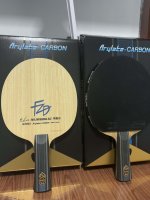
P.S. In this picture I use Victas V15 sticky but I feel it's lack of durability so I change to D09c and it feels much better
For the past six months, my main setup has been the Fan Zhendong (FZD) ALC paired with Dignics 09c (2.1mm) on my forehand and Dignics 05 (2.1mm) on my backhand (i will call D09c and D05) .
The FZD ALC has a very famous 5+2 structure: Koto, ALC, Limba, Kiri, Limba, ALC, and Koto. Yes, this is the exact same composition as the Viscaria. A lot of people online claim that the FZD ALC feels totally different from the Viscaria, but in my experience, that "different feeling" mostly comes down to the weight.
Overall Impression If you're going to buy this blade, I highly recommend finding one that weighs 90+ grams. The heavier ones just feel much more solid upon impact compared to the lighter batches. To me, the biggest actual difference between the FZD ALC and the Viscaria is the handle. The FZD handle is noticeably thicker and fuller. If you have bigger hands or just never liked the somewhat thin Viscaria grip, the FZD ALC is a massive upgrade in terms of comfort.
Key Strengths & Weaknesses So, how does it play? As I mentioned, I use D09c and D05, and I found that the FZD ALC pairs perfectly with medium-hard to hard sticky rubbers. It’s fast, but what really impressed me is how controllable it is. Looping and blocking feel very great . When I use my footwork to step around and commit to a full-power forehand stroke, the ball still lands safely on the table with heavy spin. It just gives you this great sense of safety. I actually tried the Viscaria Super ALC with the exact same rubbers. While the Super ALC gives you crazy power and a bigger sweet spot, I honestly felt I couldn't control the ball as well. The standard ALC in the FZD is much safer when you want to swing at 100% power without fear of overshooting.
It’s not completely perfect, though. The biggest weakness is the physical finish of the blade neck. Out of the box, the edges near the handle are way too sharp. You will absolutely need to use some sandpaper to sand down the wings; otherwise, it will hurt your fingers during long practice sessions. Also, if your game relies mostly on passive blocking, you might prefer an inner-carbon blade.
Clear Recommendation To wrap this up, the Fan Zhendong ALC is the most well-balanced blade I have ever used when it comes to speed, spin, and control. I highly recommend it to intermediate and advanced players who love an aggressive, topspin-heavy game. It's a fantastic, reliable blade that lets you play your shots with pure confidence.
P.S. In this picture I use Victas V15 sticky but I feel it's lack of durability so I change to D09c and it feels much better
- Speed
-
8.5
- Control
-
9
- Hardness
-
9
- Durability
-
9
Attachments

deepanmania
After EJing around a lot of blades, I still come back to my trusty FZD ALC and D09c combo.
Is this the holy grail of outer ALC blades? A refined Viscaria?
Is this the holy grail of outer ALC blades? A refined Viscaria?

NewGuyHere
I plan to upgrade to FZD ALC with D09c and D05.
But thinking to get D05 1.9mm or D09c 2.1mm on the BH for more control.
I like D09c on FH but not quite sure about D05 2.1mm on BH.
But thinking to get D05 1.9mm or D09c 2.1mm on the BH for more control.
I like D09c on FH but not quite sure about D05 2.1mm on BH.

