This user has no status.

This user has no status.




everyone knows how to feed (i mean kids already feed to each other), you don't need to learn that, or atleast I don't see anyone teaching any kids how to feed.Two things you can do to greatly increase your odds:
1) Learn to feed multiball
trust me, if you do that, the pros will be very impressed2) You don't impress a pro by blasting the ball past them.


The Andro guy ?Also my friend and coach, Akifumi Hamakawa used to be Mima Ito's practice partner and he told me"in Japan, they require a very specific skill at a specific time"
isn’t ball feeding also a skill? timing and how to make different spin?everyone knows how to feed (i mean kids already feed to each other), you don't need to learn that, or atleast I don't see anyone teaching any kids how to feed.
trust me, if you do that, the pros will be very impressed
I only seen male partners do it to female players, I haven't seen much of that happening with the same gender haha
since this thread is about professionals or semi professionalisn’t ball feeding also a skill? timing and how to make different spin?
i find feeding ball very good for hand feeling and ball placement. my serve has improved really fast after my coach taught me how to feed the ball properly.

well ... I was semi-professional / professional - the only thing I couldn't do, was feed multiball. have no idea why, I just couldn't do it. and I am not the only one ... in my club, maybe 2-3 players out of what, 15-20 were able to do it properly ... so I think it's not such an easy task ...since this thread is about professionals or semi professional
everyone has feeling
kids all feed to each other for many years,
only different is if they are robot and just feed, or they also monitor the player and push the player in the feed. that is the different between a quality feed and just human robot feed (feeding with no thinking)
hmm are you saying any semi pro or pro can feed multiball?since this thread is about professionals or semi professional
everyone has feeling
kids all feed to each other for many years,
only different is if they are robot and just feed, or they also monitor the player and push the player in the feed. that is the different between a quality feed and just human robot feed (feeding with no thinking)
yep, I have not met a single junior player in our system that can't feed, (i'm in the 16~18 year old space)hmm are you saying anyone can feed multiball?
wow,well ... I was semi-professional / professional - the only thing I couldn't do, was feed multiball. have no idea why, I just couldn't do it. and I am not the only one ... in my club, maybe 2-3 players out of what, 15-20 were able to do it properly ... so I think it's not such an easy task ...
quite the contrary - it was always one of the coaches feeding the multiball, because it was also a process of fixing the mistakes ... because sometimes, hard repetition is needed to fix some deeply embedded mistakes in stroke techniques. sometimes when you are in a drill, at the beginning it is easy to do the proper stroke, but once you are pushed to the limit, the it's harder to control and mistake(s) keep(s) creeping back in. so with this drills we eliminated (more or less successfully) many mistakes. maybe that is also why we had best technique at the time (we were also 3 time team national champions in junior and youth categories and we were also basically all top 10 players in respective categories at the time).wow,
do you guys just don't use enough multiballs in your younger days?
we put 2 players per table, and they do drills and when comes to multiball, they feed to each other.
its like this since elementary school age.
multiball is really in the dna and if you cannot feed, no one will want to train with you.
PS. I have had international players who come and train in Taiwan, and they also can't feed or bad at feeding. Maybe only the coaches feed?
that's my quality (still, was back in the young days and it is still now where we play mostly for fun, but I do help my team-mates to fix a glitch here and there - they are all non-professional, self-thought players).we also have coaches feeding, but there is normally 1 coach to 3 or 5 tables, so many other tables need to feed by itself.quite the contrary - it was always one of the coaches feeding the multiball, because it was also a process of fixing the mistakes ... because sometimes, hard repetition is needed to fix some deeply embedded mistakes in stroke techniques. sometimes when you are in a drill, at the beginning it is easy to do the proper stroke, but once you are pushed to the limit, the it's harder to control and mistake(s) keep(s) creeping back in. so with this drills we eliminated (more or less successfully) many mistakes. maybe that is also why we had best technique at the time (we were also 3 time team national champions in junior and youth categories and we were also basically all top 10 players in respective categories at the time).
as for my qualities - I am this impenetrable living wall, I can block and control ... as long as we drop down.
wow, no wonder we are lagging in Europe ...we also have coaches feeding, but there is normally 1 coach to 3 or 5 tables, so many other tables need to feed by itself.
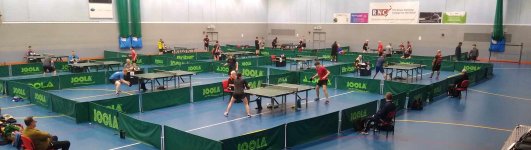
here is one of coaches feeding, you could see in the background, players feeding to each other.
joking, probably, it's same in other high-quality places around the world, but one thing I never seen is practicing doubles with multiball, that's a thing I have never seen before ...there is some doubles herewow, no wonder we are lagging in Europe ...
we did practice against single player, but never in multiball ...
on the other hand, maybe I will invest some time into feeding multiball, maybe I just need some practice ...
haha, I didn't even notice that in the video, but yeah, another video i'm making has some double training drillsforgot to say, I could already see it in the first video, in the right corner in the back ... amazing!
I always liked to play doubles, basically got my best results in doubles ...

You dedicate many years of life to hard daily training, your family gives you (moral and financial!) support throughout that time, etc. If you're lucky, you become one of the best players in your country, but still, sadly, you fail to become a national team member - e.g. because your peers simply showed better results in tournaments, or because you had a small injury, etc doesn't really matter why, so you become a practice partner to national team players.In any country