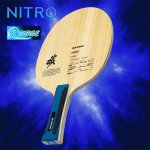

How to feel feedback with low dwell Koto

This user has no status.
🏆 Top 1% Commenter
Well-Known Member
Jan 2024
2,208
2,885
6,904
Read 2 reviews
I have a Koto blade in the form of a Yinhe Pro 01 and I like a lot about it, except that I am very much used to softer, limba topped blades.
On limba, the feeling of engaging a rubber well for a topspin has a certain feeling that I've just completely gotten accustomed to. This is the same on allwood (Korbel, but also Appelgren, Clipper, even the Offensive Classic which I didn't like much at all) and inner fibered Pro 05. I can just feel the ball getting grabbed by the rubber and engaging, deforming the sandwich.

On a Waldner Legend Carbon, with Hinoki top, the feeling is kind of similar. The contact feels a bit smoother, but it's kind of the same. This is a fast blade but it still has that dwell apparently.

Now the Pro 01, and my late beech-topped Donic Waldner Impuls 6.5 (not new Impuls) share a characteristic of the ball leaving the bat quickly. So far, I have found it difficult to judge the feedback from these blades, even though the Impuls was allwood (thin 7ply actually, it was quite a particular blade).

Thing is, when I played the Impuls I didn't know anything about the materials. I bought it off a club mate who said it was too fast for him and only now do I think I know what he meant by that. I didn't even know there was such a thing as harder and softer surfaces on blades back then. But nowadays, Pro 01 reminds me of that blade.
It's a blade that I did like, even if I never really understood why it played so differently. Which leads me to want to give this a better shot using Pro 01.

Long story short, I'm looking for tips in recognising feedback on Viscaria type blades.

Since the ball is off the bat quickly, does it help to start with thinner brushing contact? Do you focus more on sound rather than feeling?
Or is it really more a matter of committing to the shots so I go through the ball enough to feel the feedback better?
 
This user has no status.
🏆 Top 1% Commenter
Well-Known Member
Oct 2022
5,612
2,820
8,886
I have a Koto blade in the form of a Yinhe Pro 01 and I like a lot about it, except that I am very much used to softer, limba topped blades.
On limba, the feeling of engaging a rubber well for a topspin has a certain feeling that I've just completely gotten accustomed to. This is the same on allwood (Korbel, but also Appelgren, Clipper, even the Offensive Classic which I didn't like much at all) and inner fibered Pro 05. I can just feel the ball getting grabbed by the rubber and engaging, deforming the sandwich.

On a Waldner Legend Carbon, with Hinoki top, the feeling is kind of similar. The contact feels a bit smoother, but it's kind of the same. This is a fast blade but it still has that dwell apparently.

Now the Pro 01, and my late beech-topped Donic Waldner Impuls 6.5 (not new Impuls) share a characteristic of the ball leaving the bat quickly. So far, I have found it difficult to judge the feedback from these blades, even though the Impuls was allwood (thin 7ply actually, it was quite a particular blade).

Thing is, when I played the Impuls I didn't know anything about the materials. I bought it off a club mate who said it was too fast for him and only now do I think I know what he meant by that. I didn't even know there was such a thing as harder and softer surfaces on blades back then. But nowadays, Pro 01 reminds me of that blade.
It's a blade that I did like, even if I never really understood why it played so differently. Which leads me to want to give this a better shot using Pro 01.

Long story short, I'm looking for tips in recognising feedback on Viscaria type blades.

Since the ball is off the bat quickly, does it help to start with thinner brushing contact? Do you focus more on sound rather than feeling?
Or is it really more a matter of committing to the shots so I go through the ball enough to feel the feedback better?
I've been playing with Pro 01. I use slow, dwelly rubbers on it to try to compensate for the hard koto outer construction.
 
  • Like
Reactions: greenbeanmachine
says Leave the righteousness to me.
🏆 Top 1% Commenter
Well-Known Member
Nov 2020
1,611
1,467
6,999
Long story short, I'm looking for tips in recognising feedback on Viscaria type blades.

Since the ball is off the bat quickly, does it help to start with thinner brushing contact? Do you focus more on sound rather than feeling?
Or is it really more a matter of committing to the shots so I go through the ball enough to feel the feedback better?


I'd not try to sacrifice 1um from the technique, I'd not think about changing contact at all, it would be contra-productive. Focus on movement, technique, ball, opponent, let the sound or feeling in hand be secondary. Simply the fact that you're playing with another blade will give you chance to recognize the differences, and so on with other blades. You get more clarity.

Getting slower linear rubber like H3 might help with such blade if you are committed to play with it. For me, my Viscaria has less dense, more absorbing core, than my main blade, and paradoxically it is better in receive. But in power FH topspin shots, the outer carbon makes it shoot more low, and I don't want that - I mean the difference is not that big, I just prefer inner-carbon type.

Bottomline: When one wants to use a fast blade one needs to have a fast brain and a fast hand 😂
😂 😂

Yes, those quickly type the new order details...
 
This user has no status.
🏆 Top 1% Commenter
Well-Known Member
Jan 2024
2,208
2,885
6,904
Read 2 reviews
Bottomline: When one wants to use a fast blade one needs to have a fast brain and a fast hand 😂
😂 😂
Hahaha yeah so true! But, to be honest, the blade itself isn't necessarily too fast. I can play OK with it, but I haven't been able to build a real connection yet because what I normally use to get that, doesn't work in the same way here.

Yes, I can focus on technique and result, and if I do maybe I will pick up on the subtle cues eventually. I just thought I'd give it a try to see if anyone had a brilliant perspective to fast track that process.
 
says Table tennis clown
🏆 Top 1% Commenter
Well-Known Member
Apr 2020
4,666
2,963
10,850
I haven't been able to build a real connection yet because what I normally use to get that, doesn't work in the same way here.
Fair enough but let's face it this is the problem that we all have when we change blades and even when we change just rubbers.
The more drastic the difference between old and new equipment is the more difficult it can be to adjust.
Sometimes the magic will work quite quickly and of course sometimes it simply does not work at all.
I shall keep my eyes open like you, hoping someone will reveal to us the "magic bullet"
😂
 
  • Like
Reactions: Tyce
This user has no status.
🏆 Top 1% Commenter
Well-Known Member
Jan 2024
2,208
2,885
6,904
Read 2 reviews
So uhmm I wouldn't call it a magic bullet but what I just did seems to have worked well.
I just didn't play for over a week, and after that dove right in with the Pro 01. Did that clear my short term memory? I dunno.
Thing is, yes it took me a little bit to warm up, yes I managed to whack myself in the face, but I found the feeling after a while. I have to dig into the rubber with a bit more precise angle, a bit more head speed, and the speed/spin ratio needs some adjustment, but the bat is telling me, pretty clearly, when I don't hit the ball right.
It does help a lot that G1 is a pretty vocal rubber.
On the side, my footwork is pretty bad. I was out of position so many times
 
Since the ball is off the bat quickly, does it help to start with thinner brushing contact? Do you focus more on sound rather than feeling?
Or is it really more a matter of committing to the shots so I go through the ball enough to feel the feedback better?

I feel like with hard-outer blades you're looking for almost a sort of "rolling" feeling. Contacting the ball directly head-on is great for smashing and hitting power-loops, but when flicking or brush-looping you want to get the sensation of rolling the ball over the surface. There should be two phases to the hit: 1) you make a light contact where the ball rolls on the surface of your racket, allowing you some time to adjust your aim, and 2) the power in your stroke takes effect, activating the hard wood & carbon, shooting the ball off very quickly.

I think it takes a while to develop the muscle memory for this -- you need to train your touch so that it is soft until you feel the light contact, and only at this point do you tense up and release the power of your kinetic chain. Tacky rubbers help with this, for sure. I think you can very explicitly see this kind of "rolling" reflected in the technique of Ma Lin and Xu Xin.

The ideal feeling seems different compared to limba and inner-carbon blades. These blades give significant dwell when you hit the ball head-on, meaning that you can dig into the surface of the wood and hold the ball for a while. You don't get this with hard-outer blades, but you can compensate and get a bit of dwell time by rolling. This might be more of a penholder thing, idk...
 
  • Like
Reactions: Tyce
This user has no status.
Since the ball is off the bat quickly, does it help to start with thinner brushing contact? Do you focus more on sound rather than feeling?
Or is it really more a matter of committing to the shots so I go through the ball enough to feel the feedback better?
I cant stand limba blades, but i don't play with brush contact pretty much at all. For me koto and other harder outer wood have much better feeling in the fingertips. And for me it's much more important than palm vibration.

It's a matter of preference. If you find it harder to feel koto it's probably just your tendency in conceptualizing table tennis differently than people who like koto and other hard wood.

My first blade was Visc and i still find it great to learn TT. And it probably shaped my view on how blade should feel on different strokes. But most players learn tt with softer limba blades, so they just know how to use them better. You need a lot of hours to understand the feeling of vastly different structrures of the blades.

You definitely can play with a lot of force in the ball with koto, but it's hard to describe how to do it.
 
Top