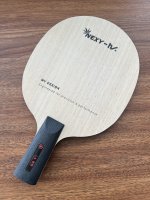
I came across a thread about Nexy’s new racket and would like to leave a comment.
My name is Oscar, and I design rackets for Nexy.
Recently, Nexy has been producing its rackets through a factory in Korea.
This is not one of the standard OEM factories that many overseas brands use.
Instead, this factory has been working with Nexy exclusively for the past four years, researching and developing new technologies together.
As I mentioned in my earlier thread, this factory now applies two innovative technologies in the production process.
The first is a process for product standardization, essential for mass production.
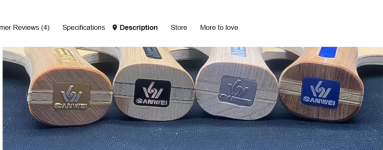
The key idea is drilling a small hole in the handle so the racket can be fixed precisely in place as it passes through various machines.
Thanks to this process, Nexy can maintain a high level of quality even in mass production.
The same hole is also used to secure the handle itself, so Nexy rackets do not suffer from loose handles.
This technology is patented.
The second innovation is the development of a new adhesive.
Every table tennis brand has long sought high-quality adhesives.
Until now, two main types have been used.
The first is water-based adhesive.
You may recall this from older Stiga rackets.
Because Stiga used water-based glue, their rackets often lacked durability and layers would separate, which was a problem for a long time.
However, they preserved the natural wooden feel, which gave those rackets their unique value.
In the 1980s, Butterfly introduced carbon-layer rackets.
These required very strong bonding, and epoxy adhesives came into play.
Gradually, the market shifted toward epoxy.
But both of these adhesives had clear drawbacks.
Water-based glue had poor durability, leading to delamination.
Epoxy was strong, but it made rackets heavier and produced an artificial feel at impact.
Still, epoxy remained the only way to achieve extremely solid bonding of the wood.
Nexy recognized these problems and began to explore new solutions.
Today, we use polyurethane adhesive, which bonds wood very firmly without adding extra weight.
Because polyurethane contains foaming properties, it can be applied without increasing mass, while also enhancing racket elasticity.
Our factory now holds a patent for this adhesive technology that allows us to adjust the trajectory of the racket.
One example is the Eiger blade, introduced in this discussion.
Eiger applies polyurethane adhesive twice, raising the trajectory.
This makes it a very unique racket.
It is true that some players who previously used the W968 have switched to Eiger.
The reputation of the W968 is well-known, so I won’t go into detail here.
Although the structures are different, Eiger delivers performance that attracts even W968 users, which explains its popularity.
Shortly after, the Rotela racket was released.
Rotela is even more suited as a true rival to the W968.
It applies both of the patented technologies described above, built with a limba outer ply and an inner-fiber construction.
Rotela now competes not only with the W968 but also, in Korea, with rackets used by Wang Chuqin and Sun Yingsha.
Many players are paying close attention to it.
I will stop here.
Thank you.





 translating the description from korean it is said that some players are switching to this from W968.