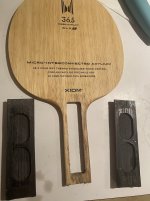
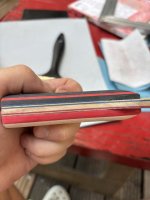
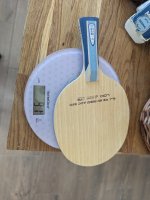
i think you dont actually understand what i mean. it is not ''STICKY STICKY'' in the sense of it being ACTUALLY sticky. but it FEELS lke that because i did actually exactly that:
using sandpaper way finer than 180. i went down all the way to 600. so the griff is so smooth polished that even tiny bits of sweat make the handle feel sticky in the same way... if you put 1 drop of water in between 2 pieces of glass.. they will stick together. that doesnt mean that the glass is actually sticky however
If you went to 600 grit (and stepped down to that grit properly from higher grit papers i.e: 120 > 180 > 240> 400> 600 grit) then you've almost certainly burnished the wood in the process.
To explain: All Wood comprises of largely the same three polymers: cellulose, hemicellulose, and lignin. Cellulose and hemicellulose fibers in the cellular walls provide the longitudinal and transverse strength the tree needs to stand up, while lignin basically acts as an extra cellular matrix binding the various strands of cellulose and hemicellulose together.
Chemically speaking, lignin is a phenolic precursor that in the presence of abrasive heat will act slightly similar to sugar - i.e. it melts and flows into microscopic gaps inbetween wood fibres (or between wood tracheids if it's a softwood), and then crystallises as it cools, much like caramel does. The abrasive action of the sand paper meanwhile has also fractured and damaged some of the outermost strands of cellulose and hemicellulose , which have them blended with the lignin to form a hard shiny shell on the outside of the wood, of indeterminate thickness. Or in other words, the outer layer of the wood ow resembles something a lot closer to baked mud bricks or a ceramic like porcelain, rather than regular wood.
If your handle scale's wood species is a particularly resinous softwood (or else a hardwood with high levels of oils and/or extractives to it) then these could have also combined with the burnished wood surface on the outside of your handle, making it even harder.
Essentially you've heat treated your handle scales to the point you've radically changed their density. That is an irreversible process unless you're willing to soak your handle in boiling caustic water until the lignin dissolves and leaches out of the timber, or else sand the stuff away again.
Additionally, as you went down to a 600 grit sand paper (which with unvarnished / unfinished timber is frankly just overkill) then there are also now a series of thousands and thousands of tiny microscopic scratches in the hard shell-like surface of the burnished wood,, that just happen to be the right diameter for capillary action to occur between the hardened wood and the sweat of your hands.
To explain: when a hard smooth surface (like fiberglass resin or burnished wood) is covered with small microscopic scratches, it has the effect of becoming like a magnet for water. When such surfaces get wet, a very thin film of water becomes trapped in the microscopic scratches,and is actually drawn up towards the wood and clings to it through the water's surface tension. Back when I was sailing and match racing competitively, we would use 400 grits and paper to sand the gel coat and/or antifouling of our boat's fibreglass hull, in order to reduce hydrodynamic drag, and get extra boat speed out of our sailing vessel through capillary action.
Basically, the thin scratches constantly held a thin film of water, and water running over water provides less drag than water running over gel coat or antifouling.
In terms of your blade, the water of your sweat is the right viscosity to be drawn up into the microscopic scratches, whereas the oil, sebum and dead skin cells from your hands are not. As a result, the sweat of your hands is actually chemically separating into its various components, through capillary action acting almost like a filter just for water.
A thin water film on its own would normally make your handle slippery, as well-burnished wood is much more hydrophobic than regular wood (ie it repels water). However, because there is also oil, sebum and dead skin cells in sweat, these items are being partially seperated out of your sweat by capillary action... Which is why your handle feels sticky, even in the absence of anything one might normally consider as adhesive.
My advice: try re-sending the handle with 180 grit, to try and break down or remove the hard shell of burnished timber. Depending on how thick and hard the burnished and densified/heat treated timber now is, this might be either very easy to do, or else extremely difficult.
Best case scenario: the layer of burnished wood is less than a millimetre thick, and is roughly the consistency and thickness of a boiled eggshell. It can therefore be sanded off without sacrificing too much wood.
Worst case scenario: the handle scales have been burnished to the point that removing the burnished wood will require removing far too much of the regular fineline timber from the handle scales. In which case, your only remaining option is to probably add grip tape to compensate for all the wood you lost from the handle through sanding the burnished wood away. Most likely however you will then need to change the handle scales entirely in order to get the blade's flex levels and throw angle back to their original state... Either that or try just wear a golfing glove on your playing hand, or using rosin on your hands, both of which should help compensate for the unpleasant playing feel of the burnished timber.
Good luck.