Thanks! That is a big question, but I’ll try to break down my chaotic process.
Basically, my design journey started with frustration.
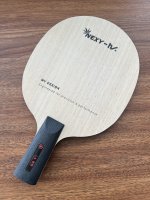
I played with Grubba All+ blade with Driver EL, when I am truly good. With new plastic ball, I am trying to look for "soul" and touch of blades like the Nittaku Acoustic and Soulspin roots, but they lacked the modern power I needed. When I looked at the market (especially the Cybershapes), I felt like innovation had stalled, everyone was using the same cores and plies as variations of viscaria and just changing the handle colors.
So I started experimenting with a few core principles:
1. The "Acoustic" Standard
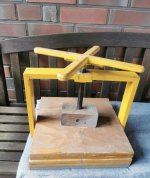
I use Liquid Hide Glue (Titebond) and Fish Glue. It’s expensive maybe to a factory, but for me, when my girlfriend screams I ruined the apartment, I can wipe the messy spot off with warm water. It also creates a crystallized bond that lets the wood "sing" rather than thud. But later to use dyneema carbon and alc. I had to use epoxy, which resulted some domestic disputes.
2. The Orientation Puzzle
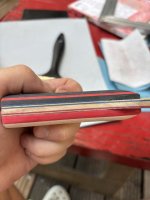
I spend a lot of time calculating ply direction.
Vertical Plies: Give you raw speed and direct power. And the blade will bend more, giving more dwell, but the sweetspot will be narrower if it's all vertical
Horizontal (Cross) Plies: Widen the sweet spot and add rigidity.
Finding the balance is the hardest part. Too many vertical plies and the blade becomes a rocket launcher with narrow sweetspot; too many cross plies and it feels stiff or like a noodle, depends on where the cross ply is.
3. The Enemy is Weight
This is my biggest struggle right now.
Unlike a factory, I can't do "Pre-Preg" carbon or high-pressure heat treatments. My early experiments with ALC/Dyneema + Hide Glue hybrids resulted in heavy blades (103g–105g) because the glue lines were too thick. The manual lamination process adds grams fast!
What's Next?
Since I can't beat the factories at making lightweight Carbon, I’m going the other way.
My next experiment is to dissolve Fish Bladder Glue pellets into a TEMPO Cellulose Nanofiber (CNF) solution. The goal is to create a "Bio-Composite" layer that is lighter than carbon but stronger than wood.
It’s a lot of trial and error (and talking to AI to double-check my chemistry), but that’s the fun of it!
Hope that answers your question.