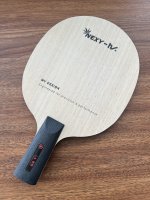
[DIY] The "Stradivarius": A 1300Hz Cybershape made with True Violin Woods (Maple/Spruce) & Hide Glue

This user has no status.
Coreywong use weight to your advantage. Newtons 2nd Law Force =Mass x Acceleration marshal artist use this when breaking things. A slower swing and a heavier paddle gives better control and more time to play your shot and a shorter return to your ready position and if you get the formula correct the same spin and speed.
Hi Coreywong Read SDC comment be prudent and only make up one board and see if you are pleased with the result.
 

SDC

This user has no status.

SDC

This user has no status.
🏆 Top 1% Commenter
Well-Known Member
Dec 2011
1,789
3,532
5,922
SDC Pre- tensioning : steel strands are tensioned before concrete is poured;they are cut after the con croncrete hardens, transferring compression by Bond. Post -tensioning : Ducts are cast into the concrete ; strands are threaded through after curing, tensioned against the hardened concrete,and then anchored. You are correct about the blades warping i had a blade cup like a half eaten orange peel but i assumed it was from the force stored in the silk.
You are correct, in my head I just read "pre-stressed" but you did use the term pre-tensioned. Pre-stressed concrete has two categories: pre and post tension. I just defaulted to post-tension...

Anyway, it's a delicate balance. If you successfully tension the fabric, it wants to return to its original position, if the forces aren't fully balanced on both sides, one will prevail.

I did experiment with pre-tension, but only with wood, not fibers.
 
  • Like
Reactions: coreywong
Coreywong I have used silk in between the veneer sheets. I use a procedure that is used in concrete reinforcement they pretension the steel reo bars and use less cement to get the same strength i stretch the silk similar to a needle point hoop . Silk is strong enough to handle the forces we apply to the ball and would follow your Luthier concept. You mentioned fish pellets I use the skin off our leather jacket fish to make handle grips. Your blades are wonderfull and reading hear i appreciate the research time and commitment you put into each blade .I did not know you could buy hide glue so i have learnt something new. A new trend you may not have seen people are using their left over rubbers instead of edge tape it looks good and your blades deserve the Best.
I had to look up those Janka numbers... 5060 lbf (Buloke)? 🤯 That's almost not wood, basically organic steel! Are those blades heavy? I am so interested in how it plays too.

You are totally right. You are building with 'Mass & Density' (Sledgehammer style), and I am trying to build with 'Geometry & Tension' (Violin style). It is fascinating that we both arrived at Silk as a solution, even from opposite ends of the spectrum.

Left over rubber on the edges? That's hilariously smart. But how do they manage the weight? That's like 5 to 10g extra right on the edge?

Re: Materials & Experimentation
If you ever want to try modern Composites (like thin Textreme Carbon, ALC, ZLC, SALC, ZLF, Dyneema Carbon, ETC.), let me know! I have access to a lot of the 'good stuff' here. I would be more than happy to mail you a few sheets to experiment with.
 
You are correct, in my head I just read "pre-stressed" but you did use the term pre-tensioned. Pre-stressed concrete has two categories: pre and post tension. I just defaulted to post-tension...

Anyway, it's a delicate balance. If you successfully tension the fabric, it wants to return to its original position, if the forces aren't fully balanced on both sides, one will prevail.

I did experiment with pre-tension, but only with wood, not fibers.
Hi SDC! It is an honor to have you in this thread. You have been my major inspiration!

The 'Orange Peel' Risk 😱
That is my biggest fear with this 'Drum Skin' silk experiment. Since I plan to use a relatively soft Hinoki core (unlike Angryballs’ Ironbark!), I assume my wood won't have the brute strength to resist the silk if the tension isn't perfectly balanced.

In your opinion, is the key to avoiding the warp simply perfect symmetry (ensuring both sides are tensioned exactly the same amount before pressing)?

Or is it safer to rely on clamping time, keeping it in the mold for 48+ hours to force the wood structure to 'accept' the new stress equilibrium before releasing it?

Pre-tensioning Wood question
You mentioned you experimented with pre-tensioning wood itself? That sounds fascinating. Were you bending the core before lamination (like a leaf spring), or stretching veneers? I’d love to hear how that played compared to a standard build.
 
What I always wonder is whether you always apply the same pressure when gluing, or whether this depends on the type of glue you use and/or the composition of the racket, wood/composite.
Hello there! Sorry I was on a business trip and took a while. I use some spring loaded wood clamps as you can see. I clamp it as tight as it gets for hide glue. Hide glue generally pull wood fibers together, so the end product is alnost always thinner than expected. For epoxy. I applied loads of pressure through f clamp and c clamps hoping to squeeze the epoxy out (didn't succeed very well). It's very rudimentary, I wish I have a pressure gauge and let me press the blade accurately.
 
This user has no status.
Member
Jan 2026
461
405
1,962
Thanks! That is a big question, but I’ll try to break down my chaotic process.

Basically, my design journey started with frustration.

I played with Grubba All+ blade with Driver EL, when I am truly good. With new plastic ball, I am trying to look for "soul" and touch of blades like the Nittaku Acoustic and Soulspin roots, but they lacked the modern power I needed. When I looked at the market (especially the Cybershapes), I felt like innovation had stalled, everyone was using the same cores and plies as variations of viscaria and just changing the handle colors.

So I started experimenting with a few core principles:

1. The "Acoustic" Standard
I use Liquid Hide Glue (Titebond) and Fish Glue. It’s expensive maybe to a factory, but for me, when my girlfriend screams I ruined the apartment, I can wipe the messy spot off with warm water. It also creates a crystallized bond that lets the wood "sing" rather than thud. But later to use dyneema carbon and alc. I had to use epoxy, which resulted some domestic disputes.

2. The Orientation Puzzle

I spend a lot of time calculating ply direction.

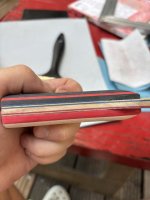
Vertical Plies: Give you raw speed and direct power. And the blade will bend more, giving more dwell, but the sweetspot will be narrower if it's all vertical

Horizontal (Cross) Plies: Widen the sweet spot and add rigidity.

Finding the balance is the hardest part. Too many vertical plies and the blade becomes a rocket launcher with narrow sweetspot; too many cross plies and it feels stiff or like a noodle, depends on where the cross ply is.

3. The Enemy is Weight
This is my biggest struggle right now.
Unlike a factory, I can't do "Pre-Preg" carbon or high-pressure heat treatments. My early experiments with ALC/Dyneema + Hide Glue hybrids resulted in heavy blades (103g–105g) because the glue lines were too thick. The manual lamination process adds grams fast!

What's Next?

Since I can't beat the factories at making lightweight Carbon, I’m going the other way.

My next experiment is to dissolve Fish Bladder Glue pellets into a TEMPO Cellulose Nanofiber (CNF) solution. The goal is to create a "Bio-Composite" layer that is lighter than carbon but stronger than wood.

It’s a lot of trial and error (and talking to AI to double-check my chemistry), but that’s the fun of it!

Hope that answers your question.

As an acoustic and fellow wood enthusiast, I really enjoyed the whole post and this comment, thanks for sharing and awesome work!
 
This user has no status.
Hello there! Sorry I was on a business trip and took a while. I use some spring loaded wood clamps as you can see. I clamp it as tight as it gets for hide glue. Hide glue generally pull wood fibers together, so the end product is alnost always thinner than expected. For epoxy. I applied loads of pressure through f clamp and c clamps hoping to squeeze the epoxy out (didn't succeed very well). It's very rudimentary, I wish I have a pressure gauge and let me press the blade accurately.
No problem, I had already forgotten my question.:) Yes, there are quite a few possibilities, of course, but I think that a press with a meter is not an unnecessary attribute for optimizing the pressing of wood/carbon, etc., and adapting it to the needs of the wood.
 
This user has no status.
@coreywong
where are you from?
Id love to try zlf, zlc and dyneema.

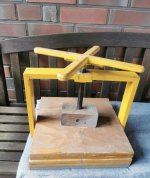
For the pressure thing I got an old book press from eBay which works great.

The top bar starts to bend up at some state, so I can messure the way it bends and this way I am able to apply similar pressure for every blade.
 

Attachments

  • Screenshot_20260128_190936_Chrome.jpg
    Screenshot_20260128_190936_Chrome.jpg
    660.5 KB · Views: 58
@coreywong
where are you from?
Id love to try zlf, zlc and dyneema.

For the pressure thing I got an old book press from eBay which works great.

The top bar starts to bend up at some state, so I can messure the way it bends and this way I am able to apply similar pressure for every blade.
hey there! your clamp looks amazing! I always wanted to get one of this, but the bulk of it for this specific purpose will get me into some trouble with my other half, so I gave up, and used the already present clamps. What kind of blades are you making? I guess you already know that the issue with ZLC and dyneema is they soak up the epoxy and became heavy, a very hectic and messy experience competing with even distribution and time.
edit: forgot the first question, I am rather complicated, that I don't know how to answer this cleanly. I am from Hong Kong, but grew up in Guangzhou China when I am young, have been living in US on and off, and I am living mostly in Taipei, Taiwan.
 
Do you have any tips for someone looking to start DIY-ing their own blades?
I don't have a tip per se, since you already asked I guess you already have lots of passion, which is the only thing you need! haha. There is something that I do miss though, is a testing/playing partner, which is rather hard to find given the thing I am doing and the stage of life I am in. I feel it could be a blessing if you have something who is happy to test the blades with you and talk about wood. Right now I mostly talk to myself and AI, and thankfully I have this forum too.
 
  • Like
Reactions: Egon
Top