The inside view, design, and construction of factory blades that come to us for repair

This user has no status.
🏆 Top 1% Commenter
Well-Known Member
Mar 2023
1,090
1,060
7,515
I’m interested in whether the handle grip plates can be easily removed when they are factory-glued. A friend has an old Viscaria that he has been playing with for more than 10 years, and the handle plate on the FH side — the one with the small Viscaria badge — is quite damaged. For now, he has a piece of cork glued there and sanded down.

He has bought new high-quality handle grip plates and would like to replace the old ones. Thank you for your answer.
Every time it's a lottery. Even in Butterfly everything is ok, but sometimes at the factory they press the handles too hard so that the wood of the blade is deformed. In this case, removing the handle without damaging the top veneer is almost impossible. The photo shows a Korbel SK7 handle, with just such a case.
It's not so clearly visible in this photo, because I took it only after removing one half and the wood inside had already started to straighten out.
1000012076.jpg
 
Last edited:
This user has no status.
🏆 Top 1% Commenter
Well-Known Member
Mar 2023
1,090
1,060
7,515
I’m interested in whether the handle grip plates can be easily removed when they are factory-glued. A friend has an old Viscaria that he has been playing with for more than 10 years, and the handle plate on the FH side — the one with the small Viscaria badge — is quite damaged. For now, he has a piece of cork glued there and sanded down.

He has bought new high-quality handle grip plates and would like to replace the old ones. Thank you for your answer.
In your case, theoretically there should be no problems, because if the blade has worked for that long, then the grip force of the handles is fine. Also, in my experience, on old blades, the glue often degrades rather than gets stronger.
 
  • Like
Reactions: returnee
This user has no status.
Member
Nov 2025
26
20
87
Thank you for your reply and the photos. I will show him the photos and your response, and then he will decide. If he decides to remove the handle plates — do you have a recommended method for doing this in order to soften the glue? Perhaps using hot air from a hair dryer first, and then slowly removing them with a thin steel scalpel blade?
 
  • Like
Reactions: Egon
This user has no status.
🏆 Top 1% Commenter
Well-Known Member
Mar 2023
1,090
1,060
7,515
Thank you for your reply and the photos. I will show him the photos and your response, and then he will decide. If he decides to remove the handle plates — do you have a recommended method for doing this in order to soften the glue? Perhaps using hot air from a hair dryer first, and then slowly removing them with a thin steel scalpel blade?
That's right. You need to warm it up well and you need to withstand the time so that the handle is warmed up all over. However, you need to not overheat it. If you bring the handle close to an industrial hair dryer at high temperature, you can set it on fire - the wood will darken.
Then you need to remove it carefully, without applying much pressure and periodically warming up the place where you removed the handle.
 
  • Like
Reactions: returnee
This user has no status.
🏆 Top 1% Commenter
Well-Known Member
Mar 2023
1,090
1,060
7,515
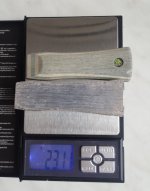
According to your experience, what is the average weight of the handle grip plates on a Viscaria blade? These brand-new handle plates weigh about 22 grams.
This is a normal weight for them. Here is the weight of the original
1000006036.jpg
 

Attachments

  • IMG-5af5d9b0e81df1d06e231252bc98bc9b-V.jpg
    IMG-5af5d9b0e81df1d06e231252bc98bc9b-V.jpg
    343.1 KB · Views: 51
  • Like
Reactions: returnee

Bob

This user has no status.

Bob

This user has no status.
New Member
Mar 2026
4
1
7
Hi Egon,
Thank you for all these details! I need help and ideas:
I have a flared innerforce too small for my hand and I'd like to add to the handle to change into anatomic. I've tried with a trash blade and seems acceptable but open to better ideas or warnings.
I experimented cork (panel in a DIY shop) and birch (matches birch) and birch fits better for me. I glued using vinyl glue. Any suggestion before I touch my babe innerforce? THANK YOU!!!!
 

Attachments

  • 20260325_175552[1].jpg
    20260325_175552[1].jpg
    880.7 KB · Views: 86
  • 20260326_084451[1].jpg
    20260326_084451[1].jpg
    266.1 KB · Views: 91
  • Wow
Reactions: belllfador
This user has no status.
🏆 Top 1% Commenter
Well-Known Member
Mar 2023
1,090
1,060
7,515
Hi Egon,
Thank you for all these details! I need help and ideas:
I have a flared innerforce too small for my hand and I'd like to add to the handle to change into anatomic. I've tried with a trash blade and seems acceptable but open to better ideas or warnings.
I experimented cork (panel in a DIY shop) and birch (matches birch) and birch fits better for me. I glued using vinyl glue. Any suggestion before I touch my babe innerforce? THANK YOU!!!!
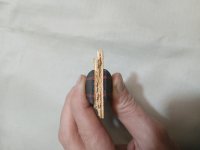
Hi, @Bob ! Personally, when the handle feels narrow, adding veneer under the existing handle works well for me. To do this, remove the handle using the method I described above, place any veneer underneath, and then glue the handle with the veneer. When extra weight is not needed, I use ayus because it's very lightweight, but if you want to change the balance of the blade, you can use heavier woods in the handle. The standard veneer thickness is 0.6 mm. On both sides this increases the handle thickness by 1.2 mm. This is often enough, but if not, you can add something thicker or another layer of veneer underneath. The advantage of this method is that, if done carefully, the blade's appearance remains virtually unchanged.
1000012192.jpg
 
Last edited:
This user has no status.
🏆 Top 1% Commenter
Well-Known Member
Mar 2023
1,090
1,060
7,515
By the way, I had the experience of replacing a very thin conical handle with a rather massive anatomical one. In the central area where the anatomical handle widens, I had to add many layers of veneer, but it all worked out. :)
1000012190.jpg
 
  • Like
Reactions: Wrighty67

Bob

This user has no status.

Bob

This user has no status.
New Member
Mar 2026
4
1
7
Hi
Thank you very much. Always very useful.
I face two problems with a added lyers: first is always a flared handle, second risks associated with the job to be done: I'm not sure I'll not "cook" the blade with heat or break something. Glueing some sticks can be reversed (almost) and gives me a better feel with an anatomic handle. I really liked the adding of veneers you told: I'll probably try this one without changing handle using a thin and flexible veneer with more than a lyer. In your last photo seems 4 layers, more than enough for me!
Which very flexible wood would you recommend to use as a patch the way I used cork?
 
Last edited:
  • Like
Reactions: Egon
This user has no status.
🏆 Top 1% Commenter
Well-Known Member
Mar 2023
1,090
1,060
7,515
Hi
Thank you very much. Always very useful.
I face two problems with a added lyers: first is always a flared handle, second risks associated with the job to be done: I'm not sure I'll not "cook" the blade with heat or break something. Glueing some sticks can be reversed (almost) and gives me a better feel with an anatomic handle. I really liked the adding of veneers you told: I'll probably try this one without changing handle using a thin and flexible veneer with more than a lyer. In your last photo seems 4 layers, more than enough for me!
Which very flexible wood would you recommend to use as a patch the way I used cork?
I don’t know, it would probably be a good idea to use ayous veneer.
 
  • Like
Reactions: Bob
This user has no status.
🏆 Top 1% Commenter
Well-Known Member
Mar 2023
1,090
1,060
7,515
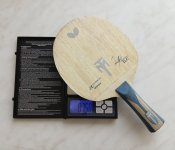
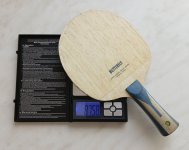
The repair process can be compared to the process of treating a person. After all, no one gets to a doctor in perfect health. Similarly, we don't get "healthy" blades.
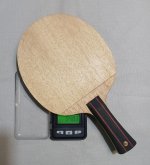
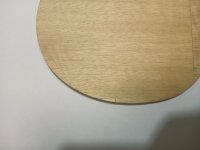
This time, a Butterfly Corbel SK7 blade had a problem: during manufacturing, the handle was pressed so hard during gluing that the wood inside the blade was deformed, the bonds within the wood weakened, and the handle broke.
We restored this blade, and now after our repair, it will definitely be better and more reliable than a new one. :)
Blade Parameters:.
Head Size - 150х157 mm
Weight - 92/95 grams
Thickness - 6,8 mm
Chord - 86 mm
Handle - Fl 100 mm in length, there are no cavities in the handle and blade itself
Frequency after repair - 1312 Hz
Balance after repair - 29 mm
1000012418.jpg
 

Attachments

  • 20260331_174416.jpg
    20260331_174416.jpg
    2.4 MB · Views: 59
  • 20260331_135117.jpg
    20260331_135117.jpg
    2.6 MB · Views: 63
  • 20260323_140409.jpg
    20260323_140409.jpg
    2.5 MB · Views: 68
  • Screenshot_20260331_194405_Spectroid.jpg
    Screenshot_20260331_194405_Spectroid.jpg
    505.9 KB · Views: 55
Last edited:
  • Like
Reactions: Julzig
says what [IMG]
says what [IMG]
🏆 Top 1% Commenter
Well-Known Member
Feb 2016
2,470
1,520
5,098
Read 2 reviews
Very cool thread, I love the addition of the frequency response graphs.

The rubber and sponge will act as a spring in series with the blade, so I wonder what the effective frequency will end up being. Due to the hysteretic nature, it will probably change, becoming higher with more deflection, won't it?

I wonder what the range is; 100Hz to 300Hz or something?
 
  • Like
Reactions: Egon
This user has no status.
🏆 Top 1% Commenter
Well-Known Member
Mar 2023
1,090
1,060
7,515
Very cool thread, I love the addition of the frequency response graphs.

The rubber and sponge will act as a spring in series with the blade, so I wonder what the effective frequency will end up being. Due to the hysteretic nature, it will probably change, becoming higher with more deflection, won't it?

I wonder what the range is; 100Hz to 300Hz or something?
For defensive blades, the frequency can start at 800 Hz. For attacking blades, it ranges from 1200 to 1700 Hz.
By the way, I added a frequency graph for SK7
 
Last edited:
says what [IMG]
says what [IMG]
🏆 Top 1% Commenter
Well-Known Member
Feb 2016
2,470
1,520
5,098
Read 2 reviews
For gaming defensive blades, the frequency can start at 800 Hz. For attacking blades, it ranges from 1200 to 1700 Hz.
By the way, I added a frequency graph for SK7
The wood only, right? I'm curious with the rubber as well. Also how nonlinear the rubber is. For me, compressing by hand, sponges and rubber seem nonlinear, and quite stiff from the first deflection. Has anyone done FEA or dynod the sponges?
 
This user has no status.
🏆 Top 1% Commenter
Well-Known Member
Mar 2023
1,090
1,060
7,515
The wood only, right? I'm curious with the rubber as well. Also how nonlinear the rubber is. For me, compressing by hand, sponges and rubber seem nonlinear, and quite stiff from the first deflection. Has anyone done FEA or dynod the sponges?
This is on a blade without rubber. Rubber muffles the sound.
I think rubber manufacturers do a lot of different analyses and tests, including on competitors' rubber.
 
Last edited:
This user has no status.
🏆 Top 1% Commenter
Well-Known Member
Mar 2023
1,090
1,060
7,515
1000012109.jpg

And this is what ZLC looks like in the Butterfly blade Timo Boll ZLC!
If you look closely, you can see that the fibers here are arranged differently than in the Xiom Stradivarius. The carbon fibers are arranged longitudinally, and the zelon is transversely, which affects the playing characteristics. In addition, the fibers appear laminated.
Parameters:.
Head Size - 150х157 mm
Weight - 85,6/87,6 grams
Thickness - 5,5 mm
Chord - 86 mm
Handle - Fl 100,5 mm in length, there are no cavities in the handle and blade itself
Frequency after repair - 1465 Hz
Balance - 26 mm
 

Attachments

  • 20260414_085509.jpg
    20260414_085509.jpg
    2.5 MB · Views: 74
  • 20260414_085456.jpg
    20260414_085456.jpg
    1.9 MB · Views: 71
  • 20260414_143657.jpg
    20260414_143657.jpg
    1.2 MB · Views: 66
  • Screenshot_20260413_195737_Spectroid.jpg
    Screenshot_20260413_195737_Spectroid.jpg
    507.6 KB · Views: 65
Last edited:
This user has no status.
Member
Jan 2021
330
269
731
Interesting. I always thought that one of the differences between Boll series and many other Butterfly blades was that the handles have caveties (like the W5 above). The ones Ive tried have felt slightly more head heavy.
 
  • Like
Reactions: Egon
This user has no status.
🏆 Top 1% Commenter
Well-Known Member
Mar 2023
1,090
1,060
7,515
can you make a time lapse of one of your repairs? would love to see how its all done.

Also, what do you use to fill in the chipped parts around the head of the paddle?
Interesting idea, I haven't done this before, but it's never too late to learn something new. When the next blade is repaired, I'll try to do it.
We fill the chips on the edges with veneer, try to choose the veneer of the same tree as in the original - if it's koto, then koto, if it's limba, then limba, and so on. In addition, although this does not affect the playing characteristics of the repair blade at all, I still choose the direction of the fibers. I really don't like the look of the repair blade when the fibers on the patch run perpendicularly or at an angle to the longitudinal fibers of the surface.
By the way, there were a total of 12 patches on both sides of the Timo Boll ZLC :D
 
  • Like
Reactions: Jslick89
Top