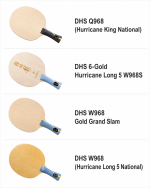

Big Upset with W968 Golden Grand Slam Version

This user has no status.
Member
Aug 2025
175
315
608
You are one of the lucky people here. And maybe your rubber replacement process is very careful, and you also use good glue. But not everyone is like that.


I agree that the Q and W series are excellent for a forehand topspin-oriented game, with a high arc and heavy spin, but they are not suitable for close-to-the-table players with a fast backhand-oriented style like mine. The main reason is that they are head-heavy, which slows down wrist usage and wrist acceleration.


In addition, blocking with this series does not provide particularly effective results either. Maybe you feel your backhand has improved because your previous backhand lacked spin, and that is exactly the outstanding advantage this series brings.


However, the key point of the modern backhand game is speed and wrist usage, especially with techniques like flicks and demi. The rebound needs to be crisp and direct, while speed is prioritized.
While this is true as a general tendency, I think it is misleading to think that everyone should go in the same direction. Speed is especially prevalent in young players, but it is far from being the only way of winning.
Even at the very top of the game you can find speed/backhand oriented (Felix, Lin Yun Ju, Harimoto), power oriented (Hugo, Alexis), spin oriented (Liang Jingkun, Gauzy), unorthodox (Truls) and balanced ones that unite all of it (Wang Chuqin - who is by far the best at the moment and a forehand player).
I think everyone, amateurs to pro, should follow their natural strengths especially, with an eye of course to the evolution of the game.
 
This user has no status.
While this is true as a general tendency, I think it is misleading to think that everyone should go in the same direction. Speed is especially prevalent in young players, but it is far from being the only way of winning.
Even at the very top of the game you can find speed/backhand oriented (Felix, Lin Yun Ju, Harimoto), power oriented (Hugo, Alexis), spin oriented (Liang Jingkun, Gauzy), unorthodox (Truls) and balanced ones that unite all of it (Wang Chuqin - who is by far the best at the moment and a forehand player).
I think everyone, amateurs to pro, should follow their natural strengths especially, with an eye of course to the evolution of the game.
I agree. Many young player plays with speed. I allways played with spin (I think people who played with the old celluloid ball were spin focused). And the young player can play with massive speed both wing, boum boum each side. Those player, I play with spinny slow ball, they strugle a lot more. I create variation, between top spin and side spin. Many time, the side spin they put it into the net.

Also, we are not pros, and we have natural playstyle. We can improve, but I think our core playstyle cannot change (unless you spend hours changing it, but it is a day job).
 
This user has no status.
You are one of the lucky people here. And maybe your rubber replacement process is very careful, and you also use good glue. But not everyone is like that.


I agree that the Q and W series are excellent for a forehand topspin-oriented game, with a high arc and heavy spin, but they are not suitable for close-to-the-table players with a fast backhand-oriented style like mine. The main reason is that they are head-heavy, which slows down wrist usage and wrist acceleration.


In addition, blocking with this series does not provide particularly effective results either. Maybe you feel your backhand has improved because your previous backhand lacked spin, and that is exactly the outstanding advantage this series brings.


However, the key point of the modern backhand game is speed and wrist usage, especially with techniques like flicks and demi. The rebound needs to be crisp and direct, while speed is prioritized.
My BH allways had spin. Instead, I gain stability in blocking with it. To me, the head heaviness actually helped me in BH. I have this inertia that allows me to "know" where my hand is, and add stabiliy to my shot. (More like a feeling, already hard to explain in my native language, so in english it is even harder) When I played Viscaria, I added weight on the top of the blade to improve that. Still I did not like. Yes the block was more direct and all, but I lacked control and precision.

I do flicks and all, but I found out that my game is better overall when I use my BH to control the game to prepare my FH, rather than being super aggressive with it. I allways had a good spinny FH, and I am better using it as much as possible. Maybe not modern TT, but it is still very effective to work on the 3rd/5th ball attack. WCQ does that (70% of his point won are before the 5th ball). HL5 and WCQ are similar.
 
  • Like
Reactions: GhostBackhand
This user has no status.
Member
Oct 2025
36
33
107
My BH allways had spin. Instead, I gain stability in blocking with it. To me, the head heaviness actually helped me in BH. I have this inertia that allows me to "know" where my hand is, and add stabiliy to my shot. (More like a feeling, already hard to explain in my native language, so in english it is even harder) When I played Viscaria, I added weight on the top of the blade to improve that. Still I did not like. Yes the block was more direct and all, but I lacked control and precision.

I do flicks and all, but I found out that my game is better overall when I use my BH to control the game to prepare my FH, rather than being super aggressive with it. I allways had a good spinny FH, and I am better using it as much as possible. Maybe not modern TT, but it is still very effective to work on the 3rd/5th ball attack. WCQ does that (70% of his point won are before the 5th ball). HL5 and WCQ are similar.
From the way you describe it, your playing style is similar to Ma Long and the older generation of players, so using the DHS Hurricane Long 5 is absolutely the right choice.

I also agree that Butterfly Viscaria lacks control and stability, but that was only when I was at a lower level. As my skills improved and handling the blade became easier, I was willing to sacrifice those aspects in exchange for the high-quality backhand that Viscaria provides.

I guess your playing distance is around mid-distance from the table, where you prioritize backhand control and use the forehand as the finishing weapon.
 
  • Like
Reactions: Kilogramme
This user has no status.
From the way you describe it, your playing style is similar to Ma Long and the older generation of players, so using the DHS Hurricane Long 5 is absolutely the right choice.

I also agree that Butterfly Viscaria lacks control and stability, but that was only when I was at a lower level. As my skills improved and handling the blade became easier, I was willing to sacrifice those aspects in exchange for the high-quality backhand that Viscaria provides.

I guess your playing distance is around mid-distance from the table, where you prioritize backhand control and use the forehand as the finishing weapon.
Exactly. Well, a mix of WCQ and Ma Long. I focus more on the 3rd ball 5th ball attack like WCQ, but when the point is on, I am more like Ma Long, controlling with BH to get me a ball on FH to attack. I studied a lot Ma Long recently, and it helped me improve my game a lot. Before, I was studied FZD, but it did not worked for me.

But, LJK used a 968, and he has/had one of the best BH in the world. So, I guess it works. I think it is more like power vs spin game. I do think spin still has its place in modern TT. Not power and speed only.
 
This user has no status.
Member
Sep 2022
33
19
136
Stories like this make me so angry at the companies that don't warn people. Honestly it's disgusting.

But yeah, DHS and Stiga are known for this.

Do NOT seal your blade. It will change the feeling. What you need to do is sand it. Go from low grit to high grit. Once it's all smooth, I like using a receipt (like from supermarket) and place a later of plastic over it like that.

Please look this up and once again I'm sorry that happened to you.
I've read that this is a myth, and that even a top pros won't be able to tell the difference in feeling between a properly sealed and an unsealed blade. Perhaps this myth stems from the fact that many people apply too much varnish or use the wrong type. Varnish should be applied onto the blade's surface and immediately wiped off with a paper towel. The idea is to allow it to penetrate the micro-cracks and seal them, rather than forming a film on the blade. After it dries, you can gently sand the surface with fine-grit sandpaper.

Removing rubbers is another issue. Many people remove them incorrectly by pulling them along the grain of the wood, which can cause splintering. Instead, you should gently peel the rubber off from side to side (across the grain).
 
This user has no status.
I've read that this is a myth, and that even a top pros won't be able to tell the difference in feeling between a properly sealed and an unsealed blade. Perhaps this myth stems from the fact that many people apply too much varnish or use the wrong type. Varnish should be applied onto the blade's surface and immediately wiped off with a paper towel. The idea is to allow it to penetrate the micro-cracks and seal them, rather than forming a film on the blade. After it dries, you can gently sand the surface with fine-grit sandpaper.

Removing rubbers is another issue. Many people remove them incorrectly by pulling them along the grain of the wood, which can cause splintering. Instead, you should gently peel the rubber off from side to side (across the grain).
The vernish i used once to seal my Fang Bo B2, i followed the manufacturer process (Xiom). It changed the feeling completely.
 
says what [IMG]
says what [IMG]
🏆 Top 1% Commenter
Well-Known Member
Feb 2016
2,470
1,521
5,099
Read 2 reviews
The vernish i used once to seal my Fang Bo B2, i followed the manufacturer process (Xiom). It changed the feeling completely.
Seeing as the flexion and conical stiffness of blades don't change at all from sealing, nor do their natural frequencies (Not even 1Hz), I still wouldn't understand the mechanism by which the feeling changes.

I'm fairly sure if nobody told anyone that sealing blades changes the feeling, they wouldn't get that idea in the first place.

EDIT: As a test, I put a thick layer of sealer on one blade and measured the natural frequencies. The error range just from instruments and environmental changes over the days is around 5%, but as far as I can tell, no change from the sealer itself. This makes sense to me because the wood is several hundred times stiffer than the sealer material.

I'm sure in terms of shear strength the blade changes (otherwise how would it prevent splintering) but it's probably not as big of a change as you'd think. It's just a bit of extra insurance. If you rip it off hard and longitudinally, plies are probably coming off even if you put a fairly thick poly coat on.
 
Last edited:
  • Like
Reactions: Peppa Pig
This user has no status.
Seeing as the flexion and conical stiffness of blades don't change at all from sealing, nor do their natural frequencies (Not even 1Hz), I still wouldn't understand the mechanism by which the feeling changes.

I'm fairly sure if nobody told anyone that sealing blades changes the feeling, they wouldn't get that idea in the first place.

EDIT: As a test, I put a thick layer of sealer on one blade and measured the natural frequencies. The error range just from instruments and environmental changes over the days is around 5%, but as far as I can tell, no change from the sealer itself. This makes sense to me because the wood is several hundred times stiffer than the sealer material.

I'm sure in terms of shear strength the blade changes (otherwise how would it prevent splintering) but it's probably not as big of a change as you'd think. It's just a bit of extra insurance. If you rip it off hard and longitudinally, plies are probably coming off even if you put a fairly thick poly coat on.
Well, I did not know that sealing a blade changed the feeling. I learn that it avoided splintering, that is why i tried to seal my blade. But then, the feeling changed significantly to me. + The surface was not sticky. I used white glue from Rev.N3 normal viscosity, and my boosted H3 (curved) was not stickking to the rubber, despite putting books on the rubber for hours after gluing. I started playing, and each shot the side started to lift. I had to wait for the rubber to be flat again. And still, the rubber was so easy to remove. One time, I hit the table in a short push, half the rubber removed (i had tape on the slice).
To improve, i sand it a bit, and it helped. But yeah, my sealing experience was bad.

Now that i learned more about sealing, I think I applied too many layer/thickness. The manufacturer said 3 layers. As I did. I don't have the sealant anymore, as I throw it away after seeing how bad it acted on the blade. Still, I played with the blade for 8 to 9 years.

I used this shit
vernis-pour-bois-de-tennis-de-table-xiom-i-sure.jpg
 
says what [IMG]
says what [IMG]
🏆 Top 1% Commenter
Well-Known Member
Feb 2016
2,470
1,521
5,099
Read 2 reviews
Well, I did not know that sealing a blade changed the feeling. I learn that it avoided splintering, that is why i tried to seal my blade. But then, the feeling changed significantly to me. + The surface was not sticky. I used white glue from Rev.N3 normal viscosity, and my boosted H3 (curved) was not stickking to the rubber, despite putting books on the rubber for hours after gluing. I started playing, and each shot the side started to lift. I had to wait for the rubber to be flat again. And still, the rubber was so easy to remove. One time, I hit the table in a short push, half the rubber removed (i had tape on the slice).
To improve, i sand it a bit, and it helped. But yeah, my sealing experience was bad.

Now that i learned more about sealing, I think I applied too many layer/thickness. The manufacturer said 3 layers. As I did. I don't have the sealant anymore, as I throw it away after seeing how bad it acted on the blade. Still, I played with the blade for 8 to 9 years.

I used this shit
vernis-pour-bois-de-tennis-de-table-xiom-i-sure.jpg
That'd be the feeling changing from gluing, yeah. If it's loose it'll be different.

One of the functions is to make the adhesion a bit lower so it peels off easier. You can (and should IMO) effectively increase adhesion by sanding the surface, although there's only so much you can do. 3 coats seems like a lot.

The manufacturer probably recommends an excessive application so that the adhesion is low and it never splinters, but you'll realistically need to experiment with your exact blade, glue and rubber. Might need to use more glue too.

It also matters a lot what you seal with, generally the stuff that actually seals the blade from moisture and doesn't just increase shear strength of the plies will also reduce surface friction a little.
 
This user has no status.
That'd be the feeling changing from gluing, yeah. If it's loose it'll be different.

One of the functions is to make the adhesion a bit lower so it peels off easier. You can (and should IMO) effectively increase adhesion by sanding the surface, although there's only so much you can do. 3 coats seems like a lot.

The manufacturer probably recommends an excessive application so that the adhesion is low and it never splinters, but you'll realistically need to experiment with your exact blade, glue and rubber. Might need to use more glue too.

It also matters a lot what you seal with, generally the stuff that actually seals the blade from moisture and doesn't just increase shear strength of the plies will also reduce surface friction a little.
The changed feeling, was a harder feeling. Limba is soft, and the sealant make it harder, kinda like koto is harder than limba. The flex, and probably the frequency remained the same, but feeling wise, it felt harder. On both wing, and i boosted only FH. But yeah, I probably did it wrong. Actually your comment is reassuring. In the future, If i want to change my GHL5 for a w968, i know that sealing (properply) should not damage the blade feeling.
 
says what [IMG]
says what [IMG]
🏆 Top 1% Commenter
Well-Known Member
Feb 2016
2,470
1,521
5,099
Read 2 reviews
The changed feeling, was a harder feeling. Limba is soft, and the sealant make it harder, kinda like koto is harder than limba. The flex, and probably the frequency remained the same, but feeling wise, it felt harder. On both wing, and i boosted only FH. But yeah, I probably did it wrong. Actually your comment is reassuring. In the future, If i want to change my GHL5 for a w968, i know that sealing (properply) should not damage the blade feeling.
If you put on a lot, it could increase the conical spring coefficient, effectively the same as making it harder. Seems like you'd need to put on a lot, though, probably a few millimeters at least. It's also unlikely the bending flex and natural frequencies would remain the same with* the conical flex changing, but I'm not gonna say it's not possible. More likely is that the measurement methods are insufficient.

I've had a few rubbers feel *very* hard just after gluing when I messed up the glue job. If the feeling changed soon, it's probably something similar.

Some day I wanna build a dyno to measure rubbers, and probably at the same time I'll build a dyno to measure blade static flexion myself. Gonna cost a ton of money and I'll need to figure out how to program and calibrate them, but I'm curious enough that I might get around to it. We'd also get curves out of that, which could expose some real differences which aren't visible with simpler methods.

*With, not without. I'd expect them all to change because they're dependent on similar things, although not at the same rate.
 
Last edited:
  • Like
Reactions: Kilogramme
This user has no status.
If you put on a lot, it could increase the conical spring coefficient, effectively the same as making it harder. Seems like you'd need to put on a lot, though, probably a few millimeters at least. It's also unlikely the bending flex and natural frequencies would remain the same without the conical flex changing, but I'm not gonna say it's not possible. More likely is that the measurement methods are insufficient.

I've had a few rubbers feel *very* hard just after gluing when I messed up the glue job. If the feeling changed soon, it's probably something similar.

Some day I wanna build a dyno to measure rubbers, and probably at the same time I'll build a dyno to measure blade static flexion myself. Gonna cost a ton of money and I'll need to figure out how to program and calibrate them, but I'm curious enough that I might get around to it. We'd also get curves out of that, which could expose some real differences which aren't visible with simpler methods.
I have never been that technical into TT equipment, but as an engineer, I find it interesting now with how you explain it. I am hanging on this forum while waiting for 3D experience to load my rocket launchpad :)
 
  • Like
Reactions: Archosaurus
Top