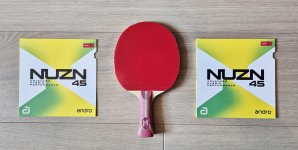
Boosting Andro NUZN ultramax?

This user has no status.
Member
Dec 2020
39
9
90
So since andro supposedly has an “ultramax” thickness option for their rubbers which I think is 2.3 mm… would boosting it almost surely make the rubber ineligible since it would exceed the overall 4mm limit?
And is max or ultramax for Esn meant to be the maximum eligible thickness for the rubber or just that it’s the maximum thickness option you can purchase from them as a customer.

would be helpful if someone can clear this up, 🙏🏻
 
This user has no status.
🏆 Top 1% Commenter
Well-Known Member
Apr 2023
1,977
1,940
8,461
The only equivalent I can think of is, Nittaku also gave G-1 "max" sponge a few years ago. Before that, the max sponge thickness was called "super thick" and it was 2.0mm. Max is therefore either 2.2 or 2.3mm (Nittaku has never explained how thick the sponge is for "max" thickness G-1).

Personally, nobody checks the overall thickness in regular club play or in local tournaments so I highly doubt it matters if after boosting, your sponge plus top sheet exceeds 4mm.

You can always try boosting NUZN with only one thin layer and measure the sponge + top sheet thickness. If it falls way below 4mm, you can try boosting it again with another thin layer, etc. You might just need to test it out yourself.

But personally, I would not worry about it, unless your club mates or the local tournament director starts pulling out rulers and starts measuring your rubber thickness.

It is a bit like the controversy of boosting or not. Most top players boost and they know it is illegal but I don't think most people care. Similarly, during the current world cup, players are finally able to challenge illegal serves but almost all of the challenges from the players are about hidden serves (hiding with the body, free arm or a big big head) but none of the challenges from the players is about how high the ball is tossed or if the ball is toss vertically or not because, well, nobody cares about the latter; they only care if they can see the ball at the point of contact on serves.

So there are things you should worry about but I don't believe exceeding 4mm would be something that you should worry about.

 
Last edited:
This user has no status.
Member
Dec 2020
39
9
90
The only equivalent I can think of is, Nittaku also gave G-1 "max" sponge a few years ago. Before that, the max sponge thickness was called "super thick" and it was 2.0mm. Max is therefore either 2.2 or 2.3mm (Nittaku has never explained how thick the sponge is for "max" thickness G-1).

Personally, nobody checks the overall thickness in regular club play or in local tournaments so I highly doubt it matters if after boosting, your sponge plus top sheet exceeds 4mm.

You can always try boosting NUZN with only one thin layer and measure the sponge + top sheet thickness. If it falls way below 4mm, you can try boosting it again with another thin layer, etc. You might just need to test it out yourself.

But personally, I would not worry about it, unless your club mates or the local tournament director starts pulling out rulers and starts measuring your rubber thickness.

It is a bit like the controversy of boosting or not. Most top players boost and they know it is illegal but I don't think most people care. Similarly, during the current world cup, players are finally able to challenge illegal serves but almost all of the challenges from the players are about hidden serves (hiding with the body, free arm or a big big head) but none of the challenges from the players is about how high the ball is tossed or if the ball is toss vertically or not because, well, nobody cares about the latter; they only care if they can see the ball at the point of contact on serves.

So there are things you should worry about but I don't believe exceeding 4mm would be something that you should worry about.
Thanks for your reply,
As for you mentioning the nittaku fastarc g1 actually the max option is really 2.1~ (not more than 2.15mm)( you find this info on their Japanese website), this is most likely because of their unusually thick top sheet for the fastarc series which has been measured and talked about on a tt forum , so this why I’m pretty much certain if someone were to boost the nittaku fastarc g-1 Max it would exceed the legal limit (haven’t tried it though)…
 
  • Like
Reactions: JJ Ng
Top