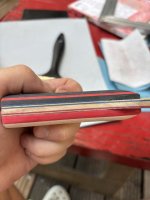
Do I need to lacquer my blade?

This user has no status.
🏆 Top 1% Commenter
Well-Known Member
Jan 2021
3,918
2,871
8,092
Read 1 reviews
I get it. but it is less slippy than dhs blade sealant?
Don’t know what DHS sealant is it contains. But I would never seal the handle regardless, it’s not necessary. I’m with upside down Karl on this, sweat makes it better and if it’s properly glued it will never detach…

Cheers
L-zr
 
This user has no status.
Member
Mar 2022
420
677
2,038
I will try and look for it as well. maybe if linseed oil on cheaper blade does not work for me...will look for the osmo oil.

Is there a way to remove sealant on other blade handle?
Short answer is just sand it off in most cases, but really it also depends on what the sealant is, and how deep it's penetrated into both the handle scales and the core woods inside the playing surface.

If it's oil based polyurethane, it's best to probably lightly sand it off, as the oil based stuff is more likely to stay on the outside surface of the wood and form a akin-like physical barrier. 🤔

If it's water-based poly though it's probably seeped much deeper into the wood than the oil based stuff. Again a light sand should do it, assuming the normal moisture content in the wood isn't too low (nb: drier wood is usually thirsty wood, and if the water based poly was very thin stuff, it could have gone 1, 2 or even 3mm deep or more into the wood, in which case you'll never get rid of all if it, but you don't really need to either, as a light sanding will still get rid of most of it on the outermost layers 🤔

I'd definitely stay away from all solvent-based sealant remover / paint stripper products if I were you. Apart from the awful stink and health risks, there's a very good chance the glues in your blade will start to dissolve as well, increasing the risk of your outer veneers lifting in some spots. 🤔🤔

With drying oil based sealants (linseed & tung oil, Danish oil, etc) again they can penetrate quite deep into the wood at times, as a lot of commercial products have a fair amount of thinners in them (which also increases the possibility of lifting your outer veneers if the outermost glue lines are a bit dodgy.) Once again a gentle sand should do the trick, just really watch out for your core wood layer, as this is typically the softest & lowest density wood in a blade, and will sand away very quickly as a result. Poly based sealants tend to stiffen the core wood's outer layer so it's a bit more impervious, but drying oils don't toughen the wood as much. 🤔

If it's a burnish seal or if it's been sealed with super glue / cyanoacrylate, or (even worse) an epoxy based product, then basically good luck with that. In all the above cases there's a good chance of you losing a fair amount of wood if you try to sand all of the sealant off, and while acetone will weaken the super glue sealant nicely it'll also definitely dissolve the wood dye in your handles as well and attack your scale glue too (...yet to find a good way around these ones myself).

If it's sealed with something like Osmo oil, beeswax candle wax or canuba wax then it's a bit easier... With Osmo oil, most of the wax outer layer will come off with a metal scraper. You can then use some localised gentle heat and 240 grit to remove the residual bits if you like. The drying-oil based layer underneath it will remain impregnated in the wood, but it's really not necessary to remove that.

Hope this helps.

 
Last edited:
This user has no status.
Member
Mar 2022
420
677
2,038
@Wakkibatty I have another question. Is Osmo oil also good for Hinoki?
I imagine it should be just fine, yeah. 🤔 I admit I've never used Original Osmo oil on Hinoki myself, as I only work with Hinoki very rarely. Osmo oil is useable on both hardwoods and softwood species though, and Hinoki falls into the latter category, so it should be all okay.

Actualky 🤔 all that being said, from memory Hinoki can have a reasonably high level of natural oils / extractives to it on occasion. In which case you may wish to either give the timber a very quick wipe down with a little turps / white spirit immediately before oiling it in order to ensure it dries properly -- or even better, use Osmo's dedicated product designed for more resinous timber species.

Hang on a minute, and let me go check first ... You've got me thinking now, so I want to make sure I'm not guiding you wrong here....

(Afk- brb)


...okay then:

Far as I can tell, it should work just fine. Original Osmo oil (the stuff I use) can safely be used on resinous softwoods like maritime pine and Douglas Fir, so Hinoki and cypress should both be fine.

While Hinoki doesn't appear to be quite as resinous a softwood as most pine species are, from what I can tell, the composition of Hinoki's oils & extractives still seems to feature some of the same terpines & phenols I often see in a fair few coniferous softwoods. It's also only flagged as being unsuitable with dark resinous hardwoods -- there's specifically no mention of any issues with any genus of cypress etc, so on that basis, I imagine it should be just fine.

(They do however recommend testing Osmo oil on an inconspicuous spot first if you're in any doubt, which is standard procedure really, and very sound advice).

NB: just be aware that as Osmo oil has a large wax component to it, it will probably also suppress / hide the usual lovely lemon-like woody scent you get from Hinoki.

Again, having never used it on Hinoki myself I can't categorically say it will work perfectly, so for that reason you proceed to use it at your own risk. That said, all the usual checks failed to turn up any major red flags, so I honestly cannot see any reason why it would not work (...unless your Hinoki piece is full of iron nails or something, in which case you should definitely avoid Osmo oil to avoid any rust stains forming).


Sources / References:

Hinoki Oil Contents:


Osmo Oil's suitability for resinous softwoods:


Last edited:
This user has no status.
🏆 Top 1% Commenter
Well-Known Member
Jan 2015
1,491
222
1,802
Sorry i come here late, but i have just simple question regarding sealing the handle.

Do i need to seal the handle knowing that maybe the blade quality isn't on par with high end names? I always use handle grip so i don't worry about slippery, but i worry about splintering and fading, mostly if i use the grip and no sealing then the wood is getting like tore off, i didn't seal the handle at all, but i found out with few blades that after a while either with grip or without a grip that the wood isn't holding much as outer surface on some parts, i sweat and my hand is not very much steady so i always prefer the grip, but the stickiness of the grip is also causing the wood to be faded or getting apart slightly, and if i keep gripping it again and again then it is likely the handle wood will be in bad shape a bit so i must always keep it with grip to hide that, but then if i sell the blade to others it won't be a good condition.
 
Top