Form is simply a means of consistency (a physics based approach)

This user has no status.
Member
Dec 2024
21
32
84
I'm posting here mostly to jot my thinking down and see if others have had similar ideas.

I've found that reducing ping pong to a simpler physics model has helped me understand the game way better. Note that I'm ~intermediate and this is intended for beginner / intermediate level.

Given an incoming ball with:
  • velocity (3D vector + linear speed), and
  • spin (3D rotational vector about the centre + rotational speed),
we can reduce the "shot" to a couple variables in our control:
  1. contact point on the ball
  2. relative speed of racket along the tangent (where, tangent is described as the vector along the surface of the ball)
  3. relative speed of the racket along the normal (where, normal is described as the vector between the contact point and the centre of the ball)
  4. when along the ball's arc to execute the shot
NB:
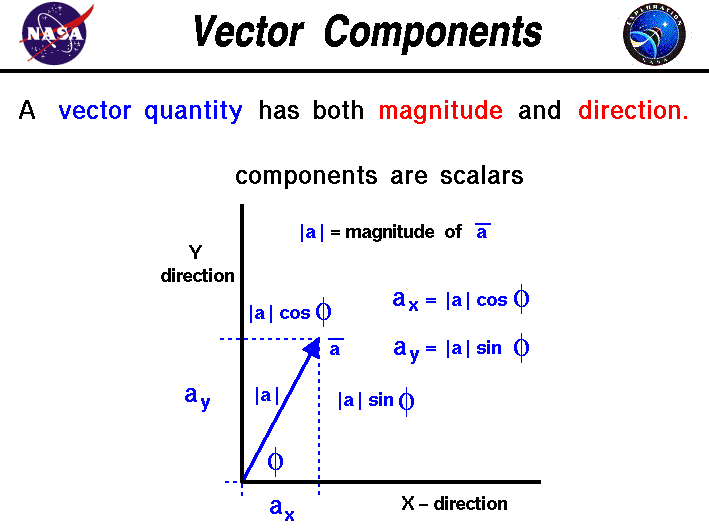
  • racket motion is "componentized" (def). This is typically understood as how much you are "brushing" vs "hitting" the ball. It's simply: how fast is racket moving "along the surface", and how fast "into the ball".
    vectpart.gif
  • Incoming speed + spin is definitely a factor, so I use "relative speed" as it relates to the incoming values. I.e. heavy underspin balls will need a different set of variables (contact point, speed_tangent and speed_normal) vs light underspin.
  • I use speed here vs. force, since the mass of the ball is negligible in this model
  • There are tons of assumptions i'm not stating for simplicity purposes (ball/topsheet/sponge/blade deformation + reaction + vibration, etc).
Back to the model, so with these 4 variables, in theory you're able to craft any shot you want. In practice it's harder of course. It begs the question: (1) How can I identify what motion to apply and where, and (2) how can I execute it consistently?

The former question (1): I believe this is a pattern recognition problem. So just seeing more balls and trying and playing around – this is how you develop your "repertoire of shots".

For the latter question (2): you can think of your "form" is a consistent means to get you these 3 things. The question becomes:
  • How can I position my body to reach my contact point with the motion that I want?
  • How can I leverage my tools to achieve the racket motion?
    • Tools: legs, hips, core, shoulder, arm, forearm, wrist, fingers
  • How can I consistently time it?
Cues like wrist snap, blade angle, "power from the legs", "pushing down on the ball", "follow through", all of that are mental models for you to achieve these 4 things. This physics approach helps me cut through the noise of advice. I've learned to tune out others' advice, as our bodies, minds, and journeys are all unique.

A practical example:
Short heavy underspin to backhand side. I could do the "FZD BH flick", coiling my body and arm system, and skimming the very top of the ball at its apex:
  • Contact point: almost top of the ball (y-axis), slight bias towards me (z-axis) and maybe on the left side (right hander) (x-axis)
    • as a result racket angle is almost flat.
  • relative tangential speed: very high
  • relative normal speed: very low
  • Contact time: apex (at highest point, not early not late)
But this is a low percentage shot for me (noob). Thusly, i can tweak these knobs and still get the ball over, with more consistency.
  • Contact point: 30% down from the top (y-axis). at 11 o'clock (slight bias for left side) (x-axis). and about 25% in from the point closest to me (z-axis).
    • as a result, racket angle ends up maybe 30deg above the horizon.
  • relative tangential speed: high
  • relative normal speed: low-medium
  • Contact time: slightly early
To do this, I don't have to coil as much as FZD. I generate force from my legs to push my hips out while engagint my shoulder to whip my (loosely held) wrist quickly to generate that tangential force. I don't need to think about normal force as it happens on its own with the BH motion.

What do you think? Over-reductive? Too complex? Obvious?

What got me thinking about this model is the fantastic drupe pong series on physics.
 
Last edited:
says Fighting the EJ bug again...
Member
Mar 2025
369
516
2,322
Read 1 reviews
I think you're hitting at the crux of the game mechanics but the calculations (even if mental, and not actually mathematical) are way too complex for most folks. There's also the effect rubber has on these calculations, which can't be ignored. That said for people who think in math/physics terms regularly, it could perhaps help with visualizing certain shots. But I can't imagine it being any more than a tool for figuring out how to play your shots in general, not in real-time.
 
This user has no status.
🏆 Top 1% Commenter
Well-Known Member
Sep 2022
2,093
2,108
8,560
I'm posting here mostly to jot my thinking down and see if others have had similar ideas.

I've found that reducing ping pong to a simpler physics model has helped me understand the game way better. Note that I'm ~intermediate and this is intended for beginner / intermediate level.

Given an incoming ball with:
  • velocity (3D vector + linear speed), and
  • spin (3D rotational vector about the centre + rotational speed),
we can reduce the "shot" to a couple variables in our control:
  1. contact point on the ball
  2. relative speed of racket along the tangent (where, tangent is described as the vector along the surface of the ball)
  3. relative speed of the racket along the normal (where, normal is described as the vector between the contact point and the centre of the ball)
  4. when along the ball's arc to execute the shot
NB:
  • racket motion is "componentized" (def). This is typically understood as how much you are "brushing" vs "hitting" the ball. It's simply: how fast is racket moving "along the surface", and how fast "into the ball".
    vectpart.gif
  • Incoming speed + spin is definitely a factor, so I use "relative speed" as it relates to the incoming values. I.e. heavy underspin balls will need a different set of variables (contact point, speed_tangent and speed_normal) vs light underspin.
  • I use speed here vs. force, since the mass of the ball is negligible in this model
  • There are tons of assumptions i'm not stating for simplicity purposes (ball/topsheet/sponge/blade deformation + reaction + vibration, etc).
Back to the model, so with these 4 variables, in theory you're able to craft any shot you want. In practice it's harder of course. It begs the question: (1) How can I identify what motion to apply and where, and (2) how can I execute it consistently?

The former question (1): I believe this is a pattern recognition problem. So just seeing more balls and trying and playing around – this is how you develop your "repertoire of shots".

For the latter question (2): you can think of your "form" is a consistent means to get you these 3 things. The question becomes:
  • How can I position my body to reach my contact point with the motion that I want?
  • How can I leverage my tools to achieve the racket motion?
    • Tools: legs, hips, core, shoulder, arm, forearm, wrist, fingers
  • How can I consistently time it?
Cues like wrist snap, blade angle, "power from the legs", "pushing down on the ball", "follow through", all of that are mental models for you to achieve these 4 things. This physics approach helps me cut through the noise of advice. I've learned to tune out others' advice, as our bodies, minds, and journeys are all unique.

A practical example:
Short heavy underspin to backhand side. I could do the "FZD BH flick", coiling my body and arm system, and skimming the very top of the ball at its apex:
  • Contact point: almost top of the ball (y-axis), slight bias towards me (z-axis) and maybe on the left side (right hander) (x-axis)
    • as a result racket angle is almost flat.
  • relative tangential speed: very high
  • relative normal speed: very low
  • Contact time: apex (at highest point, not early not late)
But this is a low percentage shot for me (noob). Thusly, i can tweak these knobs and still get the ball over, with more consistency.
  • Contact point: 30% down from the top (y-axis). at 11 o'clock (slight bias for left side) (x-axis). and about 25% in from the point closest to me (z-axis).
    • as a result, racket angle ends up maybe 30deg above the horizon.
  • relative tangential speed: high
  • relative normal speed: low-medium
  • Contact time: slightly early
To do this, I don't have to coil as much as FZD. I generate force from my legs to push my hips out while engagint my shoulder to whip my (loosely held) wrist quickly to generate that tangential force. I don't need to think about normal force as it happens on its own with the BH motion.

What do you think? Over-reductive? Too complex? Obvious?

What got me thinking about this model is the fantastic drupe pong series on physics.
Interesting angle.

I'm not gonna pretend I understand or can critique the calculations.
I would say it is an intelligent deconstruction of the game in a way to isolate the core mechanical componentry. Maybe it's correct, maybe not. If there are things/factors that unconsidered, ommitted or wrongly calculated I am not the guy to point them out.

I would think tho, that for most people it probably won't help their game to think of it in this way. It's just too complicated and excludes the human, emotional, situational, and environmental aspects of the game and all need to be included.

Like, does knowing mechanically and scientifically, every single aspect of how your cars engine and gearbox works make you a better driver?
Or does driving it, experiencing it and learning it through feel make you a better driver?
I think someone can learn to drive equally well if they have no clue about how a car works 🤷
Maybe my analogy doesn't match perfectly but you get my drift 😉
 
This user has no status.
Member
Dec 2024
21
32
84
Like, does knowing mechanically and scientifically, every single aspect of how your cars engine and gearbox works make you a better driver?
Or does driving it, experiencing it and learning it through feel make you a better driver?
I think someone can learn to drive equally well if they have no clue about how a car works 🤷
Maybe my analogy doesn't match perfectly but you get my drift 😉

great point! i get your drift ;);)

I would say the end state of "better driver" is a bit too general. Let's instead pose a specific case:
  • E.g. driving a car in snowy conditions, i attempt to take a turn and I slide, resulting in a wide turn. Knowing that objects in motion tend to stay in motion (car wants to continue straight), and the traction between the tires and the floor is lessened due to the snow, i might diagnose that that turn was too fast for the current conditions.
  • I know this example is a bit simplified but this is an example of how understanding the underlying mechanics can help diagnose what went wrong. This can easily be scaled to F1 drivers, who might have varying levels of traction in varying conditions where every inch matters.

overall, i think my post should have clarified this: this is theory. my hope is that once one gains an understanding of this, then shot-making (figuring out why something works vs. why not) becomes much easier. Definitely not calculating these things in real-time; otherwise I'd be Sony's Ace robot.

How this helps me is that I can diagnose the real issues, rather than chasing red herrings from one-liners i've heard from "ping pong form doctors" on the internet.
  • E.g. when a ball goes into the net, instead of jumping straight to "I didn't follow through" or "i didn't use my legs enough" (i.e. typical advice you'd hear), I can start with: I didn't brush the ball fast enough, and diagnose from there. what is my biggest lever to get my racket faster brushing?
And i definitely acknowledge – everyone learns differently. I think knowing theory can serve everyone to some degree, but I definitely am a Theory Enjoyer.
 
says Making a beautiful shot is most important; winning is...
🏆 Top 1% Commenter
Well-Known Member
Mar 2021
4,863
5,770
12,142
I'm posting here mostly to jot my thinking down and see if others have had similar ideas.

I've found that reducing ping pong to a simpler physics model has helped me understand the game way better. Note that I'm ~intermediate and this is intended for beginner / intermediate level.

Given an incoming ball with:
  • velocity (3D vector + linear speed), and
  • spin (3D rotational vector about the centre + rotational speed),
we can reduce the "shot" to a couple variables in our control:
  1. contact point on the ball
  2. relative speed of racket along the tangent (where, tangent is described as the vector along the surface of the ball)
  3. relative speed of the racket along the normal (where, normal is described as the vector between the contact point and the centre of the ball)
  4. when along the ball's arc to execute the shot
NB:
  • racket motion is "componentized" (def). This is typically understood as how much you are "brushing" vs "hitting" the ball. It's simply: how fast is racket moving "along the surface", and how fast "into the ball".
    vectpart.gif
  • Incoming speed + spin is definitely a factor, so I use "relative speed" as it relates to the incoming values. I.e. heavy underspin balls will need a different set of variables (contact point, speed_tangent and speed_normal) vs light underspin.
  • I use speed here vs. force, since the mass of the ball is negligible in this model
  • There are tons of assumptions i'm not stating for simplicity purposes (ball/topsheet/sponge/blade deformation + reaction + vibration, etc).
Back to the model, so with these 4 variables, in theory you're able to craft any shot you want. In practice it's harder of course. It begs the question: (1) How can I identify what motion to apply and where, and (2) how can I execute it consistently?

The former question (1): I believe this is a pattern recognition problem. So just seeing more balls and trying and playing around – this is how you develop your "repertoire of shots".

For the latter question (2): you can think of your "form" is a consistent means to get you these 3 things. The question becomes:
  • How can I position my body to reach my contact point with the motion that I want?
  • How can I leverage my tools to achieve the racket motion?
    • Tools: legs, hips, core, shoulder, arm, forearm, wrist, fingers
  • How can I consistently time it?
Cues like wrist snap, blade angle, "power from the legs", "pushing down on the ball", "follow through", all of that are mental models for you to achieve these 4 things. This physics approach helps me cut through the noise of advice. I've learned to tune out others' advice, as our bodies, minds, and journeys are all unique.

A practical example:
Short heavy underspin to backhand side. I could do the "FZD BH flick", coiling my body and arm system, and skimming the very top of the ball at its apex:
  • Contact point: almost top of the ball (y-axis), slight bias towards me (z-axis) and maybe on the left side (right hander) (x-axis)
    • as a result racket angle is almost flat.
  • relative tangential speed: very high
  • relative normal speed: very low
  • Contact time: apex (at highest point, not early not late)
But this is a low percentage shot for me (noob). Thusly, i can tweak these knobs and still get the ball over, with more consistency.
  • Contact point: 30% down from the top (y-axis). at 11 o'clock (slight bias for left side) (x-axis). and about 25% in from the point closest to me (z-axis).
    • as a result, racket angle ends up maybe 30deg above the horizon.
  • relative tangential speed: high
  • relative normal speed: low-medium
  • Contact time: slightly early
To do this, I don't have to coil as much as FZD. I generate force from my legs to push my hips out while engagint my shoulder to whip my (loosely held) wrist quickly to generate that tangential force. I don't need to think about normal force as it happens on its own with the BH motion.

What do you think? Over-reductive? Too complex? Obvious?

What got me thinking about this model is the fantastic drupe pong series on physics.
Your post reminded me of this...
 
  • Haha
Reactions: latej and pongguy69
This user has no status.
🏆 Top 1% Commenter
Well-Known Member
Mar 2015
1,441
1,151
4,262
Read 3 reviews
I'm posting here mostly to jot my thinking down and see if others have had similar ideas.

I've found that reducing ping pong to a simpler physics model has helped me understand the game way better. Note that I'm ~intermediate and this is intended for beginner / intermediate level.

Given an incoming ball with:
  • velocity (3D vector + linear speed), and
  • spin (3D rotational vector about the centre + rotational speed),
we can reduce the "shot" to a couple variables in our control:
  1. contact point on the ball
  2. relative speed of racket along the tangent (where, tangent is described as the vector along the surface of the ball)
  3. relative speed of the racket along the normal (where, normal is described as the vector between the contact point and the centre of the ball)
  4. when along the ball's arc to execute the shot
NB:
  • racket motion is "componentized" (def). This is typically understood as how much you are "brushing" vs "hitting" the ball. It's simply: how fast is racket moving "along the surface", and how fast "into the ball".
    vectpart.gif
  • Incoming speed + spin is definitely a factor, so I use "relative speed" as it relates to the incoming values. I.e. heavy underspin balls will need a different set of variables (contact point, speed_tangent and speed_normal) vs light underspin.
  • I use speed here vs. force, since the mass of the ball is negligible in this model
  • There are tons of assumptions i'm not stating for simplicity purposes (ball/topsheet/sponge/blade deformation + reaction + vibration, etc).
Back to the model, so with these 4 variables, in theory you're able to craft any shot you want. In practice it's harder of course. It begs the question: (1) How can I identify what motion to apply and where, and (2) how can I execute it consistently?

The former question (1): I believe this is a pattern recognition problem. So just seeing more balls and trying and playing around – this is how you develop your "repertoire of shots".

For the latter question (2): you can think of your "form" is a consistent means to get you these 3 things. The question becomes:
  • How can I position my body to reach my contact point with the motion that I want?
  • How can I leverage my tools to achieve the racket motion?
    • Tools: legs, hips, core, shoulder, arm, forearm, wrist, fingers
  • How can I consistently time it?
Cues like wrist snap, blade angle, "power from the legs", "pushing down on the ball", "follow through", all of that are mental models for you to achieve these 4 things. This physics approach helps me cut through the noise of advice. I've learned to tune out others' advice, as our bodies, minds, and journeys are all unique.

A practical example:
Short heavy underspin to backhand side. I could do the "FZD BH flick", coiling my body and arm system, and skimming the very top of the ball at its apex:
  • Contact point: almost top of the ball (y-axis), slight bias towards me (z-axis) and maybe on the left side (right hander) (x-axis)
    • as a result racket angle is almost flat.
  • relative tangential speed: very high
  • relative normal speed: very low
  • Contact time: apex (at highest point, not early not late)
But this is a low percentage shot for me (noob). Thusly, i can tweak these knobs and still get the ball over, with more consistency.
  • Contact point: 30% down from the top (y-axis). at 11 o'clock (slight bias for left side) (x-axis). and about 25% in from the point closest to me (z-axis).
    • as a result, racket angle ends up maybe 30deg above the horizon.
  • relative tangential speed: high
  • relative normal speed: low-medium
  • Contact time: slightly early
To do this, I don't have to coil as much as FZD. I generate force from my legs to push my hips out while engagint my shoulder to whip my (loosely held) wrist quickly to generate that tangential force. I don't need to think about normal force as it happens on its own with the BH motion.

What do you think? Over-reductive? Too complex? Obvious?

What got me thinking about this model is the fantastic drupe pong series on physics.

Racket angle at hit is a wrong approach because: 1.it will be very hard to apply in matchplay, your brain needs to do these calculations automatically. depending on many factors. 2.It's better to use an external focus instead of an internal, so focusing on hitting the upper part of the ball is better.
Mental cues are more general. Unfortunately it takes a good coach to give correct mental cues and bad advice can mess up someone's form. Don't be too concrete, film yourself and try to give mental cues to yourself.
 
  • Like
Reactions: pongguy69
This user has no status.
🏆 Top 1% Commenter
Active Member
Dec 2018
937
1,400
3,519
Read 1 reviews
...this is theory. my hope is that once one gains an understanding of this, then shot-making (figuring out why something works vs. why not) becomes much easier.
I also enjoy sports physics, but I don't think it helps much with shot-making. To quote Robert Adair from The Physics of Baseball, "...of all of the ways to learn to better throw and bat a ball, an academic study of the mechanics of the actions must be the least useful." The best I can say for it is that having a plausible reason for why a coach is telling me to do something can help motivate me to practice it even if it's a struggle. On the other hand, it hurts my motivation when a coach tells me to do something for a reason I know to be contrary to laws of physics. Sometimes ignorance is bliss.
 
This user has no status.
Member
Dec 2024
21
32
84
Racket angle at hit is a wrong approach because: 1.it will be very hard to apply in matchplay, your brain needs to do these calculations automatically. depending on many factors. 2.It's better to use an external focus instead of an internal, so focusing on hitting the upper part of the ball is better.
Mental cues are more general. Unfortunately it takes a good coach to give correct mental cues and bad advice can mess up someone's form. Don't be too concrete, film yourself and try to give mental cues to yourself.
yeah totally agree on the automatic applications, this is too hard, would not be for real time analysis.

one note, racket angle doesn't translate to how the velocity is split by the tangent vs normal. i'm just referring to the tangential and normal impulse imparted to the ball, which is a function of racket angle and the racket motion.

I also enjoy sports physics, but I don't think it helps much with shot-making. To quote Robert Adair from The Physics of Baseball, "...of all of the ways to learn to better throw and bat a ball, an academic study of the mechanics of the actions must be the least useful." The best I can say for it is that having a plausible reason for why a coach is telling me to do something can help motivate me to practice it even if it's a struggle. On the other hand, it hurts my motivation when a coach tells me to do something for a reason I know to be contrary to laws of physics. Sometimes ignorance is bliss.
that's a great quote haha. everyone learns differently, so that might've helped others /shrug

yeah, plausible explanation helps me visualize it and helps me understand the "knobs" available to me to tweak.
 
This user has no status.
🏆 Top 1% Commenter
Well-Known Member
Sep 2022
2,093
2,108
8,560
I also enjoy sports physics, but I don't think it helps much with shot-making. To quote Robert Adair from The Physics of Baseball, "...of all of the ways to learn to better throw and bat a ball, an academic study of the mechanics of the actions must be the least useful." The best I can say for it is that having a plausible reason for why a coach is telling me to do something can help motivate me to practice it even if it's a struggle. On the other hand, it hurts my motivation when a coach tells me to do something for a reason I know to be contrary to laws of physics. Sometimes ignorance is bliss.
What coaching advice did you receive that broke the laws of physics? 😂
 
says Let them be light!
🏆 Top 1% Commenter
Well-Known Member
Nov 2020
1,659
1,520
7,210
What you do is perfectly valid and necessary. You're essentially asking "why it works"...

The problem, imo, is not with the question, it is that we expect a single correct answer to this question... But there is no single answer, there is more like deep going regress of "why"... You explain why and then another why to explain the previous why... It's like when I try to explain why magnets attract or repulse to my daughter - you can start with N/S poles, you can go to field lines, you can go to atoms and electrons, their spins... all certain models trying to explain the model above... Which is not bad, but given the complexity, the question is then - what to say so that it is still acceptable and helpful... Like imagine - I try to explain to young players, how does the power transfer work - I need to use something what they can feel and also what is enough "generalizing" so that it gives them the idea - ah, ok, perhaps I can use similar generalization here, and also, that I can try to find what is under this generalization... You see, now what I write is almost as complicated as what you wrote ;-) Cheers...
 
Last edited:
This user has no status.
🏆 Top 1% Commenter
Active Member
Dec 2018
937
1,400
3,519
Read 1 reviews
What coaching advice did you receive that broke the laws of physics? 😂
Most commonly something to do with impossibly long contact time. "Contact the ball with the leading edge of the rubber so it can roll all the way across and get more spin." Or something that violates conservation of momentum. "Contact the underspin serve right off the bounce before the spin increases and it's too hard to lift."
 
This user has no status.
Member

Nov 2025
94
146
379
I think understanding the 'why' behind shot behaviour is good, but I think that turning it into no more than 2 or 3 simples cue is ideal when it comes to performance and improving.

At its simplest, aiming to contact the top of the ball against incoming topspin, and the top+back of the ball against backspin.

Of course, there's no one size fits all. There will be a range of shots, with varying amounts of pace and spin that come towards you. Rather than overthinking it, it's good to realise that there is actually an entire 'range' of ways you can play any given shot. If you brush the top of the ball with good timing, even if there might be more or less spin than you expect incoming, your shot will still land on the table.

Simplifying your mental cues and committing to your shots will build your confidence over time, because you start to realise you can attack a lot more incoming loops and pushes than you realise. The more decisive you are, the more you'll commit to your shots and begin to naturally understand what sort of incoming shots you can counter aggressively, what you should block, and what you should brush vs. hit-loop etc.

And the best way to be decisive is to simplify your decisions to as few variables as possible.
 
  • Like
Reactions: latej and pongguy69
This user has no status.
Member
Dec 2024
21
32
84
I think understanding the 'why' behind shot behaviour is good, but I think that turning it into no more than 2 or 3 simples cue is ideal when it comes to performance and improving.

At its simplest, aiming to contact the top of the ball against incoming topspin, and the top+back of the ball against backspin.

Of course, there's no one size fits all. There will be a range of shots, with varying amounts of pace and spin that come towards you. Rather than overthinking it, it's good to realise that there is actually an entire 'range' of ways you can play any given shot. If you brush the top of the ball with good timing, even if there might be more or less spin than you expect incoming, your shot will still land on the table.

Simplifying your mental cues and committing to your shots will build your confidence over time, because you start to realise you can attack a lot more incoming loops and pushes than you realise. The more decisive you are, the more you'll commit to your shots and begin to naturally understand what sort of incoming shots you can counter aggressively, what you should block, and what you should brush vs. hit-loop etc.

And the best way to be decisive is to simplify your decisions to as few variables as possible.

100% agree with this. great way to learn the game (2-3 simple cues), but also a way to refine your game through how I can expand my range, limit test my placement, add deception etc.

this is my way of reducing it down to simple variables: isolating it to the interface between racket and ball. not advice-that's-secondary-to-the-core-mechanics, like "thrust your left hip", "stop the forward motion of the backhand flip early", etc
 
  • Like
Reactions: jonol
Top