
Ladies and Gentleman, Dreams do come true
- Thread starter TensorBackhand
- Start date



You are using an out of date browser. It may not display this or other websites correctly.
You should upgrade or use an alternative browser.
You should upgrade or use an alternative browser.


This user has no status.
🏆 Top 1% Commenter
Well-Known Member
Well-Known Member


@TensorBackhand I just noticed that your measuring pin looks a bit different than mine in your picture. My meausuring pin is like a ballpoint pen tip, exactly like the model that igor posted in the video above. Is yours the same?
This user has no status.

This user has no status.
🏆 Top 1% Commenter
Well-Known Member
Well-Known Member
This user has no status.
This user has no status.
🏆 Top 1% Commenter
Well-Known Member
Well-Known Member
yes, that's what I thought too. But that technique gives wild readings. like R53 reads at 40d if I only push until the base is touching the sponge.Aren't you supposed to push down until the rest of the base is flush with the topsheet/sponge?
This user has no status.
This user has no status.
🏆 Top 1% Commenter
Well-Known Member
Well-Known Member
Yes I think mine is like Igor's. It's kinda cylindrical and thick@TensorBackhand I just noticed that your measuring pin looks a bit different than mine in your picture. My meausuring pin is like a ballpoint pen tip, exactly like the model that igor posted in the video above. Is yours the same?
This user has no status.
This user has no status.
🏆 Top 1% Commenter
Well-Known Member
Well-Known Member
Dragon grip should be 55, but only measured 51d to me.
Omega China should be 55, measured 52 to me.
Dynaryz ZGR should be 57, measured 52 to me.
But again, it all depends on how hard I push. When I push harder with 2 hands, I can get it to show 55.
Omega China should be 55, measured 52 to me.
Dynaryz ZGR should be 57, measured 52 to me.
But again, it all depends on how hard I push. When I push harder with 2 hands, I can get it to show 55.
This user has no status.
This user has no status.
🏆 Top 1% Commenter
Well-Known Member
Well-Known Member
So in the end, it seems like with "hard" rubbers, you have to push down harder to get the 55+ reading. If you push with 1 hand, it's like you can't penetrate the sponge and it reads at 50.
With "soft" rubbers, you have to push softer to get the 47- reading. If you push with 2 hands, it forces the rubber to get harder and it reads around 53d.
With "soft" rubbers, you have to push softer to get the 47- reading. If you push with 2 hands, it forces the rubber to get harder and it reads around 53d.
This user has no status.
🏆 Top 1% Commenter
Well-Known Member
Well-Known Member
So in the end, it seems like with "hard" rubbers, you have to push down harder to get the 55+ reading. If you push with 1 hand, it's like you can't penetrate the sponge and it reads at 50.
With "soft" rubbers, you have to push softer to get the 47- reading. If you push with 2 hands, it forces the rubber to get harder and it reads around 53d.
I wonder if your model is different from mine. I measure all my rubbers the same way with two hands. When I measure C-1, I get 45d every single time. I can measure a harder rubber like Loki Rxton 3 Blue and get 51 consistently every time too.
I have noticed the 'pressing hard' technique can get me 55+d readings. But that level of force to do that is way more than what I need to use for measuring.
This user has no status.
This user has no status.
🏆 Top 1% Commenter
Well-Known Member
Well-Known Member
If I kinda use medium pressure, my R47 reads around 47. But if I use heavy pressure, it reads 55d.
This user has no status.
This user has no status.
🏆 Top 1% Commenter
Well-Known Member
Well-Known Member
This user has no status.
This user has no status.
Member

You are supposed to push down until the base is flush with the topsheet/sponge. Trust the device. It is what it is. Do not fuddle to get the hardness you think you should get.
Often the manufacturer only specifies sponge hardness, but in practice it would be rubber + sponge.
Often the manufacturer only specifies sponge hardness, but in practice it would be rubber + sponge.

says
Table tennis clown
🏆 Top 1% Commenter
Well-Known Member
Well-Known Member

if it is not pushed down EVERYTIME to the stopping flange the figures will always be inconsistent ?????????
They will depend entirely on what you had for breakfast
They will depend entirely on what you had for breakfast
This user has no status.


Make a video show the process plz.View attachment 25954
For the past 2 years I have lived through the frustration of not knowing the true hardness of my rubbers. I have been confused and infuriated by companies using inconsistent and unreliable measurements. But now I finally got my own shore O durometer and can finally find out the truth.
I will be measuring and posting some hardnesses. Let me know if you want to know about any specific rubbers.
This user has no status.
This user has no status.
🏆 Top 1% Commenter
Well-Known Member
Well-Known Member

That isn't very consistent. There should be instructions that say to push but not so hard that the main body hits starts to deform the rubber. If you push real hard the main body of the durometer has already compressed the ruibber so much the little pin will see more opposition.So I'm just trying out the durometer on an old sheet of Tenergy 05. If I firmly press with medium pressure, it reads 45. If I push hard, it reads about 47. and if I put all my strength into it, it hits 50.
How to use a durometer
The durometer body just touches the rubber.
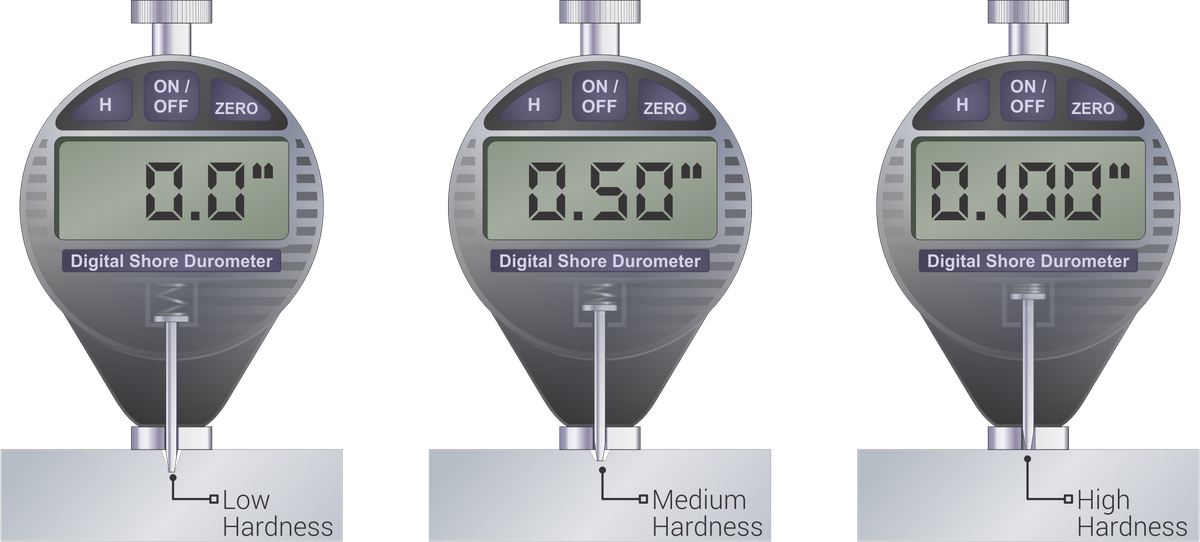
Durometer Hardness Testing Explained
Hardness generally refers to the resistance of a material to scratching or indentation, and a qualitative measure of the strength of the material. The most commonly used hardness tests are the Rockwell test, Brinell test and the Vickers hardness test. This article will provide an introduction...
 www.engineeringclicks.com
This user has no status.
This user has no status.
🏆 Top 1% Commenter
Well-Known Member
Well-Known Member
Yeah I tried just barely touching the sponge. but then the readings are way different from manufacturer measurements. It's just a completely different world then.That isn't very consistent. There should be instructions that say to push but not so hard that the main body hits starts to deform the rubber. If you push real hard the main body of the durometer has already compressed the ruibber so much the little pin will see more opposition.
How to use a durometer
The durometer body just touches the rubber.
Durometer Hardness Testing Explained
Hardness generally refers to the resistance of a material to scratching or indentation, and a qualitative measure of the strength of the material. The most commonly used hardness tests are the Rockwell test, Brinell test and the Vickers hardness test. This article will provide an introduction...
I want to at least try to keep the same standard between manufacturer and my own measure.
says
Table tennis clown
🏆 Top 1% Commenter
Well-Known Member
Well-Known Member
did the unit come with 3 different measuring tips ?????Yeah I tried just barely touching the sponge. but then the readings are way different from manufacturer measurements. It's just a completely different world then.
I want to at least try to keep the same standard between manufacturer and my own measure.
This user has no status.
This user has no status.
🏆 Top 1% Commenter
Well-Known Member
Well-Known Member
Came with nothingdid the unit come with 3 different measuring tips ?????
says
Table tennis clown
🏆 Top 1% Commenter
Well-Known Member
Well-Known Member
If the tip is too big you have to just about sit on the darn tool to reach your parameters on the scale and of course if it is too small you can reach 50 by pushing it with the little finger.Came with nothing
Now these here little dribble from Ali shop:
Type A is suitable for general rubber, synthetic rubber, soft rubber, poly fat, leather, wax etc.
The type O is suitable for the micro-porous materials made of foaming agent in the plastic.
Type D is suitable for general hard rubber, resin, acrylic, glass, thermoplastic rubber, printing plate, fiber etc.
It tells me you should have bought type A but you start up picture shows Type O
Now don't say I never do anything for you 🤣🤣🤣🤣
.aliexpress.com/item/32856788398.html?spm=a2g0o.productlist.main.3.34fauIOhuIOhTU&algo_pvid=62a23044-d6b8-44ad-8a4f-c997ac462551&aem_p4p_detail=202307192125135820334725896980000129225&algo_exp_id=62a23044-d6b8-44ad-8a4f-c997ac462551-1&pdp_npi=3%40dis!NZD!27.89!26.22!!!17.22!!%40211bf4c516898271133308579d0776!10000000029725846!sea!NZ!139609019&curPageLogUid=2FdPp07ltAtm&search_p4p_id=202307192125135820334725896980000129225_2
This user has no status.
This user has no status.
🏆 Top 1% Commenter
Well-Known Member
Well-Known Member
By the way, what is the purpose of the wheel on top? What does turning that do?If the tip is too big you have to just about sit on the darn tool to reach your parameters on the scale and of course if it is too small you can reach 50 by pushing it with the little finger.
Now these here little dribble from Ali shop:
Type A is suitable for general rubber, synthetic rubber, soft rubber, poly fat, leather, wax etc.
The type O is suitable for the micro-porous materials made of foaming agent in the plastic.
Type D is suitable for general hard rubber, resin, acrylic, glass, thermoplastic rubber, printing plate, fiber etc.
It tells me you should have bought type A but you start up picture shows Type O
Now don't say I never do anything for you 🤣🤣🤣🤣
.aliexpress.com/item/32856788398.html?spm=a2g0o.productlist.main.3.34fauIOhuIOhTU&algo_pvid=62a23044-d6b8-44ad-8a4f-c997ac462551&aem_p4p_detail=202307192125135820334725896980000129225&algo_exp_id=62a23044-d6b8-44ad-8a4f-c997ac462551-1&pdp_npi=3%40dis!NZD!27.89!26.22!!!17.22!!%40211bf4c516898271133308579d0776!10000000029725846!sea!NZ!139609019&curPageLogUid=2FdPp07ltAtm&search_p4p_id=202307192125135820334725896980000129225_2
says
Table tennis clown
🏆 Top 1% Commenter
Well-Known Member
Well-Known Member
how about Zero-calibration ??By the way, what is the purpose of the wheel on top? What does turning that do?
Similar threads
- Replies
- 1
- Views
- 2K

- Replies
- 353
- Views
- 78K


- Replies
- 21
- Views
- 60K