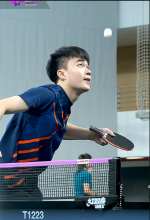


Lin Yun-Ju serve

This user has no status.
Member
Nov 2023
120
69
243
Just seen this video and it made me curious - how applicable it is for club level tennis?

Youtube

Usually for short serve or half long everyone's first bounce is mid table or higher. However.. how difficult would it be to learn to have the first bounce at around the baseline and make it bounce short on the opponents half. Anyone tried that?

Went to put on some Lin Yun-Ju matches but can't really see him do this serve.. i wonder how old that clip is..
 
  • Like
Reactions: TampaBayTableTennis
This user has no status.
Active Member
Jan 2016
569
999
1,870
Just seen this video and it made me curious - how applicable it is for club level tennis?

Youtube

Usually for short serve or half long everyone's first bounce is mid table or higher. However.. how difficult would it be to learn to have the first bounce at around the baseline and make it bounce short on the opponents half. Anyone tried that?

Went to put on some Lin Yun-Ju matches but can't really see him do this serve.. i wonder how old that clip is..

This isn’t even true.
Don’t believe the words people say. Just use your eyes and see for yourself.

Link to see 15 seconds in against Timo Boll
 
Last edited:
This user has no status.
🏆 Top 1% Commenter
Active Member
Dec 2018
925
1,370
3,479
Read 1 reviews
This isn’t even true.
Don’t believe the words people say. Just use your eyes and see for yourself.

Link to see 15 seconds in against Timo Boll
Disagree. Even in your video I can see examples of LYJ short serves with the first bounce fairly close to the baseline (see 1:14). And I've heard players talking about how his serve trajectory is unusually hard to read. Also remember an interview with Timo where he was talking about making the first bounce of his short serve closer to the baseline to make them harder to read.

I've practiced doing this and as expected found it more difficult. Is it worth the practice time for an amateur? Not yet for me, but if you have good touch I think it's worth giving it a try.
 
This user has no status.
Active Member
Jan 2016
569
999
1,870
Disagree. Even in your video I can see examples of LYJ short serves with the first bounce fairly close to the baseline (see 1:14). And I've heard players talking about how his serve trajectory is unusually hard to read. Also remember an interview with Timo where he was talking about making the first bounce of his short serve closer to the baseline to make them harder to read.

I've practiced doing this and as expected found it more difficult. Is it worth the practice time for an amateur? Not yet for me, but if you have good touch I think it's worth giving it a try.

compared to his long serves, i would still consider those first bounces close to half-table. the camera angle at 1:14 is pretty bad, but you can see his other short serves in the rest of the video (and long serves).

for serving short, there's a lot of leeway for the first bounce. there's even more leeway if you serve it a little high (which you see in the youtube tutorial).

the whole point of having the first bounce halfway into the table is to keep the serve low and slow. if you are left handed and don't think you'll get punished against a right handed player, you can go ahead and serve a bit higher and put your first bounce a couple inches closer.
 
This user has no status.
Member
May 2024
144
327
812
It’s much more difficult to consistently execute a short serve this way, and even if you can I think it should mainly be used as a surprise change-up rather than a base serve.

The reason is that for the serve to bounce close to your baseline and then short on the opponent’s side, the ball has to pass over the net after the peak of its trajectory. So this serve will necessarily bounce up higher than an equivalently short serve that uses a lower/tighter bounce. That can sometimes be useful, but higher bouncing short serves give the receiver a lot of options if they’re aware.

But I could imagine it’s a useful serve to pull out in certain situations, especially if you use a lot of long and half-long serves.
 
This user has no status.
🏆 Top 1% Commenter
Active Member
Dec 2018
925
1,370
3,479
Read 1 reviews
compared to his long serves, i would still consider those first bounces close to half-table. the camera angle at 1:14 is pretty bad, but you can see his other short serves in the rest of the video (and long serves).

for serving short, there's a lot of leeway for the first bounce. there's even more leeway if you serve it a little high (which you see in the youtube tutorial).

the whole point of having the first bounce halfway into the table is to keep the serve low and slow. if you are left handed and don't think you'll get punished against a right handed player, you can go ahead and serve a bit higher and put your first bounce a couple inches closer.
Excellent point about lefty vs righty. No doubt keeping this kind of serve low is extremely difficult; I can't do it with any consistency (and I'm also right handed) so not useful so far.
 
This user has no status.
🏆 Top 1% Commenter
Well-Known Member
Sep 2013
13,139
15,419
36,968
Read 3 reviews
Usually for short serve or half long everyone's first bounce is mid table or higher. However.. how difficult would it be to learn to have the first bounce at around the baseline and make it bounce short on the opponents half. Anyone tried that?
This is all very common in semi-pro to pro space
whether or not all players do it, is one thing
but it is required in the development stages to learn (base line bounce, to short serve)

how applicable is it for amateur table tennis - many things the pros do, are not applicable, but not impossible.
you need hours of practice, probably hundreds of hours.
 
says nothing
says nothing
🏆 Top 1% Commenter
Well-Known Member
Apr 2021
1,105
1,277
3,973
Read 1 reviews
this video is very interesting, I practiced my servers following this video and tried in real matches:

- Press the ball down after contact is extremely useful with half long serve, making opponents mistake it with a topspin serve, I got many points with opponents hit the net with this serve

- Short serve is very difficult to execute consistently, I couldn't get the timing of adding backspin + pressing down precisely. I feel like pressing inside table is easier to get 2 bounces serve
 
This user has no status.
Now, to be honest, I see very few professionals who serve short. Most don't really serve short behind the net, but rather halfway onto the opponent's side of the table. When I look at the amateurs, many of their serves are noticeably shorter behind the net, but probably/usually with less effect than with professionals. The reason could be that professionals open immediately, no matter how short the serve is, and can thus start an open game right away.
 
This user has no status.
🏆 Top 1% Commenter
Well-Known Member
Jan 2021
3,918
2,871
8,092
Read 1 reviews
this video is very interesting, I practiced my servers following this video and tried in real matches:

- Press the ball down after contact is extremely useful with half long serve, making opponents mistake it with a topspin serve, I got many points with opponents hit the net with this serve

- Short serve is very difficult to execute consistently, I couldn't get the timing of adding backspin + pressing down precisely. I feel like pressing inside table is easier to get 2 bounces serve
I agree, it’s a great tool to have in the toolbox. I think one of the clues to judge serves is to be able to perform them. I will definitely try this approach. My serves are at best very conventional…

Cheers
L-zr
 
  • Like
Reactions: longle
Top