Looping with thinner sponges

says Xxxxxz
says Xxxxxz
Member
Jan 2015
159
41
220
Is there a recommended minimum thickness for looping? I'm thinking of trying some more control-based rubbers rather than all out offensive rubbers. The rubbers I'm looking at are generally classified as "allround" rubbers and they come with some thinner sponge options. Will I still be able to loop with a 1.5mm sponge, for example (as compared to 2.1mm or max)? And i assume looping would be easier in a thinner sponge if I went for a tacky Chinese rubber where the spin comes more from the rubber rather than the sponge?
 
This user has no status.
🏆 Top 1% Commenter
Well-Known Member
Moderator
Oct 2014
20,033
26,618
71,042
Read 17 reviews
Is there a recommended minimum thickness for looping? I'm thinking of trying some more control-based rubbers rather than all out offensive rubbers. The rubbers I'm looking at are generally classified as "allround" rubbers and they come with some thinner sponge options. Will I still be able to loop with a 1.5mm sponge, for example (as compared to 2.1mm or max)? And i assume looping would be easier in a thinner sponge if I went for a tacky Chinese rubber where the spin comes more from the rubber rather than the sponge?

Depends on what you are trying to do. The real issue is that without sponge, the ball goes into the wood too easily and there is a maximum spin you can produce on thick contact shots and you may struggle to have the time/technique to control these thick contact shots with spin if the sponge is thin.

With tacky rubber, the spin does NOT come from the rubber - the principles are exactly the same as with regular rubbers. Tack only helps in reducing the speed of the rubber to release the ball which helps with control in certain shots.

You can loop with any inverted rubber - but for the regular feeling of looping, anything less than 1.8mm will struggle, especially if you want to counterloop as counterloops are rarely thin impact shots. But most brush or thin contact loops will work with any sponge, though they do get risky with anything below 1.5mm.

So, if you want to loop backspin or just loop for spin, and even with some deception as some balls will come out dead because of the thinner sponge, 1.0- 1.5mm or above is okay.

If you want to loop topspin or counterloop with authority with consistently heavy spin, 1.8mm is the minimum and at higher levels you need 2.0mm or max, thicker sponge is better.

Harder sponge makes it harder to bottom out, but also makes it harder to feel the ball.
 
says Xxxxxz
says Xxxxxz
Member
Jan 2015
159
41
220
I'd have assumed tacky rubber was more efficient at stopping the incoming spin and adding your own spin. I'm assuming that based on the further assumption that tacky rubber increases the rubbers grip on the ball and therefore doesn't allow the ball to skid on rubber. I may be completely wrong, but I've always assumed something like a spectrum; anti-spin of LP'S at one end of the spectrum and tacky rubber at the other...with non-tacky inverted rubber slightly more towards the LP end of the spectrum than tacky.
 
This user has no status.
Member
Dec 2016
496
392
1,723
Hi,
I can't speak for chinese rubbers but you'll definitely be able to loop with thinner rubbers. I actually think it's a good move to make in general, up to a certain level. Not long ago, being away from where I live, I unexpectedly took part in a small tournament and had to borrow a "beginners" racquet: 35° sponge conventional rubbers, 1.8 on one side, 1.5 on the other on a blade as simple as they come. At first I had silly amounts of fun swinging at everything that came my way, as playing felt so easy, and progressively just forgot about it. A lot of my loops came back of course, but that was even a good thing, as I had to go all out on my strokes, focus on ball placement and work on every possible aspect to try and optimise them. Even then my shots weren't deadly mind you, but by the end of the day I felt had played better than... well, almost ever.
To put things in context, I used to be fairly solid and stopped for ten years, came back to it a few months ago. Still using every move in the book and playing aggressively overall, but I had been very frustrated with my consistency until that day. I lost one match (opponent around 1900 I'd imagine, peach of a forehand, super smooth...), which I'd have lost anyway. That's even more useful: slower setup allowed me to stay in the game longer and I could still spin/powerspin/slam a few past him. Of course, I could return considerably more of his than I would have with my normal bat (Joola Maxxx on it is deceiving: coming back to the game after such a long time, my loops quickly felt incredible during training but I'd be awful during matches).

Not meaning to make it all about me really, this was just to illustrate the point. I have to point out that counter-looping was really hard though, as the thing would bottom out so easily. Right now I am thinking that an all-wood off-/off blade with 1.8/2.0mm linear medium/medium-hard rubbers would do me nicely and could take any regular offensive player past that 1900 threshold easily (meaning that setup would be plenty, of course it does take commitment), with the added bonus that there's some margin to go with even then.
You haven't really said what your current level is at, but I think until someone can loop comfortably on both wings, the first setup I mentioned is the way to go. Again, a lot of shots will feel underwhelming and playing will be more tiring but that's the whole point really: instead of a thick and springy sponge, you're the one putting in the work and learning (not to mention the bragging rights and what you will gain in feel and safety).

 
says The sticky bit is stuck.
🏆 Top 1% Commenter
Well-Known Member
Jan 2017
2,842
2,707
8,362
Read 8 reviews
I'd have assumed tacky rubber was more efficient at stopping the incoming spin and adding your own spin. I'm assuming that based on the further assumption that tacky rubber increases the rubbers grip on the ball and therefore doesn't allow the ball to skid on rubber. I may be completely wrong, but I've always assumed something like a spectrum; anti-spin of LP'S at one end of the spectrum and tacky rubber at the other...with non-tacky inverted rubber slightly more towards the LP end of the spectrum than tacky.

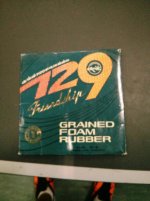
Well, I played with the original (eggplant coloured; a ball could stick to it for half a minute) Friendship 729 a frew decades ago, and to my feeling tack does blunt incoming spin somewhat. In touch games, you sometimes have to need to make a substantial effort to put even that little speed you need to the ball back over the net into it.

There's tacky and there's grippy! My old 729 did produce loaded spins, but it wasn't just tacky, it was grippy too. Tack may help increase dwell time, which will help to apply rotational force to the ball, but in the end it's the friction coefficient -- the grippiness -- that makes the spin.

Then again, there's also slippage. I've had perfectly good powerful drives drop flat on the floor below my bat due to that, from an perhaps older and worn or maybe slightly moist T05. Perhaps tack might help reduce slippage; couldn't say.

Back to the original subject, I'm looping just fine with 1.7mm of sponge. Yes, at a certain point it bottoms out; that point is somewhere in the vicinity of where I start going for all-out flat hits.
 
  • Like
Reactions: Suga D
This user has no status.
🏆 Top 1% Commenter
Well-Known Member
May 2015
3,220
3,924
27,424
Read 5 reviews
Well, I played with the original (eggplant coloured; a ball could stick to it for half a minute) Friendship 729 a frew decades ago....

Are you talking about this one?
VID_20150728_213222.mp4_snapshot_00.04_[2015.07.29_21.54.02].jpg
VID_20150728_213222.mp4_snapshot_00.01_[2015.07.29_21.53.35].jpg
IMG_20150728_212608_ttd.jpg
VID_20150728_212922.mp4_snapshot_00.30_[2015.07.29_21.51.59].jpg

Man, that thing is sticky. After 30+ years it still can lift a ball easily.

For counterlooping i agree that the sponge should have a minimum thickness of 1.7/1.8
At lower levels where it's rather loop vs. block even 1.5/1.6 should still be working to a degree.
But for higher level play 2.0 or more will help producing more rotation.
 
Last edited:
says The sticky bit is stuck.
🏆 Top 1% Commenter
Well-Known Member
Jan 2017
2,842
2,707
8,362
Read 8 reviews
  • Like
Reactions: Suga D
This user has no status.
🏆 Top 1% Commenter
Well-Known Member
May 2015
3,220
3,924
27,424
Read 5 reviews
Yes, that's it. Great stuff. (A++, Would Buy Again.)

Nice.

What ist really interesting is, that it's only slightly slower than my 'modern' usual racket with H3N and T05.
I guess after a day or two i would be totally used to it again.
Too bad I'm not allowed to use it anymore.
Thank you, ITTF.
:(
 
  • Like
Reactions: UpSideDownCarl
This user has no status.
Is there a recommended minimum thickness for looping? I'm thinking of trying some more control-based rubbers rather than all out offensive rubbers. The rubbers I'm looking at are generally classified as "allround" rubbers and they come with some thinner sponge options. Will I still be able to loop with a 1.5mm sponge, for example (as compared to 2.1mm or max)? And i assume looping would be easier in a thinner sponge if I went for a tacky Chinese rubber where the spin comes more from the rubber rather than the sponge?

All I know is you will find it harder to loop with thin sponge. I prefer minimum 2.0mm for looping
 
  • Like
Reactions: BeGo
Top