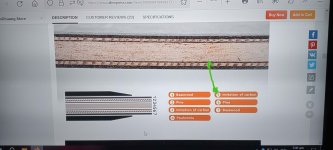
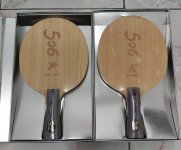
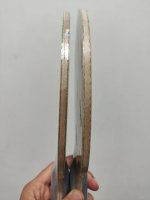
I agree with you for x version of 506x, looking with bare eyes, the medial ply is thinner than 506a, but the 506x toply is thicker than 506a, and I think thats make 506x feeling is softer than 506a
DHS ‘506A’ is a new outer-fiber blade which is released in 2023, and is the second outer-fiber model added to the ‘506’ series following ‘506X’. ‘506’…

ttgearlab.com
DHS ‘506X’ is an outer-fiber blade which is rare in the blade range of DHS. ‘506’ series was originally a blade family consisting mainly of 7-ply wood blades such as ‘…
ttgearlab.com
506X, 85.2g, Vp = 1.31, Vl = 1.39, Vl/Vp = 1.06
506A, 87.6g, Vp = 1.24, Vl = 1.37, Vl/Vp = 1.10
In this blog, for understanding a blade and comparing blades, four performance indices – two elasticity indices and two vibration indices – will be used. Ep : Elasticity Index (Primary)…
ttgearlab.com
Vp = "felt by player's palm... little (fifth) finger and a part of palm", Vl = "felt at the fingertip of index finger"
Vl/Vp = values >= 1.0 sharper feeling at index finger and softer at palm and vice versa for values below 1.0
Performance-wise and vibration-wise the 506X is closer to the older Viscarias (Ec/Ep 0.9 vs 0.91 for old Viscaria, M series, 86g). The 506A holds the ball even longer (Ec/Ep 0.84). Both have a larger head (159 mm x 150 mm) than Viscaria.
All outer blades compared:
https://ttgearlab.com/2024/03/15/performance-indices-db-outer-fiber-blades/
Seems like I have to test both blades