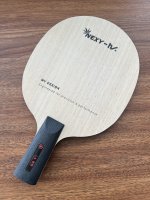
Nexy Designer's Diary

This user has no status.
Member
Feb 2023
302
124
712
The rest of the answer is in accordance with everything I had already said previously and it basically shows how the equation is indeed applicable to TT. However, the problem is not static, but dynamic, as you had already pointed out previously as well, so the answer is not so clear and direct, there are other variables at play.


No misconception on my part 🙂. I trust you are telling the truth obviously, but it also proves my previous point where I stated that players who stay closer to the table prefer more handle heavy blades. Female players usually stay closer to the table than male and they have shorter arm swings.

However, the W968 composition is more head heavy by nature, due to the woods it uses. While its possible to manufacture lighter specimens of course, by selecting lower density cores and veneers, it's still a heavier composition than for example Vicaria, which uses a Kiri core.


I never said it's a special know how, in fact I wrote that it is basic woodworking knowledge. Of course that composite layers overcome the feeling and performance of a blade (as I have also wrote), but not all blades have composites and not all composites are the same. It's about trying to fully understand the behavior of the blade in all its parts. To me it's just funny that you won't acknowledge that changing the grain orientation of the woods, which basically changes the whole structure of the blade, plays a big part on how it feels and performs, yet you claim that the gluing process (which is probably around 1% of the blade) drastically changes the behavior (which totally does).
Especially since vibration was mentioned too, and doesn't grain orientation directly affect that as well? Out of curiosity will a vertical+vertical (1st and 2nd ply say for a w968 composition) orientation become more elastic then a vertical+horizontal? Just plain curiosity
 
This user has no status.
Member
Aug 2025
60
148
211
(Below article was written some years ago in Korean web community.)

-------------------------------------------

Earlier, I provided answers to two out of the five questions.
Now, let us deal with the remaining three questions.


First, let’s recall which questions have not yet been answered:


  1. Why is the 5-ply blade considered the standard for all-wood blades?
  2. Why is the 7-ply blade regarded as a speed-enhanced version of the 5-ply?
  3. Why are 9-ply, 11-ply, and other higher-ply all-wood blades so rare?

Let’s go through each one step by step.


3. Why is the 5-ply blade considered the standard for all-wood blades?​


The 5-ply blade likely became the standard because of Stiga’s Allround Classic.


That blade has sold over a million units, and it has already been more than ten years since the commemorative edition was released. At this point, there are hardly any table-tennis players worldwide who have not heard of it.


(Even though the Allround Classic is not as popular today, its usefulness remains high. It is actually slightly thicker than the Offensive Classic, which makes it more attractive nowadays for players who want to rally with continuous topspins using the poly ball.)


The Allround Classic played a major role in spreading the perception that a table-tennis blade “should” have 5 plies.


At that time, table-tennis styles were diverse, not dominated only by drive-oriented attackers. Thus, the Allround Classic was not seen as limited to allround players, but rather was broadly chosen by virtually all offensive-minded players.


(The Offensive Classic followed the structure of the Allround Classic but used a dyed outer ply for a harder feel. It emphasized spin over power, making it appealing for players who wanted to win by continuous close-to-the-table topspin rallies rather than single finishing shots. This blade was used by Wang Liqin and gained huge popularity among Chinese players, as well as in Korea alongside the Clipper series.)


In fact, the Allround Classic is thicker than the Offensive Classic. While the Offensive Classic became very popular thanks to Wang Liqin’s fame and was widely used by Chinese players, the Allround Classic is what established Stiga’s reputation in Europe.


Now, let’s examine the underlying reason why 5-ply blades emerged as the standard.


A table-tennis blade can essentially be divided into:


  • the core layer, which controls weight, balance, and power
  • the outer plies, which control spin and feel

Once you understand this simple distinction, you can make sense of countless blade designs.


Traditionally, soft woods such as limba or hinoki were used for the outer plies. Later, harder woods such as koto, white ash, mahogany, and walnut became popular. These harder plies solved the “soft outer” problem often associated with Stiga blades, and they helped create blades with non-Stiga characteristics. In a sense, Stiga itself had not favored very hard outer plies.


Then came the ban on speed glue. Water-based glues entered the market, which hardened upon drying and could sometimes damage the surface ply when removed. At this point, Stiga began producing blades with harder outer plies. A milestone was the Ebony series (Ebenholz). These were favored by many Chinese women players such as Guo Yue.


The Ebenholz series was followed by the Rosewood and Maplewood series, ushering in the hardwood era. Chinese brands quickly copied these designs. Of course, Stiga’s real strength lay not just in the choice of wood, but in its ability to slice veneers extremely thin and glue them with minimal adhesive. When thicker veneers were glued with lots of adhesive, the resulting blades had entirely different playing properties. That is why Chinese players considered Stiga blades impossible to replicate.


Meanwhile, core construction also evolved. One must remember: the more plies a blade has, the more glue layers it contains. Some brands promote high-ply blades as being faster and stronger, but in reality, additional glue layers make the blade feel harder and may even reduce speed. The blade becomes more like alternating wood and plastic sheets rather than pure wood.


This issue relates to the fifth question, but let me preview it here.


Manufacturers needed the core layers to be dimensionally stable over time. Thus, a 3-ply core became the norm: a thick central ply flanked by two cross-grained plies to prevent warping.


Therefore, the table-tennis blade naturally settled on a structure of a 3-ply core plus two outer plies = 5 plies total. This was so straightforward and effective that it became the standard. The design challenge then became: which wood to use for the outer plies to influence feel and spin.


Not all brands followed Stiga’s approach. Some experimented with different cross-grain arrangements, but these raised issues of warping or required specially selected, stable woods.


A famous example is Tibhar’s IV-L blade, which used such an alternative construction. It gave a very soft, spinny feel, which at one time I personally favored.


In summary, the 5-ply standard emerged because:


  1. Blades can be understood as core + outer plies.
  2. The core must be stable → 3-ply cross-grain solution.
  3. Adding the outer plies brings the total to 5.

This solved both stability and feel in a balanced way. Adding more plies created structural compromises.


4. Why is the 7-ply blade regarded as a speed-enhanced version of the 5-ply?​


Strictly speaking, this question is less relevant today. As the designer of Nexy blades, I have made 5-ply blades that play like 7-plies, and 7-plies that feel like 5-plies. The boundary has blurred.


But before that boundary disappeared, the traditional understanding was:


  • 5-ply = the standard all-wood construction
  • 7-ply = a reinforced, faster version

The most famous example is Stiga’s Clipper series.


The Clipper was built with a 3-ply core, plus 2-ply outer construction (five outer plies in total). It used dyed veneers in the core reinforcement layers. This innovative structure created a faster, more powerful blade while retaining Stiga’s traditional philosophy of core + outer plies.


The 7-ply arrangement allowed makers to adjust reinforcement layers and outer plies in various ways. Depending on design, a 7-ply could feel much like a thickened 5-ply, or conversely, a 5-ply could be designed to feel like a lighter 7-ply.


This is why people often regarded 7-plys as “speed-up versions” of 5-plys. But modern design techniques allow great flexibility: the distinction is no longer absolute.


5. Why are 9-ply, 11-ply, and other high-ply all-wood blades so rare?​


Essentially, because they are unnecessary.


Adding more plies mainly subdivides the existing structure (core, reinforcement, outer). For example, 7-ply simply means the core and reinforcement layers are further split.


9-ply or 11-ply blades sometimes exist as experimental designs, but generally:


  • More plies = more glue layers
  • More glue layers = less wood feel, sometimes less speed

In most cases, extra plies make the blade too stiff, too heavy, or too “dead”.


Modern composite blades (with carbon, arylate, etc.) are essentially “multi-ply” by another route. A 5-ply wood blade with inner carbon becomes a 7-layer structure (wood + composite). A 7-ply wood with composites can be 9 layers.


Thus, we don’t need 9- or 11-ply pure-wood blades. Instead, makers insert composite layers to achieve desired speed and stability while maintaining wood feel.


Exceptions exist (e.g., Tibhar Samsonov Quad series), but those require precise engineering and data. By contrast, some Chinese brands advertise “11-ply carbon” which is essentially meaningless—it’s just multiple glue layers with carbon dust, resulting in unplayable weight.


So the practical summary is:


  • 5-ply = standard
  • 7-ply = traditional reinforced version of 5-ply
  • 9- or 11-ply = uncommon, often impractical, unless carefully engineered


Thus concludes the discussion on blade ply structures. Thank you for following this long explanation.


(P.S. In Korea, the most common design historically has been the “Hinoki-carbon” blade: a 3-ply hinoki structure with carbon inserted. In such cases, warping issues are less relevant thanks to the stabilizing effect of the carbon layer. This is a slightly different category, but worth noting.)

 
This user has no status.
Member
Aug 2025
60
148
211
This is Oscar, the operator of the Nexy brand.

The Chedech blade holds a rather special place in the overall flow of Nexy blades. Many people recognize Chedech as a representative model of our fourth-generation “surface material experiments,” but to me, it is a little more than that. It isn’t simply a new product added to the lineup; it is a blade that quietly reflects what Nexy was thinking about at that particular moment. In that sense, Chedech is more like a record—capturing the thoughts, questions, and direction that guided us at that time. That is why I wanted to introduce this blade in a more detailed and personal manner in this note.


화면 캡처 2025-11-28 191728.png


Before I begin, I want to clarify one important principle:
Nexy blades should not be understood in terms of “upgrades” or “superiority.”
From 2007 to the present sixth generation, Nexy has always built products based on different directions and philosophies at each stage. No generation is inherently better or worse than another. They simply aim for different things. Chedech is no exception. Rather than being a “better version” of anything, Chedech is a blade that captures the specific problem Nexy wanted to solve at that time.

Around the time Chedech was conceived, I was focused on how players were reacting to the introduction of the poly ball. As the ball changed, the feeling in the hand changed as well. Shots that used to travel naturally began to lose a bit of their penetration. Many players commented that their swing was the same, but the force wasn’t transmitting the way it used to. This wasn’t merely a matter of technique or rubber selection—it was something we needed to reconsider from a structural viewpoint. I began by looking again at how energy moves at the moment of impact and how the surface of the blade interacts with the ball.

This led naturally to deeper exploration of surface materials.
Nexy’s fourth generation was already a time when we were experimenting with surface properties, and I believed the “dragging sensation” of Hinoki—its ability to feel as though it carries the ball a little longer—was still meaningful in the poly ball era. Hinoki doesn’t literally hold the ball longer, but it gives the impression that it does. I thought this sensory effect still had value. What I wanted was not to duplicate Hinoki, but to reinterpret its functional sensibility through a different material—something that could create a similar sense of “carry” without making the entire blade too soft.

That is when we turned to Wenge.

There is, however, a big misunderstanding about Wenge.
Not all Wenge feels the same. The material varies widely in density, drying quality, and grain structure. Standard Wenge tends to feel dry and hard. But the Wenge used in Chedech is from one of the highest grades available among Chinese sources. It is distinctly more oily, smoother, and has a clearer grain pattern. When you run your hand across it, it has a slight sliding sensation—a tactile “glide.” It doesn’t actually hold the ball longer, of course, but it creates the impression that it might, offering a subtle elasticity during contact that makes the ball feel more controlled.

In this sense, Chedech’s Wenge shares a conceptual similarity with Hinoki, but the feeling is entirely different. While Hinoki gently “presses” and cushions the ball, Chedech’s Wenge feels as though it brushes lightly across the ball before releasing it, creating a momentary softness without sacrificing firmness. This sensory balance was precisely what I felt the poly ball era needed.

Butterfly and Stiga have also released blades with Wenge surfaces, but Chedech’s version is noticeably different. The Wenge on Chedech is richer in oils, smoother, and more defined in grain. This contributes to a unique cushioning effect that softens the sharpness normally associated with carbon blades. To me, this is the most important characteristic of Chedech: the carbon and the Wenge each maintain their distinct roles without overwhelming one another.

Feedback from players clearly reflects these qualities.
Those who rely on quick tempo and forward pressure tend to like Chedech quite a lot. Smashes leave the racket without hesitation, and forehand drives travel straighter and faster than expected. Players who prefer deep, dragging loop drives sometimes mention that the blade feels firm at first, but once the rubber pairing is adjusted, Chedech can still create a smooth, controlled trajectory. I view this adjustment process as a natural part of understanding Chedech. A blade is not a fixed object—it becomes complete through the user’s style and configurations.

During production, I checked the surface repeatedly—ensuring the oil level of the Wenge was stable, that the grain direction did not compromise rebound, and that the balance between elasticity and density was correct. Chedech was not simply a surface-material experiment; it was a blade created at a moment when Nexy was trying to organize everything we had researched about surface concepts. Because of that, even the smallest variations mattered.

The result is a blade that represents Nexy’s attempt to redefine “the direction of force.”
Firm but not harsh.
Sensitive enough to provide a momentary sense of carry, yet direct enough to transmit energy without loss.
A blade where the force doesn’t scatter but gathers at a single point.
These are the characteristic sensations you will immediately notice when you hit a ball with Chedech.

I don’t view Chedech as simply another blade in the lineup.
It contains the questions and explorations we faced during a transitional era in table tennis. It is, in a small way, a record of how Nexy tried to interpret the new poly ball environment and answer the changes it demanded. Some players will feel it as a fast, straightforward blade; others will appreciate its subtle control and unique balance. All of these impressions are true, because Chedech is a blade shaped as much by the thoughts behind it as by the materials that compose it.

Thank you for reading.
 
says Hitting Mach Speeds
Member
Oct 2022
300
212
1,074
Hello Oscar, sorry if I barge in here.
I noticed a new Rubber "ROJETA" by Nexy on the ITTF LARC and wanted to ask you if you could give some insights, since it is hard to find infos here.
I really liked the ETIKA Rubber, played it for roughly 2 years. And since the ROJETA is also made in Japan, I must say that I am really intrigued.

How will it compare to the ETIKA for example?
 
  • Like
Reactions: Ghostzen
This user has no status.
Member
Aug 2025
60
148
211
Thank you very much for your interest in our upcoming rubber, ROJETA.

The ROJETA rubber has been developed based on the core characteristics and technical foundations of the ETIKA series. We are currently finalizing the details to ensure it meets the high standards you expect from Nexy.

Detailed specifications and further information will be announced shortly.

Thank you for your continued support.
 
  • Like
Reactions: Julzig
Top