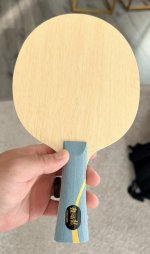


ovtcharov innerforce alc splintering?

This user has no status.
🏆 Top 1% Commenter
Well-Known Member
Sep 2024
1,576
2,076
5,571
Maybe I'm then not good enough. That can certainly be the case.

But think about this one. Everybody knows that Butterfly blades come factory-sealed. Out there, there are many, many really good table tennis players that can be considered pros or half-pros or ...
Do you honestly think they would play all those factory-sealed blades if those have a glassy feeling?
Same with Victas Koki Niwa ZC which is factory-sealed like hell. Would anyone play it if it as a glassy feeling?

Whatever protective coating Butterfly uses in manufacturing isn't available to the public so I can only speak to experience with publicly sold sealers, and they can often (not always) lead to glassy feelings. This is pretty well documented. I'm sure you can minimize that by using a tiny amount but then at that point it also leads to the question how much protection the sealant is offering if it didn't change the feel whatsoever. Because as mentioned earlier, one cannot say that a chemical is changing the strength and resilience of the wood but at the same time magically not having any change in the physical properties of it, those two things simply cannot be the case lol.
 
says what [IMG]
says what [IMG]
🏆 Top 1% Commenter
Well-Known Member
Feb 2016
2,470
1,520
5,098
Read 2 reviews
Whatever protective coating Butterfly uses in manufacturing isn't available to the public so I can only speak to experience with publicly sold sealers, and they can often (not always) lead to glassy feelings. This is pretty well documented. I'm sure you can minimize that by using a tiny amount but then at that point it also leads to the question how much protection the sealant is offering if it didn't change the feel whatsoever. Because as mentioned earlier, one cannot say that a chemical is changing the strength and resilience of the wood but at the same time magically not having any change in the physical properties of it, those two things simply cannot be the case lol.
It's very much so possible to change the shear strength of a material without changing its bending stiffness and so on. I can also assure you that the public has access to any kind of material that manufacturers do, this isn't some kind of security cleared, export-restricted good.
 
This user has no status.
🏆 Top 1% Commenter
Well-Known Member
Sep 2024
1,576
2,076
5,571
It's very much so possible to change the shear strength of a material without changing its bending stiffness and so on. I can also assure you that the public has access to any kind of material that manufacturers do, this isn't some kind of security cleared, export-restricted good.
I can assure you the public does not have access to any kind of material that manufacturers do lol. I am not sure where "bending stiffness" came from, I didn't say that stiffness is what specifically changes, just feeling overall.
 
says what [IMG]
says what [IMG]
🏆 Top 1% Commenter
Well-Known Member
Feb 2016
2,470
1,520
5,098
Read 2 reviews
I can assure you the public does not have access to any kind of material that manufacturers do lol. I am not sure where "bending stiffness" came from, I didn't say that stiffness is what specifically changes, just feeling overall.
Why not? You just buy it from the suppliers. Do you think Butterfly has some R&D lab where they're producing new elements?

Feeling is a function of vibration frequency which is a function of stiffness. Sealing a blade does not, as far as measurements go, change any of its stiffnesses or vibration frequencies. It would probably change the shear strength of the plies in a transverse direction, but you're not exactly loading the blade that way when you hit a ball with it.
 
  • Like
Reactions: Conehead
This user has no status.
🏆 Top 1% Commenter
Well-Known Member
Sep 2024
1,576
2,076
5,571
Why not? You just buy it from the suppliers. Do you think Butterfly has some R&D lab where they're producing new elements?

Feeling is a function of vibration frequency which is a function of stiffness. Sealing a blade does not, as far as measurements go, change any of its stiffnesses or vibration frequencies. It would probably change the shear strength of the plies in a transverse direction, but you're not exactly loading the blade that way when you hit a ball with it.
Okay so what formulation is Butterfly using for their protective coating and how does it compare to the ones that you and I can purchase in terms of chemical composition and the resulting feeling?

I suspect neither you or I truly know all the aspects that contribute to what feeling is but as I said before, it is insane to suggest that high level players can't feel the differences in a blind test (or that they typically change blades every few weeks lol).
 
says what [IMG]
says what [IMG]
🏆 Top 1% Commenter
Well-Known Member
Feb 2016
2,470
1,520
5,098
Read 2 reviews
Okay so what formulation is Butterfly using for their protective coating and how does it compare to the ones that you and I can purchase in terms of chemical composition and the resulting feeling?

I suspect neither you or I truly know all the aspects that contribute to what feeling is but as I said before, it is insane to suggest that high level players can't feel the differences in a blind test (or that they typically change blades every few weeks lol).
You could lab test it if you want. Very likely it's a wax based wood varnish. No surface treatment should do anything to the feeling, that's just not how springs like this work. It could change the surface CF if you were hitting the ball bare with no covering, varnishes and waxes tend to be a bit slipperier. It may increase the amount of glue needed for the same adhesion.

Which is more insane to suggest, that people are feeling differences that don't show up on machines, or that people are superstitious and have their own human beliefs about things? Pros who are honest will just tell you that they prefer a certain blade thickness, or rubber mass, or whatever, due to past positive experience of playing well with them, not due to some kind of empirical difference that they're quantifying.
 
This user has no status.
🏆 Top 1% Commenter
Well-Known Member
Moderator
Oct 2014
19,973
26,531
70,870
Read 17 reviews
It's very much so possible to change the shear strength of a material without changing its bending stiffness and so on. I can also assure you that the public has access to any kind of material that manufacturers do, this isn't some kind of security cleared, export-restricted good.
@Archosaurus,

I know you are one of those with a strong belief that it is possible to learn through reason and physics things that are better learned from hard experience. While this is a free web forum and everyone can do what they want, it is more productive to probe and understand the experiences of actual players and seeing whether it is legitimate when tested and empirically validated than to try to discern what is supposedly possible from the brilliance of your mind.

Claiming that the public even *knows* what goes into the manufacturing process for blades is fairly ridiculous, and I can assure you that even when someone *knows* how to loop, it doesn't mean they can loop like Ma Long, which means that success in doing something might carry implicit/tacit knowledge and variables which are not easy to replicate or observe - some of this shows up in the physics (we can measure Ma Long's spin etc.) but it isn't as easy to measure Ma Long's timing, evolution or neural development or other such things. These are things it is easier to appreciate when you start with different perspectives of the problem, including actual exposure and experience to players and equipment. Some thing similar applies to blades, claiming that just because two blades have the same overall composition that they will play the same assumes a lot of things, and that manufacturing processes and material qualities to not create differences that are not limited to the composition.

BTW, none of this means that if you gave a player a blade and then gave them an identical blade with a thin layer of laquer that they wouldn't play at the same level with it, even after feeling the difference. But it would take experiments that you haven't performed to validate things with the confidence you are claiming. The informed position from @ThePongCommenter is that there are many things pros pick up based on how sensitive and refined their feeling is that you have no experience with. This is my experience as well. Try to accept that experience until you have done something to validate it, arguing is really waste of time in the absence of your either testing those claims or showing you have experience with significantly strong players that contradicts it.
 
This user has no status.
🏆 Top 1% Commenter
Well-Known Member
Moderator
Oct 2014
19,973
26,531
70,870
Read 17 reviews
You could lab test it if you want. Very likely it's a wax based wood varnish. No surface treatment should do anything to the feeling, that's just not how springs like this work. It could change the surface CF if you were hitting the ball bare with no covering, varnishes and waxes tend to be a bit slipperier. It may increase the amount of glue needed for the same adhesion.

Which is more insane to suggest, that people are feeling differences that don't show up on machines, or that people are superstitious and have their own human beliefs about things? Pros who are honest will just tell you that they prefer a certain blade thickness, or rubber mass, or whatever, due to past positive experience of playing well with them, not due to some kind of empirical difference that they're quantifying.
What is your evidence that people are feeling differences that do not show up on machines? Again in the absence of an experiment, this is another version of "the dwell time of the ball is so short that human beings cannot be changing their racket angle during the contact time".

No, pros who are honest will often be able to tell you based on various tests that a blade is faster or slower than another blade and they makes switches based on their ability to produce certain balls or feel certain things. Sometimes, it is up to the measurement to validate this feeling, but you don't have any experience discussing these issues with pros. Kanak Jha like Zyre 03, but he felt he couldn't use it on his backhand with his Viscaria SALC. So he later switched to a Timo Boll ALC with Zyre 03 on both sides. Now what past positive experience of playing well with a Timo Boll ALC with Zyre 03 on both sides did he use to make this change?

I make similar changes all the time as do you. The difference is that our information, consistency and choices are less than the pros.
 
This user has no status.
🏆 Top 1% Commenter
Well-Known Member
Sep 2024
1,576
2,076
5,571
You could lab test it if you want. Very likely it's a wax based wood varnish. No surface treatment should do anything to the feeling, that's just not how springs like this work. It could change the surface CF if you were hitting the ball bare with no covering, varnishes and waxes tend to be a bit slipperier. It may increase the amount of glue needed for the same adhesion.

Which is more insane to suggest, that people are feeling differences that don't show up on machines, or that people are superstitious and have their own human beliefs about things? Pros who are honest will just tell you that they prefer a certain blade thickness, or rubber mass, or whatever, due to past positive experience of playing well with them, not due to some kind of empirical difference that they're quantifying.
You don't sound like you know what "pros who are honest" will tell you, I do. And I may not know what you know about the science of feeling. I'll leave it at that, I don't see this conversation going anywhere productive anymore.
 
  • Like
Reactions: NextLevel
says what [IMG]
says what [IMG]
🏆 Top 1% Commenter
Well-Known Member
Feb 2016
2,470
1,520
5,098
Read 2 reviews
What is your evidence that people are feeling differences that do not show up on machines? Again in the absence of an experiment, this is another version of "the dwell time of the ball is so short that human beings cannot be changing their racket angle during the contact time".
I never claimed so, mostly because I don't believe that people are feeling changes that haven't happened. They're more likely feeling an actual change that has happened. The most obvious thing that comes to mind is a different glue surface adhesion, because last I checked we don't commonly validate that when gluing and rather look at glue amounts and drying times. If sealing or any other modification changes the adhesion, then it's probably also changing the spring behavior of the unit in a way that you can actually just measure it with a rebound test or something simple like that.

While the racket angle thing is true, comments like that miss the big picture, which is the totality of the swing action that lead to, and followed, the contact. I'm not trying to make that kind of ill-advised argument based on some looney physics idea like "it doesn't matter how you swing because everything happens at contact" or whatever. Nothing I've written is particularly crazy unless you don't believe in kinematics. There could be some super precise timing thing going on that's not represented in static measurements so that's fair enough. Maybe even hysteresis; who knows. It would be cool to know.

Regarding your previous comment, I don't think that a theoretical approach will teach you what a practical one will. They're two separate things, at best they can inform eachother, and ideally you would make connections between them. If tabletennis development had actual money in it (talking billions, not millions) then this would be more obvious, but nobody's really doing the work yet, or maybe ever.

I do also believe that to have a full understanding, you need to be able to walk the walk as well. Lots of engineers won't agree with this, but this one I do know from personal experience, so I'm sure it's the same in table tennis as well.

I'm not trying to claim this is some kind of super scientific argument or that everyone else is wrong, it's just a discussion for fun and to maybe find out something new.
 
This user has no status.
🏆 Top 1% Commenter
Well-Known Member
Moderator
Oct 2014
19,973
26,531
70,870
Read 17 reviews
I never claimed so, mostly because I don't believe that people are feeling changes that haven't happened. They're more likely feeling an actual change that has happened. The most obvious thing that comes to mind is a different glue surface adhesion, because last I checked we don't commonly validate that when gluing and rather look at glue amounts and drying times. If sealing or any other modification changes the adhesion, then it's probably also changing the spring behavior of the unit in a way that you can actually just measure it with a rebound test or something simple like that.

While the racket angle thing is true, comments like that miss the big picture, which is the totality of the swing action that lead to, and followed, the contact. I'm not trying to make that kind of ill-advised argument based on some looney physics idea like "it doesn't matter how you swing because everything happens at contact" or whatever. Nothing I've written is particularly crazy unless you don't believe in kinematics. There could be some super precise timing thing going on that's not represented in static measurements so that's fair enough. Maybe even hysteresis; who knows. It would be cool to know.

Regarding your previous comment, I don't think that a theoretical approach will teach you what a practical one will. They're two separate things, at best they can inform eachother, and ideally you would make connections between them. If tabletennis development had actual money in it (talking billions, not millions) then this would be more obvious, but nobody's really doing the work yet, or maybe ever.

I do also believe that to have a full understanding, you need to be able to walk the walk as well. Lots of engineers won't agree with this, but this one I do know from personal experience, so I'm sure it's the same in table tennis as well.

I'm not trying to claim this is some kind of super scientific argument or that everyone else is wrong, it's just a discussion for fun and to maybe find out something new.
You made a statement about "pros who are honest". In other words, you claimed to know what an honest pro's judgment should be. Such statements should be made very carefully and be based on strong evidence. You really haven't presented any. It's not fun to argue with people who present a different level of insight from what their experience guarantees. Logic can give the appearance/feeling of insight when none really exists. Continually putting the weight on arguments relieves anyone of the hard work that gives real knowledge, which is the actual execution and refinement of the experiences gained. That's my main point here.

Of course in principle, we believe that there should be some physical difference in blade performance informing what the pros feel. Even the choice of gluing method or glue can inform differences as well. But if you want to argue that pros do not know what they feel and this is how they should feel, I think you need a good experiment.

Butterfly may be using something everyone knows about, but blade manufacturing is both deceptively simple and definitely complicated enough that the source of the properties of a blade could lie in many things, including whatever is used to seal the blade, how much of it is used to seal the blade, whether the amount should vary with the outer material etc. I am just sketching out possibilities here, and while it is possible to ground all these things in some simple variable in physics, it is also a bit of a prejudice to argue that this is the only way that players can make their judgment. Again, do the experiments if you want to speak about it so confidently. You don't even know exactly what Butterfly does to seal its blades!
 
Last edited:
  • Like
Reactions: Archosaurus
says what [IMG]
says what [IMG]
🏆 Top 1% Commenter
Well-Known Member
Feb 2016
2,470
1,520
5,098
Read 2 reviews
You made a statement about "pros who are honest". In other words, you claimed to know what an honest pro's judgment should be. Such statements should be made very carefully and be based on strong evidence. You really haven't presented any. It's not fun to argue with people who present a different level of insight from what their experience guarantees. Logic can give the appearance/feeling of insight when none really exists. Continually putting the weight of arguments relieves anyone of the hard work that gives real knowledge, which is the actual execution and refinement of the experiences gained. That's my main point here.

Of course in principle, we believe that there should be some physical difference in blade performance informing what the pros feel. Even the choice of gluing method or glue can inform differences as well. But if you want to argue that pros do not know what they feel and this is how they should feel, I think you need a good experiment.

Butterfly may be using something everyone knows about, but blade manufacturing is both deceptively simple and definitely complicated enough that the source of the properties of a blade could like in many things, including whatever is used to seal the blade, how much of it is used to seal the blade, whether the amount should vary with the outer material etc. I am just sketching out possibilities here, and while it is possible to ground all these things in some simple variable in physics, it is also a bit of a prejudice to argue that this is the only way that players can make their judgment. Again, do the experiments if you want to speak about it so confidently. You don't even know exactly what Butterfly does to seal its blades!
Fair, maybe I should include a hyperbole warning in the future.

My experience and the experience of my peers and superiors is that professional atheletes absolutely can get stuff pretty wrong. A lot of them have no clue how the sausage is made either, and they will tell you insane stuff that doesn't hold water at all. The only difference here is that in what I'm involved in, this is much easier to quantify and approach a common understanding in because there's telemetry about almost everything and it's a well known science for the most part. Racket sports tend to be more human experience oriented.

Now you could argue that it's not the same thing, and maybe it isn't, but it's what I've found from being involved at an expert level in both the doing and thinking and from interviewing more advanced people and coaching various skill levels.

The one common trend I've found in higher skilled people vs lower skilled people is that the higher skilled people are harder to fool. Their feedback is more useful because they're consistent enough that they can check behavior individually. Nobody on the planet is able to pinpoint anything without looking at data, but some people can narrow it down.
 
This user has no status.
🏆 Top 1% Commenter
Well-Known Member
Moderator
Oct 2014
19,973
26,531
70,870
Read 17 reviews
Fair, maybe I should include a hyperbole warning in the future.

My experience and the experience of my peers and superiors is that professional atheletes absolutely can get stuff pretty wrong. A lot of them have no clue how the sausage is made either, and they will tell you insane stuff that doesn't hold water at all. The only difference here is that in what I'm involved in, this is much easier to quantify and approach a common understanding in because there's telemetry about almost everything and it's a well known science for the most part. Racket sports tend to be more human experience oriented.

Now you could argue that it's not the same thing, and maybe it isn't, but it's what I've found from being involved at an expert level in both the doing and thinking and from interviewing more advanced people and coaching various skill levels.

The one common trend I've found in higher skilled people vs lower skilled people is that the higher skilled people are harder to fool. Their feedback is more useful because they're consistent enough that they can check behavior individually. Nobody on the planet is able to pinpoint anything without looking at data, but some people can narrow it down.
I have no doubt professional players can get stuff wrong. But it is important to look at what they get wrong and how it was shown to be wrong. Sometimes, that is very insightful and in the end, it often isn't so much that they were wrong, but that what they were interpreting did not line up with what was literally true. Even grandmasters don't always see what the computer does, but if you don't have the variations, claiming the grandmaster is wrong is cool sounding, may be factually correct, but is completely uninsightful. In other words, ultimately, there is no substitute for doing the work
 
  • Like
Reactions: Archosaurus
says what [IMG]
says what [IMG]
🏆 Top 1% Commenter
Well-Known Member
Feb 2016
2,470
1,520
5,098
Read 2 reviews
I have no doubt professional players can get stuff wrong. But it is important to look at what they get wrong and how it was shown to be wrong. Sometimes, that is very insightful and in the end, it often isn't so much that they were wrong, but that what they were interpreting did not line up with what was literally true. Even grandmasters don't always see what the computer does, but if you don't have the variations, claiming the grandmaster is wrong is cool sounding, may be factually correct, but is completely uninsightful. In other words, ultimately, there is no substitute for doing the work
Listening to people correctly is a skill. It's easy to scoff at statements which aren't true in a technical sense and just ignore them as nonsense, although I find that people who do that are lacking theoretical understanding and just don't understand what is actually being communicated.

I found that when I advanced my practical skills in my field and performed at a level equivalent to what the athletes would, my theoretical understanding also improved. Now I see a lot of purely theoretical misunderstandings that people make due to their lack of ability in the practical.

Gaining expert ability in the practical aspect also greatly helped the translation from practical feedback into theoretical solutions, it's a bit like learning more vocabulary or grammar in a language.

So in that sense I'm in agreement with your post, more than I may have been prior to the above.
 
This user has no status.
🏆 Top 1% Commenter
Well-Known Member
Moderator
Oct 2014
19,973
26,531
70,870
Read 17 reviews
Listening to people correctly is a skill. It's easy to scoff at statements which aren't true in a technical sense and just ignore them as nonsense, although I find that people who do that are lacking theoretical understanding and just don't understand what is actually being communicated.

I found that when I advanced my practical skills in my field and performed at a level equivalent to what the athletes would, my theoretical understanding also improved. Now I see a lot of purely theoretical misunderstandings that people make due to their lack of ability in the practical.

Gaining expert ability in the practical aspect also greatly helped the translation from practical feedback into theoretical solutions, it's a bit like learning more vocabulary or grammar in a language.

So in that sense I'm in agreement with your post, more than I may have been prior to the above.
Let's be clear here: what level of performance are you claiming is the equivalent of what athletes perform at and how did you validate this level of performance? Is this in table tennis or some other sport? Are you speaking about professional athletes or just any athletic level of performance?
 
says what [IMG]
says what [IMG]
🏆 Top 1% Commenter
Well-Known Member
Feb 2016
2,470
1,520
5,098
Read 2 reviews
Let's be clear here: what level of performance are you claiming is the equivalent of what athletes perform at and how did you validate this level of performance? Is this in table tennis or some other sport? Are you speaking about professional athletes or just any athletic level of performance?
Not table tennis by any means, and not quite a sport in the sense you'd think of it.

The validation is comparing performance in motorsport simulation laptimes against young pros who are keen in the sim (Important as many older drivers just can't get along with it), and also comparing sim laptime performance to real in a reasonably correlated, sophisticated model with similar control loadings to the real thing. Of course the sim is always missing some things and is inherently easier to perform in, which is why you'd wanna do a like-to-like comparison if possible.

Motorsport stuff, so a little different from more directly physical sports, but I don't think it makes it any easier. I had to practice for an unknown amount of thousands of hours and get personal coaching from elite people to be able to go from the "good amateur" to "okay pro" level. Of course doing it for real under competitive pressure and higher athletic stresses is its own thing, but I'm only talking about "skill" here.

I can't really give too many hints who exactly is being compared to, but they are by all accounts serious professionals with licenses that you can't just buy into.
 
This user has no status.
Let's be clear here: what level of performance are you claiming is the equivalent of what athletes perform at and how did you validate this level of performance? Is this in table tennis or some other sport? Are you speaking about professional athletes or just any athletic level of performance?
i feel like most pros might be bound to their contract with the company that sponsors them to not share secrets. take what pros say with a grain of salt.
 
  • Like
Reactions: Archosaurus
says what [IMG]
says what [IMG]
🏆 Top 1% Commenter
Well-Known Member
Feb 2016
2,470
1,520
5,098
Read 2 reviews
i feel like most pros might be bound to their contract with the company that sponsors them to not share secrets. take what pros say with a grain of salt.
My situation is a little special so I can be honest about it and mention that I am doing some things, but there's a relationship of trust and some sensitive data involved, so I can only provide very unconvincing sounding "proof". I'm always happy to have my brain prodded if someone wants to talk VD, driver training or model development.

I don't know how table tennis professionals communicate in regards to how truthful they are about their claims, but I know in my field, lips are tight and people are very reluctant to communicate anything that would give their competitors an advantage. I've accidentally trained some of my competitors, so I can understand on a personal level why companies and skilled individuals will omit some things or just lie about them.
 
This user has no status.
🏆 Top 1% Commenter
Well-Known Member
Moderator
Oct 2014
19,973
26,531
70,870
Read 17 reviews
i feel like most pros might be bound to their contract with the company that sponsors them to not share secrets. take what pros say with a grain of salt.
Sure, if you know any pros, you can share if that is your experience in table tennis. Its when you don't that you can come up with all kinds of ideas. Let's just say that what you just claimed is something I have never experienced talking to pros but you may have other experiences.
 
Top