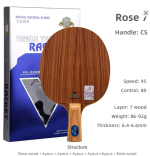
Rosewood V is better than Rosewood VII imo but Rosewood VII is not bad. There are some professionals who have used it, but you do have to be very precise with it. Personally I'm not good enough at TT to play that precisely, but maybe you are.
iirc rosewood is harder than walnut, so Rosewood V should be harder than Intensity.
The main thing I like about rosewood blades is that they have a very nonlinear effect which creates great harmony with tacky Chinese rubbers. You can touch the ball short with lots of control if you touch it softly, but when you take a big swing (even if it is somewhat relaxed) you get a sharp cracking sound and a very fast ball. So you can switch from drop shots to power-loops seamlessly. You get the benefits of wood in the short game, and you don't need to struggle to add power when playing behind the table -- something that is rare with all-wood blades.
This description of the playing feel is spot on. In my experience rosewood is a hugely fast, non-linear, two-to-three-speed wood.
It's probably more correct of me to say rosewood (and other woods like it) react a lot to impact forces, because it's both very hard AND very stiff compared to other common outer woods.
The wood also doesn't 'give' very much at the point of impact due to its stiffness. The stiffness and hardness combined is what gives it this non-linear, three-speed nature.
Generally, rosewood outer blades have *very* heavy spin when slow looping or brushing the ball lightly without engaging the sponge. With these strokes, the impact forces don't really reach the wood much (Ie: speed one)
If you moderately engage the sponge with a loop-drive, then the blade is quite fast. There's still only a small amount of the impact forces actually reaching the outer wood layer however, so you're still not quite seeing the full speed of the blade (speed two)
It's only when you engage the sponge *fully*, in a proper drive, lob or full-blooded smash that you see its true speed. It's extreme hardness gives it high speed anyway, but it's high stiffness compounds the effect. The wood doesn't flex inward towards the medial layers very much at the point of impact, which means the rubber's sponge is compressed more than normal.... This doesn't happen with harder but more flexy woods like koto or walnut, as at the point of impact, the outer wood still flexes or gives a little bit directly underneath the ball.
The more 'unyielding' nature of rosewood, combined with the slightly higher amount of sponge compression, results in a sudden jump in speed with heavier shots, compared to your slower strokes (speed three).
If you're the kind of player who has really good touch, and loves to open up with a slow spinny loop then follow it with a full-blooded fast loop or drive, then a set of rosewood outers (or other woods just like them) are really up your alley, as are tacky Chinese rubbers. If you have the touch to handle it, rosewood-like outers and tacky rubbers are a killer FH combo. 😎😎😜