Rubber with highest Throw Angle

This user has no status.
🏆 Top 1% Commenter
Well-Known Member
Moderator
Oct 2014
20,000
26,566
70,952
Read 17 reviews
So if someone swings hard and fast with a hurricane then they will find the throw higher than someone with a slower swing? Is this more the case with flat hits and drives, or with spinnier loops?

It is usually loops and loop drives. Hurricane is good for someone with the footwork to get into position and loop drive consistently. In fact some people will tell you not to rank Europe and China rubbers along the same continuum as their strokes don't respond to the ball the same way. I don't fully agree but I get the point. The tack and the hard sponge mean you can get spin at pretty high stroke speeds.
 
Last edited:
  • Like
Reactions: BeGo
This user has no status.
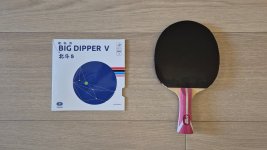
Well, Thanks guys for the reply. I recently buy Yinhe big dipper and used it for 1 training session. I used it on FH and the throw angle is pretty high for my stroke. I can lift heavy backspin pretty effortlessly. I like it so much. i hope I can be a better player with Yinhe Big Dipper.
 
This user has no status.
🏆 Top 1% Commenter
Well-Known Member
Moderator
Oct 2014
20,000
26,566
70,952
Read 17 reviews
Well, Thanks guys for the reply. I recently buy Yinhe big dipper and used it for 1 training session. I used it on FH and the throw angle is pretty high for my stroke. I can lift heavy backspin pretty effortlessly. I like it so much. i hope I can be a better player with Yinhe Big Dipper.

I used it in 38 degree for 6 mths (2014 Nov to 2015 April or so) on both forehand and backhand - it was my first committed plastic ball rubber - and I learned a lot while using it. QC issues made me change.
 
Last edited:
This user has no status.
🏆 Top 1% Commenter
Well-Known Member
Moderator
Oct 2014
20,000
26,566
70,952
Read 17 reviews
What kind of QC issues do you experienced when using it ?

I just could not trust that the rubber was 38 degrees and that it was always responding the same way. It started feeling harder and more pure "Chinese" than mixed. I don't think someone using 40 degrees will have that issue and maybe they have finalized the issues and quality as it was new and in demand when I first used it. I just wish someone could consistently produce what they originally sold as 38 deg.
 
This user has no status.
Member
Aug 2015
328
211
708
I just could not trust that the rubber was 38 degrees and that it was always responding the same way. It started feeling harder and more pure "Chinese" than mixed. I don't think someone using 40 degrees will have that issue and maybe they have finalized the issues and quality as it was new and in demand when I first used it. I just wish someone could consistently produce what they originally sold as 38 deg.
If the QC problems was resolved could you change to BD again?
I'm very tempted to test that rubber too

Sent from my 2014819 using Tapatalk
 
This user has no status.
This user has been banned.
Apr 2016
11
12
23
[FONT=&quot]The term throw angle is usually based on the arc with which the ball leaves the blade after the impact. Given the same stroke, the rubber with the higher arc would be labelled as high throw.[/FONT]
[FONT=&quot]The problem with the above definition is that a single rubber doesn’t have a single throw angle, but many different ones. Based on the incoming ball(spin and speed) and your stroke (blade angle, stroke direction) you get a unique throw angle for every ball. As we can see (or later see since the explanations follow below), we can only compare different rubbers throw angles on certain stroke types.[/FONT]
[FONT=&quot]However, people aren’t stupid and we’ll see later on why this infamous term enjoys such a high popularity, how and why the usual rubber reviewer labels a rubber as high or low throw and how you can still benefit from these (false or inexact) reviews to make a good decision.[/FONT]
 
  • Like
Reactions: BeGo
This user has no status.
Active Member
Nov 2015
559
840
2,039
The term throw angle is usually based on the arc with which the ball leaves the blade after the impact. Given the same stroke, the rubber with the higher arc would be labelled as high throw.
The problem with the above definition is that a single rubber doesn’t have a single throw angle, but many different ones. Based on the incoming ball(spin and speed) and your stroke (blade angle, stroke direction) you get a unique throw angle for every ball. As we can see (or later see since the explanations follow below), we can only compare different rubbers throw angles on certain stroke types.
However, people aren’t stupid and we’ll see later on why this infamous term enjoys such a high popularity, how and why the usual rubber reviewer labels a rubber as high or low throw and how you can still benefit from these (false or inexact) reviews to make a good decision.

This was lifted from here:

https://thoughtsontabletennis.wordpress.com/2015/09/07/throw-angle/

You've done it several times already - any particular reason you decided to participate in forum that way? Unless you are a bot, of course.
 
Top