


This user has no status.

This user has no status.
Member


I’ve loved the Sanwei Target National series for a long time now. What most don't really know is that I chose it as a replacement for my dead Tenergy 25 many many moons ago after seeing a review from a Japanese YouTube channel (Sanwei has republished it on their YT channel). What immediately struck me then was how deadly fast and low my topspin drives were, especially when struck with venom from further away the table.
I also loved the highly tacky surface and the seemingly indestructible nature of the rubber – it can be marked all over with ball marks etc. and will still be magically capable of generating great spin.
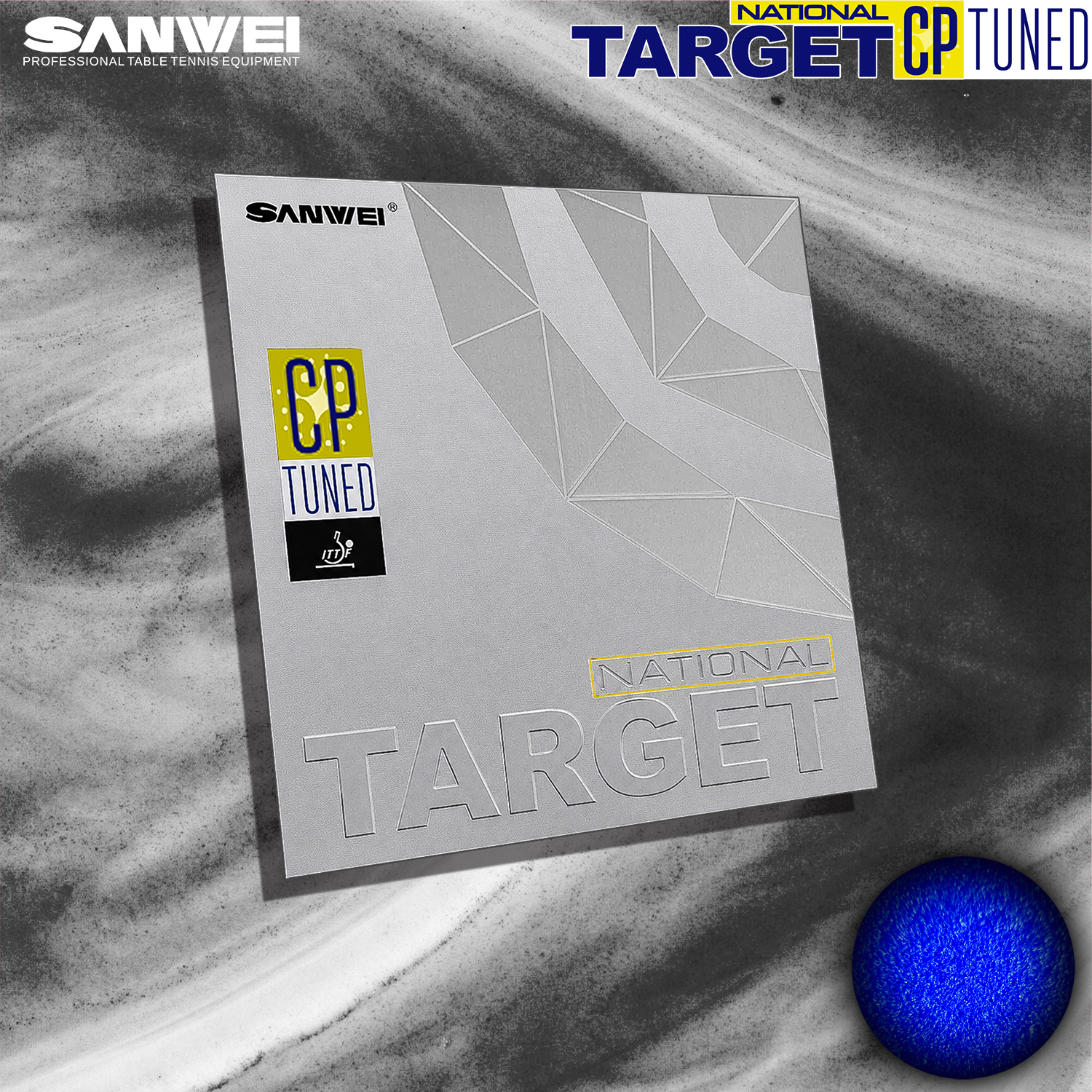
Enter Sanwei's latest release, the Target National CP-Tuned rubber.
In their marketing, they've described the CP-Tuned sponge like this:
Cake Sponge ←—— CP-Tuned Compact Sponge ——→ High-Density Sponge
“The idea was to maintain the deformation characteristics of a cake sponge, while adding more internal support and a stronger sense of compression.”
Here's some more information before I go into how that plays out in practice.
Technical details:
Uncut weight: 70g (+/- 1g).
Cut weight on a DHS Fang Bo B2x (159 mm x ~149 mm): 55g
Hardness variations: 38° / 39° / 40° / 41° (Review is for the hardness versions in bold)
Tackyness: Very tacky out of the packet
Additional info: Factory-tuned. The effect is quoted to last 1 to 2 months (Sanwei describes a 2 stage, 4 working days process).
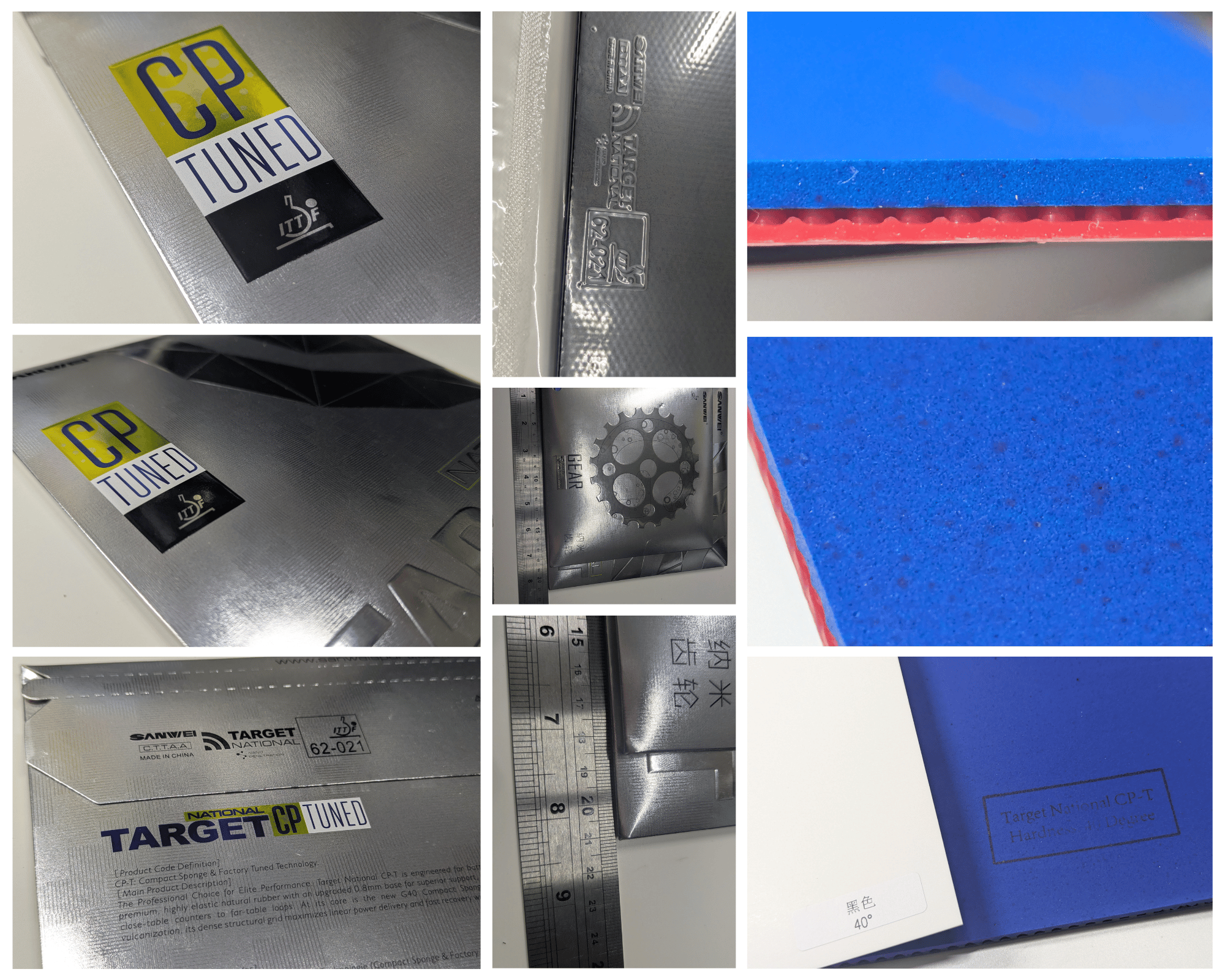
Photos:
Initial impressions
The first thing you'll notice, and it's hard not to, is the size of the packet. It's huge! Absolutely dwarfs the packaging for other rubbers. I measured the length at 21.2cm while the Sanwei Gear's packet is about 19cm.
The words CP-Tuned are laid out prominently above the ITTF logo on the front of the Target's now classic silver packaging, and the word National now has a subtle shiny outline applied to it.
I also asked Sanwei's rep a few questions about the rubber (Answers lightly edited for readability):
1. The Sanwei Target CP-Tuned is very tacky out of the packet. How was the tackiness level achieved?
"We use high-quality natural rubber to achieve the strong tackiness of CP-Tuned. The goal was to create a top sheet that delivers excellent grip and spin potential while maintaining consistent performance."
2. How was the tackiness balanced against the Sanwei Target National CP-Tuned's objectives?
"We specifically developed the CP-Tuned to compete with the DHS Hurricane 3 National. We wanted players to enjoy a more affordable and comparable performance, without the extra hassle of boosting. That was the core objective through its development: delivering the performance expected from a high-end Chinese rubber in a more convenient, cost-effective package."
3. Why is the packaging so big? It's huge!
"There are a few reasons behind it! First, we wanted to protect such a high-performance rubber properly. The vacuum-sealed plastic helps preserve performance while the rigid packaging provides extra protection against impact and potential physical damage during shipping and handling."
"The other reason: We wanted to give players a little sense of occasion when they opened it. We believe the experience of receiving and unboxing a premium piece of equipment should feel special too. After all, it's not just another sheet of rubber!"
Review
Note: I glued the black 40° and red 38° on my DHS Fang Bo B2X blade and also got impressions from a range of playing ability all the way up to Division 1 level.
Right out of the packet, I did a ball holding test (Link to YouTube Short) and the black held the ball slightly longer than the red. The level of tackiness in the Sanwei Target National CP-Tuned was a nice surprise since I've noticed a range of brands actually reducing the amount of tack in their recent releases. Even the famously tacky DHS Hurricane 3 seems to be less tacky than before.
Probably the first thing noticed is the huge amount of spin you can generate with this rubber – and the next is that the 40° version feels pretty hard! One of my more highly skilled friends remarked that it might need some breaking in time if playing fresh out of the packet. In top spin rallies, the ball flew fast and low (like you would expect from a Sanwei Target National rubber), with huge amounts of spin.
Chop it, drive it, loop it, this rubber is capable of a lot. Sanwei describes it as a rubber that really benefits from better technique and form and I concur, particularly for the 40° version. Passive shots and blocks would often fail to clear the net. You do need some technique and arm speed to properly engage it – my shoulder definitely felt the effects after extended playing time (Or perhaps more likely, I need better technique and use more of my body and legs to help generate that power!).
Some blocks also bounced off the rubber and failed to land on the table when I over extended, which indicated a certain level of elasticity and bounciness in the CP-Tuned's sponge.
Serves were very spinny from small, quick wrist movements and the rubber is naturally very suitable for 3rd and 5th ball attacks. Key point is this was made for offense rather than all round play so you should take advantage of the rubber's capabilities to control points through speed and spin rather than placement and all-round control.
The CP-Tuned sponge also sits in an in-between space between being high tension (and really bouncy – boing boing!) and having the 'dead', highly linear feeling so common in traditional Chinese table tennis rubbers.
Summary
If you've got solid fundamentals, go for the 40° or 41° hardness version to enjoy the full capability of the Sanwei Target National CP-Tuned rubber. For the mortals among us who still want to enjoy this rubber, I'd recommend the 38° hardness version on the forehand instead.
Play test video
I also loved the highly tacky surface and the seemingly indestructible nature of the rubber – it can be marked all over with ball marks etc. and will still be magically capable of generating great spin.
Enter Sanwei's latest release, the Target National CP-Tuned rubber.
In their marketing, they've described the CP-Tuned sponge like this:
Cake Sponge ←—— CP-Tuned Compact Sponge ——→ High-Density Sponge
“The idea was to maintain the deformation characteristics of a cake sponge, while adding more internal support and a stronger sense of compression.”
Here's some more information before I go into how that plays out in practice.
Technical details:
Uncut weight: 70g (+/- 1g).
Cut weight on a DHS Fang Bo B2x (159 mm x ~149 mm): 55g
Hardness variations: 38° / 39° / 40° / 41° (Review is for the hardness versions in bold)
Tackyness: Very tacky out of the packet
Additional info: Factory-tuned. The effect is quoted to last 1 to 2 months (Sanwei describes a 2 stage, 4 working days process).
Photos:
Initial impressions
The first thing you'll notice, and it's hard not to, is the size of the packet. It's huge! Absolutely dwarfs the packaging for other rubbers. I measured the length at 21.2cm while the Sanwei Gear's packet is about 19cm.
The words CP-Tuned are laid out prominently above the ITTF logo on the front of the Target's now classic silver packaging, and the word National now has a subtle shiny outline applied to it.
I also asked Sanwei's rep a few questions about the rubber (Answers lightly edited for readability):
1. The Sanwei Target CP-Tuned is very tacky out of the packet. How was the tackiness level achieved?
"We use high-quality natural rubber to achieve the strong tackiness of CP-Tuned. The goal was to create a top sheet that delivers excellent grip and spin potential while maintaining consistent performance."
2. How was the tackiness balanced against the Sanwei Target National CP-Tuned's objectives?
"We specifically developed the CP-Tuned to compete with the DHS Hurricane 3 National. We wanted players to enjoy a more affordable and comparable performance, without the extra hassle of boosting. That was the core objective through its development: delivering the performance expected from a high-end Chinese rubber in a more convenient, cost-effective package."
3. Why is the packaging so big? It's huge!
"There are a few reasons behind it! First, we wanted to protect such a high-performance rubber properly. The vacuum-sealed plastic helps preserve performance while the rigid packaging provides extra protection against impact and potential physical damage during shipping and handling."
"The other reason: We wanted to give players a little sense of occasion when they opened it. We believe the experience of receiving and unboxing a premium piece of equipment should feel special too. After all, it's not just another sheet of rubber!"
Review
Note: I glued the black 40° and red 38° on my DHS Fang Bo B2X blade and also got impressions from a range of playing ability all the way up to Division 1 level.
Right out of the packet, I did a ball holding test (Link to YouTube Short) and the black held the ball slightly longer than the red. The level of tackiness in the Sanwei Target National CP-Tuned was a nice surprise since I've noticed a range of brands actually reducing the amount of tack in their recent releases. Even the famously tacky DHS Hurricane 3 seems to be less tacky than before.
Probably the first thing noticed is the huge amount of spin you can generate with this rubber – and the next is that the 40° version feels pretty hard! One of my more highly skilled friends remarked that it might need some breaking in time if playing fresh out of the packet. In top spin rallies, the ball flew fast and low (like you would expect from a Sanwei Target National rubber), with huge amounts of spin.
Chop it, drive it, loop it, this rubber is capable of a lot. Sanwei describes it as a rubber that really benefits from better technique and form and I concur, particularly for the 40° version. Passive shots and blocks would often fail to clear the net. You do need some technique and arm speed to properly engage it – my shoulder definitely felt the effects after extended playing time (Or perhaps more likely, I need better technique and use more of my body and legs to help generate that power!).
Some blocks also bounced off the rubber and failed to land on the table when I over extended, which indicated a certain level of elasticity and bounciness in the CP-Tuned's sponge.
Serves were very spinny from small, quick wrist movements and the rubber is naturally very suitable for 3rd and 5th ball attacks. Key point is this was made for offense rather than all round play so you should take advantage of the rubber's capabilities to control points through speed and spin rather than placement and all-round control.
The CP-Tuned sponge also sits in an in-between space between being high tension (and really bouncy – boing boing!) and having the 'dead', highly linear feeling so common in traditional Chinese table tennis rubbers.
Summary
If you've got solid fundamentals, go for the 40° or 41° hardness version to enjoy the full capability of the Sanwei Target National CP-Tuned rubber. For the mortals among us who still want to enjoy this rubber, I'd recommend the 38° hardness version on the forehand instead.
Play test video