Yinhe PRO-01G: is green arylate better?

This user has no status.
Member
May 2024
79
50
159
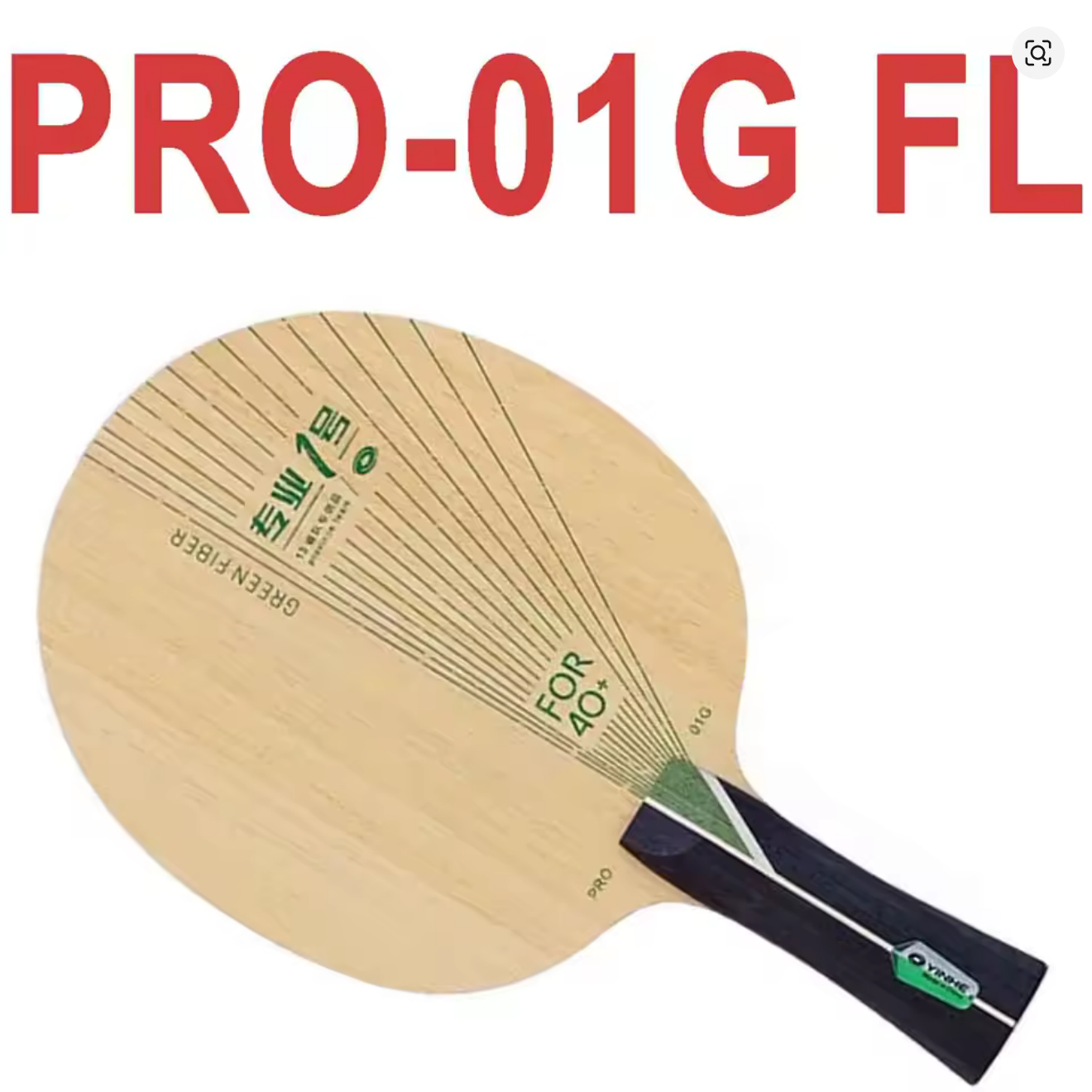
There is a new version of PRO-01, with green arylate. Let's presume it's the Korean made fiber, present also in other blades from established manufacturers, and not a paint job only :D Does anybody have any experience with this blade?

I see also that Sanwei launched a new green arylate product, SANWEI 75G, cheaper than the Verdi, an inner fiber model. Any feedback on that one?


1780578255893.png
 
This user has no status.
Member
Nov 2025
155
227
667
I get the impression that Yinhe makes mostly cosmetic changes to their catalogue of blades and just updates naming or something.

Presumably, it boosts sales to release something 'new'. It presumably is being produced at a new location due to the change in fiber, but again, this seems like it would be mostly cosmetic to me.

Without being able to pick apart the green vs blue version of ALC, I'm inclined to think that the most noticeable thing would be variations in weight and not that the fibers themselves are meaningfully different.
 
  • Like
Reactions: kindof99
This user has no status.
Member
Aug 2024
233
131
460
Taken from TokSpin.com (same person/business as Chinese PingPong on Aliexpress):
YINHE PRO-01G is the enhanced green arylate carbon version of the popular PRO-01 offensive table tennis blade. It features an external fiber construction that delivers a crisp, hard and bouncy feel for aggressive play. It is engineered for players who want more power than standard blue ALC blade options.

Furthermore, it boasts a stiffer, faster response with stronger bottom-end power compared to standard blue ALC models. It excels at close to mid-table fast attack and explosive counter loop shots that catch opponents off guard. It delivers consistent, predictable feedback even on full-power offensive strokes.
 
This user has no status.
Member

Sep 2025
47
80
156
Taken from TokSpin.com (same person/business as Chinese PingPong on Aliexpress):
"Bottom-end power" is probably a mistranslation of dijin, which should actually be translated as power ceiling. Better dijin just means can linearly support higher input force before bottoming out/plateauing, typically only relevant far from the table.
 
  • Like
Reactions: al_111
says Shoo...nothing to see here. - zeio
🏆 Top 1% Commenter
Well-Known Member
Jan 2018
13,480
13,131
29,938
"Bottom-end power" is probably a mistranslation of dijin, which should actually be translated as power ceiling. Better dijin just means can linearly support higher input force before bottoming out/plateauing, typically only relevant far from the table.
Well, there is an official DHS definition on the term 底勁 that WLQ also uses like us mere mortals.

It corresponds to the coefficient of restitution, or COR for short. A fancy term for bounce.

https://www.tabletennisdaily.com/forum/topics/stories-of-dhs-and-blade-prototypes.38746/post-560224
But what exactly does "greater control" mean? To "decipher" the intuitive language of national team players like Wang Liqin, the research institute invested heavily in developing a simulated ball-hitting blade testing system. After thousands of simulations, they finally mapped the players' intuitive language to quantifiable technical parameters—"large control" requires the ball to remain on the blade long enough for the player to exert sufficient force; "sufficient power" refers to the initial velocity of the ball upon leaving the blade; the greater the power, the faster the ball travels, and so on.
 
Last edited:
This user has no status.
Member

Sep 2025
47
80
156
Well, there is an official DHS definition on the term 底勁 that WLQ also uses like us mere mortals.

It corresponds to the coefficient of restitution, or COR for short. A fancy term for bounce.

https://www.tabletennisdaily.com/forum/topics/stories-of-dhs-and-blade-prototypes.38746/post-560224
Well, I don't know about DHS engineers from 2005, but based on the Chinese reviews that I've been reading, 底劲 specifically refers to the top gear, the performance when one has the opportunity to fully swing and actively commit maximum power input.

There are other confonding terminology like 速度感、一速、二速、摆速.

Trying to map TT lingo to quantifiable physics measurements is probably a tricky endeavor that would take us too far off topic.
 
  • Like
Reactions: golden_son
says Shoo...nothing to see here. - zeio
🏆 Top 1% Commenter
Well-Known Member
Jan 2018
13,480
13,131
29,938
Well, I don't know about DHS engineers from 2005, but based on the Chinese reviews that I've been reading, 底劲 specifically refers to the top gear, the performance when one has the opportunity to fully swing and actively commit maximum power input.

There are other confonding terminology like 速度感、一速、二速、摆速.

Trying to map TT lingo to quantifiable physics measurements is probably a tricky endeavor that would take us too far off topic.
Doesn't matter. Many of those colloquial terms/technical jargon refer to the same thing in physics terms, just different stages of the shot from different perspectives (frames of reference in physics).

For instance,
底勁 = initial velocity of the ball upon leaving the racket, which, in practice, depends on the swing speed and interaction between ball, rubber and blade.
一速 = velocity of the ball before bounce
二速 = velocity of the ball after bounce, typically depends on the tangential COR (initial angular velocity/spin) to normal COR (initial linear velocity/speed) ratio
攞速 = literally swing speed, more to do with biomechanics due to the swing weight of the racket, but also used for speed of transition between FH and BH strokes
速度感 = sense of speed, which loosely corresponds to catapult effect in English

p.s.
On that note, this is where a former member had consistently failed/refused to come to terms with and tried to force people into using the physics terms, when it doesn't really matter as long as we have a general consensus on what terms mean what.
 
Last edited:
Top