

Daily Table Tennis Chit Chat

This user has no status.
🏆 Top 1% Commenter
Well-Known Member
Aug 2016
1,845
2,820
13,714
So many threads & posts on here talk about technique and while they're all good, I learned this weekend that mentality, fight & emotion can make up just as much of a difference.

IMO, the mental aspect/game in any human endeavor, table tennis included, is 80-90% more important than the physical aspects. Almost all elite athletes have roughly the same skill/expertise/experience... what differentiates one from the other is the 'better' athlete has a stronger willpower/imagination/confidence/visualtization/self-talk/etc over their opponent. They believe in themselves more than their opponent believing in themselves.
 
This user has no status.
🏆 Top 1% Commenter
Well-Known Member
Aug 2016
1,007
1,403
3,392
IMO, the mental aspect/game in any human endeavor, table tennis included, is 80-90% more important than the physical aspects. Almost all elite athletes have roughly the same skill/expertise/experience... what differentiates one from the other is the 'better' athlete has a stronger willpower/imagination/confidence/visualtization/self-talk/etc over their opponent. They believe in themselves more than their opponent believing in themselves.

+1

Yeah I've seen enough videos now where Liu Guoliang is being translated talking to his team and he's big on fighting spirit etc. Figure nobody knows the game better than him so he must be onto something.

I kinda learned that lesson 1st had this weekend as evidenced by my post.
 
This user has no status.
🏆 Top 1% Commenter
Well-Known Member
Moderator
Oct 2014
19,978
26,540
70,898
Read 17 reviews
IMO, the mental aspect/game in any human endeavor, table tennis included, is 80-90% more important than the physical aspects. Almost all elite athletes have roughly the same skill/expertise/experience... what differentiates one from the other is the 'better' athlete has a stronger willpower/imagination/confidence/visualtization/self-talk/etc over their opponent. They believe in themselves more than their opponent believing in themselves.

I agree with the sentiment but disagree with the details. Ridiculously talented elite athletes do exist and they can make mental issues irrelevant when they are healthy.
 
This user has no status.
🏆 Top 1% Commenter
Well-Known Member
Dec 2010
3,769
4,559
16,101
A classic example of this for and against this argument .... the one and only Mr. Roger Federer ...

Take the Roger Federer before 2001 , he was a tantrum throwing , lazy , cry baby , not much different to what Nick Kyrgios and Bernard Tomic is showing these days , well may be a little better ... then he broke through by winning Wimbledon 2003 , along with his coach Peter Carter passing away , he became mature and started using his skills ....

he hit a second plateau when he stopped winning Grand Slams , now this time around , I know people are saying that he has gotten over it mentally , but I think its more technical , once he learnt to use his Backhand on high balls easily with the new large headed racquet , I think it has given him more freedom both from having to run around his backhand / slicicing his backhand on the first ball and also mentally having not to worry about his backhand falling apart ...

so the second time around, I don't think its a mental game its more a tactical and technique growth fuelled by new equipment , you may argue that its also the openness to adopt something new this late in the career , something if like Ma Long suddenly learnt to use Backhand oriented playbook like Zhang Jike ...

so in summary, I think both of the things are possible , again both can be true without either assertion being false ..
I agree with the sentiment but disagree with the details. Ridiculously talented elite athletes do exist and they can make mental issues irrelevant when they are healthy.
 
This user has no status.
🏆 Top 1% Commenter
Well-Known Member
Moderator
Oct 2014
19,978
26,540
70,898
Read 17 reviews
A classic example of this for and against this argument .... the one and only Mr. Roger Federer ...

Take the Roger Federer before 2001 , he was a tantrum throwing , lazy , cry baby , not much different to what Nick Kyrgios and Bernard Tomic is showing these days , well may be a little better ... then he broke through by winning Wimbledon 2003 , along with his coach Peter Carter passing away , he became mature and started using his skills ....

he hit a second plateau when he stopped winning Grand Slams , now this time around , I know people are saying that he has gotten over it mentally , but I think its more technical , once he learnt to use his Backhand on high balls easily with the new large headed racquet , I think it has given him more freedom both from having to run around his backhand / slicicing his backhand on the first ball and also mentally having not to worry about his backhand falling apart ...

so the second time around, I don't think its a mental game its more a tactical and technique growth fuelled by new equipment , you may argue that its also the openness to adopt something new this late in the career , something if like Ma Long suddenly learnt to use Backhand oriented playbook like Zhang Jike ...

so in summary, I think both of the things are possible , again both can be true without either assertion being false ..


We have quite a few in table tennis, no need to go to tennis. Look at Fan Zhendong and Harimoto, such players do not grow on trees. And anyone arguing that Fan has mental issues needs to be 20 again ( of course, I believe that is is his real age).
 
says Spin and more spin.
🏆 Top 1% Commenter
Well-Known Member
Moderator
Dec 2010
16,640
18,535
56,964
Read 11 reviews
I agree with the sentiment but disagree with the details. Ridiculously talented elite athletes do exist and they can make mental issues irrelevant when they are healthy.

A classic example of this for and against this argument .... the one and only Mr. Roger Federer ...

Take the Roger Federer before 2001 , he was a tantrum throwing , lazy , cry baby , not much different to what Nick Kyrgios and Bernard Tomic is showing these days , well may be a little better ... then he broke through by winning Wimbledon 2003 , along with his coach Peter Carter passing away , he became mature and started using his skills ....

he hit a second plateau when he stopped winning Grand Slams , now this time around , I know people are saying that he has gotten over it mentally , but I think its more technical , once he learnt to use his Backhand on high balls easily with the new large headed racquet , I think it has given him more freedom both from having to run around his backhand / slicicing his backhand on the first ball and also mentally having not to worry about his backhand falling apart ...

so the second time around, I don't think its a mental game its more a tactical and technique growth fuelled by new equipment , you may argue that its also the openness to adopt something new this late in the career , something if like Ma Long suddenly learnt to use Backhand oriented playbook like Zhang Jike ...

so in summary, I think both of the things are possible , again both can be true without either assertion being false ..

Not an argument: if you understood fully what NL said, it allows for the importance of the mental aspects of the game while recognizing that sometimes there are amazing talents that just pop up. And they are so talented that it makes the mental issues irrelevant.

The first thing I thought of was Micheal Jordan and then Hussein Bolt. Maybe both of them had the mental game part. But both of them had outrageous talent.

And NL's examples of FZD and Harimoto also show two young kids with outrageous talent.

And without the talent, no amount of mental game is going to make me win against someone 2 full levels higher than me. The difference between me and people better than me is definitely more technical than mental.
 
Last edited:
This user has no status.
🏆 Top 1% Commenter
Well-Known Member
Jun 2011
3,095
1,277
5,264
Read 7 reviews
@NextLevel

Thank you for filming and uploading the games played in your leagues. I was just now watching a new video and realized that most of the amateur table tennis I've seen on video can only be seen because you film it.

I also film our low league matches..
Mostly table tennis trash, but.. sometimes.. sometimes miracles happen ;)
 
  • Like
Reactions: OldschoolPenholder
This user has no status.
🏆 Top 1% Commenter
Well-Known Member
Moderator
Oct 2014
19,978
26,540
70,898
Read 17 reviews
Not an argument: if you understood fully what NL said, it allows for the importance of the mental aspects of the game while recognizing that sometimes there are amazing talents that just pop up. And they are so talented that it makes the mental issues irrelevant.

The first thing I thought of was Micheal Jordan and then Hussein Bolt. Maybe both of them had the mental game part. But both of them had outrageous talent.

And NL's examples of FZD and Harimoto also show two young kids with outrageous talent.

And without the talent, no amount of mental game is going to make me win against someone 2 full levels higher than me. The difference between me and people better than me is definitely more technical than mental.

Usain Bolt is probably the best example and sprinting/racing is probably the easiest ground to show something like that. Even Phelps. Sure they had great mental toughness and trained hard, but those guys were so far ahead of the competition at their peak that their worst times could often beat competitive fields and they were essentially racing against themselves. Bolt was so good that even when he declined, he was still too far ahead of the pack. Phelps was so good as a swimmer at his peak that he once set a US men's freestyle record in the first leg of a relay despite not being selected for or attempting to swim freestyle for the US swimming team. Which tells you he could likely have been a top US sprint swimmer had he decided to go that route. He swam 3 Olympics after his peak and one before and his medal record is so ridiculous that if he didn't exist, you would think no one would ever be able to do it.
 
This user has no status.
🏆 Top 1% Commenter
Well-Known Member
Aug 2016
1,007
1,403
3,392
Want your guys thoughts on this. What do you like and what do you see at tournaments you go to?

So our state games just wrapped up and all the non-sanctioned (meaning non-USATT tournaments in my area. Never been to a USATT event) have used Round Robin formats. Meaning you play everyone in your designated groups. Round robins are good for making sure players get a lot of games in. They're paying money so that part of it is nice value wise. But I've always found them to be convoluted & anti-climatic.

Outside of the tournament organizers, I'm pretty sure nobody really knows where the results stand. They kinda watch & ask around to see what people's records are. For the times when say you have a 3 man RR and the records are... 3-0, 2-1, 0-3 sure it's easy to tell who came in 1st, 2nd & 3rd. But in our last state games there were a lot of tied records which means it goes to the next tiebreaker. Nobody really knew what those were.

I could go on & on about my dislike for RRs but I'll try to keep this somewhat shorter. That's why i'm a fan of standard tournament bracket events. They're faster, more clear in where players stand and it's as simple as win & advance. Lose & go home. For us double elimination tournaments would have to be the option since I don't think players would like the idea of losing their first game and being done. But at least they'd get 2 matches with double elimination. Shoot there's even 3 game guarantee double elimination tournaments out there (even though they are inherently unfair as theoretically someone could lose their first 2 games then on their 3rd match go on to win the whole thing)

If you guys were running a tournament, what would be your preferred method? Or what do you see at tournaments you visit?

Thanks
 
  • Like
Reactions: OldschoolPenholder
says Spin and more spin.
🏆 Top 1% Commenter
Well-Known Member
Moderator
Dec 2010
16,640
18,535
56,964
Read 11 reviews
The USATT sanctioned tournaments I have seen there is a round robin group. And then there is an elimination bracket. They do this so that a lot of people can enter the tournament and the elimination bracket still does not have to be too big. So in round robin groups of 4, the top 2 players from each group advance to the elimination bracket.

For your purposes you could do larger round robin groups where or 8, 10 or as many as you want and use the round robin groups for seeding in the elimination bracket. And make it so, everyone gets into the elimination bracket and it is single elimination. If it was RR groups of 8, everyone would play a guarantee of 7 RR matches and then at least one match in the elimination. It would not go as long as RR where everyone in the tournament has to play everyone else and then tie breakers need to be played. And everyone would get a decent number of matches. And everyone would get a shot in the elimination bracket.
 
This user has no status.
🏆 Top 1% Commenter
Well-Known Member
Aug 2016
1,007
1,403
3,392
The USATT sanctioned tournaments I have seen there is a round robin group. And then there is an elimination bracket. They do this so that a lot of people can enter the tournament and the elimination bracket still does not have to be too big. So in round robin groups of 4, the top 2 players from each group advance to the elimination bracket.

For your purposes you could do larger round robin groups where or 8, 10 or as many as you want and use the round robin groups for seeding in the elimination bracket. And make it so, everyone gets into the elimination bracket and it is single elimination. If it was RR groups of 8, everyone would play a guarantee of 7 RR matches and then at least one match in the elimination. It would not go as long as RR where everyone in the tournament has to play everyone else and then tie breakers need to be played. And everyone would get a decent number of matches. And everyone would get a shot in the elimination bracket.

Okay thanks for the info.

For a little background, our biggest event is always our Opens.

We always do RR groups of 3 to determine A Singles, B Singles & C Singles. From there, we round robin again for those class singles.

I'd probably prefer those be double elimination.

This last weekend we at a lot of RR groups of 6 & 7 where everybody played everybody and it just ran long as playing that many games simply takes a while.

I appreciate the info.
 
  • Like
Reactions: OldschoolPenholder
says Spin and more spin.
🏆 Top 1% Commenter
Well-Known Member
Moderator
Dec 2010
16,640
18,535
56,964
Read 11 reviews
Okay thanks for the info.

For a little background, our biggest event is always our Opens.

We always do RR groups of 3 to determine A Singles, B Singles & C Singles. From there, we round robin again for those class singles.

I'd probably prefer those be double elimination.

This last weekend we at a lot of RR groups of 6 & 7 where everybody played everybody and it just ran long as playing that many games simply takes a while.

I appreciate the info.

I think that format sounds good. RR groups of three to determine A, B and C. And then Double Elimination.

Could also be RR groups of 4 or 5 to determine A, B and C. And then single elimination. Either way, everyone gets to play a certain amount. Nobody gets shorted at 1 or 2 games. And you have the clear decisiveness of semifinals matches and finals. And you have the excitement for players and participants of knowing they are semi and finals matches. So, more than likely, more people will stick around to see who wins.

Honestly, I am not experienced at running tournaments. So I am just guessing. But it sounds to me like your ideas of how to set it up should be good.
 
Last edited:
This user has no status.
🏆 Top 1% Commenter
Well-Known Member
Dec 2010
3,769
4,559
16,101
What I was trying to say and may be it did not come out as clearly as I intended is that its a fine line. Its very difficult to separate out the two , and Roger's career being as long as it is its easy to find examples where both arguments fit.
At one point in time he was simply ahead of the field , when the field narrowed down he faltered mentally and technically and again he found out mental and technical solutions to overcome lowering expectations, retooling his backhand and having a never ending love for the sport and hunger for more success. To figure out which one is true is like a Chicken and Egg problem did he retool his backhand because he was hungry for more success or did he became hungry once he figure out a solution.
Of course talents can be skilled enough to dominate the field , like Bolt, Phelps , or even Katie Ledecky . Or there are examples on the other side where not so great talents have dominated the field through sheer will power when other talents have waned.
Take the example of Agassi , he was not more talented than Sampras but he always got into a dogfight with him , I know you don't follow Cricket , there was somebody called Steve Waugh , considerably less talented than his brother Mark but who captained Australia to success and prolonged his career by a mile just because he was ready to get hit with 90 mph balls on his body when he had problems ducking , or even Kobe Bryant who was about to give up on basketball when he heard Michael Jordan was also cut from his high school basketball team ....

Point is at the rarefied atmosphere of sporting success every single flaw gets highlighted , mental or otherwise. So no matter how talented you are you will be found out by your opponents. If you play long enough people tend to catch up with you, the reason Phelps and Bolt quit is because they knew the field was becoming level and they will have to reach into their mental strength to keep dominating the field and its not easy to do. There are very few athletes who have been able to keep their love for the game going long enough to supplement their talents with smart adaptability and sheer force of will ... now which is which and which mattered is hard to tell ..

Your assertion at the end is of course valid , because you are putting forth examples that are too far apart. We have to compare people who are competitive against each other in terms of overall skill.


Not an argument: if you understood fully what NL said, it allows for the importance of the mental aspects of the game while recognizing that sometimes there are amazing talents that just pop up. And they are so talented that it makes the mental issues irrelevant.

The first thing I thought of was Micheal Jordan and then Hussein Bolt. Maybe both of them had the mental game part. But both of them had outrageous talent.

And NL's examples of FZD and Harimoto also show two young kids with outrageous talent.

And without the talent, no amount of mental game is going to make me win against someone 2 full levels higher than me. The difference between me and people better than me is definitely more technical than mental.
 
  • Like
Reactions: OldschoolPenholder
says Spin and more spin.
🏆 Top 1% Commenter
Well-Known Member
Moderator
Dec 2010
16,640
18,535
56,964
Read 11 reviews
Ummmm, the opinion was voiced that in success, the mental was 80-90% more important than the physical aspects. NextLevel pointed out that it is a fine sentiment but that sometimes there are people who have so much talent that, for them, the mental side of things becomes far less important.

It does sound like you are presenting things that agree with the idea that sometimes a player can have so much talent that the mental game does not need to be focused on to the same extent. But at the same time you sound like you are saying the opposite as well.

A nice example of how important the mental side of things can be is Larry Bird. Many felt he really did not have the talent. But man was he good.

An example of someone where talent overrode the need to focus so much on the mental aspects of the game was Bolt.

If both can exist than mental game being 80-90% more important than the physical is not quite right.

I think Darrel Strawberry is a good example of how lack of mental game can cause a super talent to crash as his talents start to fade. Please note, I worded that very carefully. He was a super talent. He had all the attributes to be a real solid hall of gamer. He faded earlier than he should have because, as he started losing a step physically, he could not make up for it with the mental. Drugs may have helped his demise. But his stay at the top was short because the mental game never kicked in. Yet he was at the top despite having so little mental game it was crazy.

And I think the idea that Phelps' and Bolt's talents faded because of something other than the fact that they were aging in a sport dominated by much younger athletes, is naive. How many Olympics did each perform in? How many else have done that?

Anyway, for most the mental side of things in any sport is very important.

But I would have to say, to be a top athlete in most sports you usually need both. Every so often there is a major talent who does not need as much of the mental in his/her prime. As they get older, of course they will need it more.

And every so often there is someone with a little less then top physical attributes whose mental game is so good that they become a top athlete as well.


Sent from The Subterranean Workshop by Telepathy
 
Last edited:
This user has no status.
🏆 Top 1% Commenter
Well-Known Member
Dec 2010
3,769
4,559
16,101
I agree its a difficult topic , and my point is that is difficult to put a number on it whether its 80-90 percent or whether talent can override mental game or the lack thereof.
Lets say we agree on most of the things we discussed.
Ummmm, the opinion was voiced that in success, the mental was 80-90% more important than the physical aspects. NextLevel pointed out that it is a fine sentiment but that sometimes there are people who have so much talent that, for them, the mental side of things becomes far less important.

It does sound like you are presenting things that agree with the idea that sometimes a player can have so much talent that the mental game does not need to be focused on to the same extent. But at the same time you sound like you are saying the opposite as well.

A nice example of how important the mental side of things can be is Larry Bird. Many felt he really did not have the talent. But man was he good.

An example of someone where talent overrode the need to focus so much on the mental aspects of the game was Bolt.

If both can exist than mental game being 80-90% more important than the physical is not quite right.

I think Darrel Strawberry is a good example of how lack of mental game can cause a super talent to crash as his talents start to fade.

And I think the idea that Phelps' and Bolt's talents faded because of something other than the fact that they were aging in a sport dominated by much younger athletes, is naive. How many Olympics did each perform in? How many else have done that?

Anyway, for most the mental side of things in any sport is very important.

But I would have to say, to be a top athlete in most sports you usually need both. Every so often there is a major talent who does not need as much of the mental in his/her prime. As they get older, of course they will need it more.

And every so often there is someone with a little less then top physical attributes whose mental game is so good that they become a top athlete as well.


Sent from The Subterranean Workshop by Telepathy
 
says Spin and more spin.
🏆 Top 1% Commenter
Well-Known Member
Moderator
Dec 2010
16,640
18,535
56,964
Read 11 reviews
I agree its a difficult topic , and my point is that is difficult to put a number on it whether its 80-90 percent or whether talent can override mental game or the lack thereof.
Lets say we agree on most of the things we discussed.

But we can safely say that for me, the physical failings are 80-90% mental. [emoji2]


Sent from The Subterranean Workshop by Telepathy
 
Last edited:
This user has no status.
🏆 Top 1% Commenter
Well-Known Member
Jan 2016
5,313
6,823
27,616
trained 1 hour last night with a veteran player, he must have been quite good when young, and he still is even though far from what he must have been as his footwork isn't great anymore and he's a PH who likes to play one or two steps away from the table

Quite a good training, he likes to coach me a bit. He congratulated me that I've improved a lot. But says #1 thing i should do is try to play with a bit more control, so a bit less fast but with more consistency, and i play even better when i think control instead of speed and kill.
 
says The sticky bit is stuck.
🏆 Top 1% Commenter
Well-Known Member
Jan 2017
2,842
2,707
8,362
Read 8 reviews
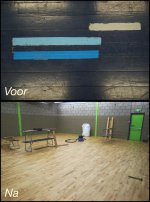
Been arranging for a few things, and carrying them out with a bunch of volunteers at the club: painting walls, fixing the wall flushing, and renewing the floor by a solid beech one. Almost done; and in a few days the body will start forgetting the pain.

merged.jpg
 
This user has no status.
🏆 Top 1% Commenter
Well-Known Member
Moderator
Oct 2014
19,978
26,540
70,898
Read 17 reviews
Top