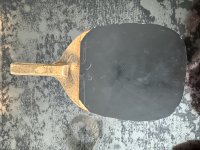
1 ply Hinoki Clear Epoxy Around prevents breaking

This user has no status.
Active Member
Jul 2019
596
563
2,432
Hello to all 1 ply hinoki users, I have read somewhere that 1 ply hinoki they put clear epoxy on all around the side to prevent breaking, is it true?
Will it change the feel a lot?
I want your opinions.
I Have owned several 1-ply hinoki in the past and have done the epoxy trick with a pair of darker 1ply. They still felt like Hinoki to play with, and after 3 years they survived to be sold on. The. epoxy protected against chipping round the. edge quite well. I don't know that it would prevent splitting along the grain which is the big worry. My current 1 ply (yin-he) ayous wood has a few chips & dents round the edge. (no epoxy) but very sound, more a war club than a racket.
I think my main advice is to own 2 at a time, only :-
if you can afford it
or
if you are a serious tournament player

otherwise maybe research the Yinhe 1 ply like mine. which is much cheaper
 
This user has no status.
Member
Mar 2022
420
677
2,038
The weakness in Hinoki is inherently built into its structure, so there's only so much you can do to protect it.

It's latewood (i.e.:winter growth) is extremely dense compared to its earlywood (summer growth). This creates geometrically regular large density shifts in the wood, each of which then becomes a mechanical points of weakness once you've quarter-sawn the board to make your one-ply.

This growth pattern is partially due to the very cold climates hinoki grows in -- a lot of other cold-climate softwood species are the same: western red cedar, douglas fir and western hemlock being just a few examples. It's extremely slow growth rate is also a factor (eg: look at the very dense grain of Huon pine for an equivalent).

Mostly though, this growth pattern (and the snapping problem) is due to genetics more than anything else, so trying to stop the splitting is a losing battle.
-- Like @haggisv said, the epoxy would really only prevents chipping, which lessens the risk of localised impact related splitting. Hinoki is a very resinous species so the epoxy isn't going to penetrate the wood at all - it's just a surface band-aid measure.A quick edge burnish should also help, but given there's a lot of exposed end grain on a blade, I doubt any improvement from the burnishing is going to be massive).

Only thing that's really guaranteed to extend the life of a Hinoki one-ply is to avoid ox rubbers entirely -- you really want the cushioning effect of that sponge layer to help minimise the impact stresses, especially if you're a hard hitter.

But if you absolutely positively *must* use ox rubbers on a Hinoki one ply, then maybe consider burnishing the playing surface as well. Again, it won't do much (apart from harden the playing feel a little and speed the blade up a bit) but it's definitely better than nothing.

 
Yes splitting along the grain is the big risk. Foam edge tape can help as well, but if you hit the table hard enough you can still split the blade... both the epoxy or foam edge tape only providing limited protection.
Even if I epoxy all around the SIDE of hinoki even on the handle side? Will not a big help to avoid splitting? If that's the case, seems like i will not spend on epoxy.
 
  • Like
Reactions: lodro
says Making a beautiful shot is most important; winning is...
🏆 Top 1% Commenter
Well-Known Member
Mar 2021
4,848
5,737
12,094
The weakness in Hinoki is inherently built into its structure, so there's only so much you can do to protect it.

It's latewood (i.e.:winter growth) is extremely dense compared to its earlywood (summer growth). This creates geometrically regular large density shifts in the wood, each of which then becomes a mechanical points of weakness once you've quarter-sawn the board to make your one-ply.

This growth pattern is partially due to the very cold climates hinoki grows in -- a lot of other cold-climate softwood species are the same: western red cedar, douglas fir and western hemlock being just a few examples. It's extremely slow growth rate is also a factor (eg: look at the very dense grain of Huon pine for an equivalent).

Mostly though, this growth pattern (and the snapping problem) is due to genetics more than anything else, so trying to stop the splitting is a losing battle.
-- Like @haggisv said, the epoxy would really only prevents chipping, which lessens the risk of localised impact related splitting. Hinoki is a very resinous species so the epoxy isn't going to penetrate the wood at all - it's just a surface band-aid measure.A quick edge burnish should also help, but given there's a lot of exposed end grain on a blade, I doubt any improvement from the burnishing is going to be massive).

Only thing that's really guaranteed to extend the life of a Hinoki one-ply is to avoid ox rubbers entirely -- you really want the cushioning effect of that sponge layer to help minimise the impact stresses, especially if you're a hard hitter.

But if you absolutely positively *must* use ox rubbers on a Hinoki one ply, then maybe consider burnishing the playing surface as well. Again, it won't do much (apart from harden the playing feel a little and speed the blade up a bit) but it's definitely better than nothing.
Using pips, especially OX type is like having a platonic best friend only relationship with Megan Fox.
IMG_0220.jpeg
 
  • Haha
Reactions: Wakkibatty
says Table tennis clown
🏆 Top 1% Commenter
Well-Known Member
Apr 2020
4,667
2,963
10,852
Even if I epoxy all around the SIDE of hinoki even on the handle side? Will not a big help to avoid splitting? If that's the case, seems like i will not spend on epoxy.
If you do not just apply epoxy resin around all the edges but also a light fiberglass with it, this would indeed help to protect the edges from splintering. The edges would of course then be like a "hardened ring " around the blade. What this would do to the performance of the hinoki blade, as in vibrations, resonance, flex etc is a completely different animal.

on a little bit different note: Carpenters who install beautiful wooden stairs harden the surfaces of the steps using epoxy. This is mostly started with a mixture that is heavily thinned with epoxy thinners so that the mix can soak into the wood it is then finished of
with 1 or more layers of normal epoxy mixture and this will give the steps a nice hard finish.
If you do this to the hinoki blade you will end up with a brick on a stick 🤣
 
  • Like
Reactions: Wakkibatty
This user has no status.
Member
Mar 2022
420
677
2,038
Even if I epoxy all around the SIDE of hinoki even on the handle side? Will not a big help to avoid splitting? If that's the case, seems like i will not spend on epoxy.
The weakness in Hinoki comes not from the sides of the blade, but from within the grain.

On most woods, there is a huge density / hardness / strength deficiency between latewood and hardwood. This difference in density is anywhere from 8 times the density of the earlywood, to 32 times, which is just staggering.

It's like putting marshmallow between two aluminum plates, then wrapping the edge of both in layer of thick plastic -- supporting the edge won't make the marshmallow any stronger.

Also, all blades flex and vibrate under impact - Hinoki one plys even more so, as its a single layer of solid material.

Over time, this flexing weakens the bonds between the layers of wood, and the wood fatigues along its weakest point, until it snaps.

This is exactly the same as metal fatigue -- the effect is exactly like crushing an aluminum can very flat, then flexing it back and forth. The flexing makes the metal weak and brittle - a fault line develops, and the can tears in half.

@lodro above is correct in how builders use epoxy, and about what it would do to a One-Ply. But unlike stair treads, the base material of Hinoki is *both* soft *and* brittle.

There may be some *small* strengthening with epoxy on the sides, but it won't save the blade from wear and tear. Choosing a heavier (and therefore denser and stronger) one ply will work much better, as the wood is inherently stronger.
 
Last edited:
  • Like
Reactions: lodro
says Table tennis clown
🏆 Top 1% Commenter
Well-Known Member
Apr 2020
4,667
2,963
10,852
The weakness in Hinoki comes not from the sides of the blade, but from within the grain.

On most woods, there is a huge density / hardness / strength deficiency between latewood and hardwood. This difference in density is anywhere from 8 times the density of the softwood, to 32 times, which is just staggering.

It's like putting marshmallow between two aluminum plates, then wrapping the edge of both in layer of thick plastic -- supporting the edge won't make the marshmallow any stronger.

Also, all blades flex and vibrate under impact - Hinoki one plys even more so, as its a single layer of solid material.

Over time, this flexing weakens the bonds between the layers of wood, and the wood fatigues along its weakest point, until it snaps.

This is exactly the same as metal fatigue -- the effect is exactly like crushing an aluminum can very flat, then flexing it back and forth. The flexing makes the metal weak and brittle - a fault line develops, and the can tears in half.
Sounds like build in obsolescence. 😁
 
  • Like
Reactions: Wakkibatty
This user has no status.
Member
Mar 2022
420
677
2,038
Sounds like build in obsolescence. 😁
Yes and no.

No, in that virtually every conifer / softwood is capable of failing in this manner if it's subjected to enough stress for long enough. Softwoods just doesn't have the same physical transverse grain strength that hardwoods do.

And yes, in that there's other woods out there that provide similar spin, speed and playing feel to hinoki, but aren't nearly as prone to snapping. They don't necessarily *have* to use Hinoki to get the play performance or mechanical properties they are after, but for whatever reason they continue to do so, despite knowing of it's disadvantages. 🙂
 
  • Like
Reactions: lodro
This user has no status.
🏆 Top 1% Commenter
Well-Known Member
Jan 2021
3,922
2,876
8,104
Read 1 reviews
Yes and no.

No, in that virtually every conifer / softwood is capable of failing in this manner if it's subjected to enough stress for long enough. Softwoods just doesn't have the same physical transverse grain strength that hardwoods do.

And yes, in that there's other woods out there that provide similar spin, speed and playing feel to hinoki, but aren't nearly as prone to snapping. They don't necessarily *have* to use Hinoki to get the play performance or mechanical properties they are after, but for whatever reason they continue to do so, despite knowing of it's disadvantages. 🙂
What is such another wood type?

Cheers
L-zr
 
This user has no status.
Member
Mar 2022
420
677
2,038
Well, there's Skollawood for one, obviously (thank you for that opportunity to plug my product 🤣🤣 it felt tacky to say it without prompting 😂😂)...

...but there's also:

...various other cypress species (Hinoki is a particularly fragile wood compared to other cypress trees like macrocarpa... (In fairness though, the grain in macrocarpa isn't nearly as straight as hinoki)

Okoume / Gabon was the one ply wood of choice in the early 20th century before Hinoki became popular. Similar spin, speed, springiness and weight to Hinoki, and a downright killer medial wood in its own right.

...what else 🤔...

Several australian species of araucaria are pretty springy - hoop pine for example (NB: not an actual pine) is a pretty decent Hinoki substitute in a medial layer if you can find a the right piece of it -- (wouldn't make a one ply from it though, as it's a bit heavy). Norfolk island pine is another candidate, though cutting viable wood from between its regular massive knots is frustrating and drives you absolutely nuts, not to mention creating a LOT of waste in the proces, hence I don't use it very much.

Western red cedar in a one ply is pretty damn close to Hinoki in speed, spin and playing feel, and just like Araucaria and okoume it's a great medial wood with genuine 'pop' to it. (Port Oxford cedar is probably a bit too heavy, but would also come close in terms of speed).

Some folks make one plys from ayous and Kiri too, and I can't deny they can make a nice one ply... But while they're good one ply blades, I wouldn't really consider them as a true Hinoki substitute, as their playing feel just differs too much to call them a true substitute.

I also have a really LOVELY piece of 9mm thick, low-density European white ash in my workshop, that has a really damn lovely impact response to it. Haven't tried making a One-Ply from White Ash yet, but the dynamic bounce, speed, and soft vibration I get from this particular piece has me seriously contemplating it 😁😁

There's probably many other potential candidates I haven't discovered or tried yet apart from the above --- (something to look forward to I guess ☺️☺️) ...but at time of writing however, for my money Sköllawood and cypress are the two best Hinoki alternatives. Out of of all the ones i've mentioned off the top of my head, these two woods come closest to reproducing not just hinoki's massive speed, spin and control, but also that gorgeous buttery playing feel it has.

I freely admit Hinoki will always be special stuff with a playing feel that's virtually impossible to match -- but I also feel that it's propensity to break easily makes it a less than ideal choice for a one-ply blade, compared to stronger species like cypress or Skollawood

(NB: as I've said many times, given the time and investments I've made into developing Skollawood as a One-Ply material, I'm far from impartial on this particular subject ☺️☺️).
 
Last edited:
  • Like
Reactions: Lazer
This user has no status.
Ive built some 1 ply blades from Western red cedar and kiri and I use to apply an edge banding from hard wood (walnut wenge or something) and this adds more stability in transverse direction which for me makes the blades more balanced.

I'd also say this reduces the risk of braking along the grain...

I can imagine that epoxy will have a similar effect.
 
This user has no status.
🏆 Top 1% Commenter
Well-Known Member
Jan 2021
3,922
2,876
8,104
Read 1 reviews
Well, there's Skollawood for one, obviously (thank you for that opportunity to plug my product 🤣🤣 it felt tacky to say it without prompting 😂😂)...

...but there's also:

...various other cypress species (Hinoki is a particularly fragile wood compared to other cypress trees like macrocarpa... (In fairness though, the grain in macrocarpa isn't nearly as straight as hinoki)

Okoume / Gabon was the one ply wood of choice in the early 20th century before Hinoki became popular. Similar spin, speed, springiness and weight to Hinoki, and a downright killer medial wood in its own right.

...what else 🤔...

Several australian species of araucaria are pretty springy - hoop pine for example (NB: not an actual pine) is a pretty decent Hinoki substitute in a medial layer if you can find a the right piece of it -- (wouldn't make a one ply from it though, as it's a bit heavy). Norfolk island pine is another candidate, though cutting viable wood from between its regular massive knots is frustrating and drives you absolutely nuts, not to mention creating a LOT of waste in the proces, hence I don't use it very much.

Western red cedar in a one ply is pretty damn close to Hinoki in speed, spin and playing feel, and just like Araucaria and okoume it's a great medial wood with genuine 'pop' to it. (Port Oxford cedar is probably a bit too heavy, but would also come close in terms of speed).

Some folks make one plys from ayous and Kiri too, and I can't deny they can make a nice one ply... But while they're good one ply blades, I wouldn't really consider them as a true Hinoki substitute, as their playing feel just differs too much to call them a true substitute.

I also have a really LOVELY piece of 9mm thick, low-density European white ash in my workshop, that has a really damn lovely impact response to it. Haven't tried making a One-Ply from White Ash yet, but the dynamic bounce, speed, and soft vibration I get from this particular piece has me seriously contemplating it 😁😁

There's probably many other potential candidates I haven't discovered or tried yet apart from the above --- (something to look forward to I guess ☺️☺️) ...but at time of writing however, for my money Sköllawood and cypress are the two best Hinoki alternatives. Out of of all the ones i've mentioned off the top of my head, these two woods come closest to reproducing not just hinoki's massive speed, spin and control, but also that gorgeous buttery playing feel it has.

I freely admit Hinoki will always be special stuff with a playing feel that's virtually impossible to match -- but I also feel that it's propensity to break easily makes it a less than ideal choice for a one-ply blade, compared to stronger species like cypress or Skollawood

(NB: as I've said many times, given the time and investments I've made into developing Skollawood as a One-Ply material, I'm far from impartial on this particular subject ☺️☺️).
Interesting.
When it comes to Kiso Hinoki. If I have two pieces of wood one denser than the other, which one to expect the best feel from?

Cheers
L-zr
 
This user has no status.
Member
Mar 2022
420
677
2,038
Interesting.
When it comes to Kiso Hinoki. If I have two pieces of wood one denser than the other, which one to expect the best feel from?

Cheers
L-zr
Without actually bouncing a ball on them, it's just impossible to say sorry 🙂🙂

Individual pieces of wood vary hugely in their density distribution -- even with a wood like Hinoki. I constantly buy sequential veneers for all my blades so I can get the best possible grain match on both FH and BH. But even with thin veneers sequentially sliced from the same spot in the same log and taken from the same tree, you still frequently get slightly different density patterns in each individual slice. Pieces of timber are like family members -- no matter how strong any physical resemblance may be, and no matter how many genes they may have in common, at the end of the day they're still all unique individuals. 😂

Plus as always, what feels great to one person may feel average to another, as playing touch is such a personal thing.

The only reliable generalisation I would be willing to make about two pieces of Hinoki (without seeing them in person) is that -- statistically speaking -- the heavier one will have more dense wood in it than the lighter one.

As denser timber is generally harder wearing than less dense timber (regardless of the species), the denser piece is theoretically a little more likely to stand up well to physical damage, and is therefore a bit more likely to last a little longer before failing. But again, it depends on where exactly the dense wood is located within the panel, and what condition the surrounding timber is in.Just because one piece is denser, that doesn't necessarily mean that extra density is all evenly spread across the board.
 
Last edited:
  • Like
Reactions: Lazer
This user has no status.
Member
Mar 2022
420
677
2,038
Ive built some 1 ply blades from Western red cedar and kiri and I use to apply an edge banding from hard wood (walnut wenge or something) and this adds more stability in transverse direction which for me makes the blades more balanced.

I'd also say this reduces the risk of braking along the grain...

I can imagine that epoxy will have a similar effect.
I agree -- In terms of preventing impact damage, then absolutely it works 🙂 I do this with a lot of my blades, and it's a brilliant technique to protect the edge grain.

In terms of preventing flex-related material fatigue however, it would only help if it prevents the playing surface from flexing at any inherently weak spots in the board, which is far less likely.
 
Last edited:
says Table Tennis - the sport for life.
Member
Jan 2013
413
448
1,984
Interesting.
When it comes to Kiso Hinoki. If I have two pieces of wood one denser than the other, which one to expect the best feel from?
The tighter grain is generally preferred, as long as it's straight as well.

It's not just about the feel of the 1-ply, it's also the vibrations. 1-ply blades often have excessive vibrations, which is something most players would not like. This is where Kiso Hinoki is special, as the vibrations are not excessive (as long as it's thick enough) while the weight is still reasonable. it's a design challenge for sure.
I talked to Darker about this, and they told me how difficult it is to find the right cut and density of the Kiso Hinoki, which is often hundreds of years old. There is a real shortage of Kiso Hinoki now, which is why the prices of those blade keep rising.

I remember testing a 1-ply pine blade once, the feel was nice but the vibrations were rediculous. :ROFLMAO:
 
This user has no status.
🏆 Top 1% Commenter
Well-Known Member
Jan 2021
3,922
2,876
8,104
Read 1 reviews
I remember testing a 1-ply pine blade once, the feel was nice but the vibrations were rediculous. :ROFLMAO:
This sounds like an oxymoron to me. It either feels good or not...
I hate blades with no vibration and too much vibration. It should be just enough so that You now whether You hit the sweet spot or not.

Cheers
L-zr
 
  • Like
Reactions: Wakkibatty
Top