None of those incorporate the physics of a fast moving racket head that makes a rolling contact a cross the top of the ball though. That contact is definitely longer than a millisecond, it's possible to feel the difference when you do this versus say a flat smash or soft bounce where the ball obviously spends less time on the rubber.
One thousand of a second is too small of an estimation for this contact otherwise none of us would notice any difference between hard 9ply wooden blade A with 50° rubbers and soft flexy 5ply blade B with 38° rubbers.
Also, just take the FH drive as an example, the racket is not stationary as the ball hits it, the racket if following the ball upon impact and 'driving' it, this has an impact on the contact time also.
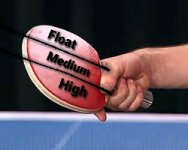
Bringing it back to the original Q from the Op, I actually can't say if it's 10 mili seconds or 20 or 30 or whatever but I do know that racket speed, rubber softness, angle of contact, point of contact etc all have a direct impact on the spin you achieve.
It doesn't matter if the racket is stationary or not (we are not talking about relativistic velocities

). What matters is the impact velocity either this is only the ball or it is v_ball + v_racket.
I agree that we might have a slightly longer contact time or rolling contact when we loop backspin with a thin contact and match the angular velocity.
Trying out Sony RX100 v at 1000 fps - impact of a table tennis ball
Contact on an incoming top spin ball - speed, rotation and angles at 1500 fps
"... Contact is very short - our tests show significantly less that 1/1000 sec -, but during that time a lot of energy is transferred - first from the ball into the rubber and then from the whole racket back into the ball..."
What our senses can perceive is quite remarkable e.g.:
https://en.wikipedia.org/wiki/Pacinian_corpuscle
"The
Pacinian corpuscle (also
lamellar corpuscle, or
Vater-Pacini corpuscle)
[1] is a low-threshold
mechanoreceptor responsive to vibration or pressure, found in the skin and other internal organs.
[2] In the skin it is one of the four main types of
cutaneous receptors... The corpuscles are especially sensitive to vibrations, which they can sense even centimeters away.
[7] Their optimal sensitivity is 250 Hz, and this is the frequency range generated upon fingertips by textures made of features smaller than 1
μm.
[10][11]"

en.wikipedia.org
"Merkel nerve endings are the most sensitive of the four main types of mechanoreceptors to
vibrations at low frequencies, around 5 to 15 Hz. Merkel nerve endings are extremely sensitive to tissue displacement, and may respond to displacements of less than 1 μm."
1 um was state of the art when manufacturing semiconductors around 1984. 0.8 um was used for the first Intel Pentium in 1993.