Contact time with the rubber and hitting area

says Open t o play :)
So I've watched a lot of videos of pros about serves and many actually say that hitting the ball on the front part of the blade generates more spin as you can "brush" the ball for a longer period of time.
e.g. Heming Hu here:

But some other professional actual say quite the opposite - that the contact point is basically just a "point" and it doesnt matter whether you hit the ball at the front or back of the blade (acceleration not taken into account).
e.g. in this video of German League player Hermann:
(sorry, its German but auto subtitles might work)

So what is true now?
 
This user has no status.
🏆 Top 1% Commenter
Active Member
Dec 2018
925
1,370
3,479
Read 1 reviews
Hemming's wrong, Hermann's right. Contact time is about 1 millisecond, so the ball rolls only a tiny fraction of its circumference even with the fastest spin. Contacting at different spots on the rubber is often used to change the amount of spin imparted, but it has nothing to do with rolling distance (contrary to what many even world class coaches believe).
 
says Table tennis clown
🏆 Top 1% Commenter
Well-Known Member
Apr 2020
4,666
2,963
10,850
Hemming's wrong, Hermann's right. Contact time is about 1 millisecond, so the ball rolls only a tiny fraction of its circumference even with the fastest spin. Contacting at different spots on the rubber is often used to change the amount of spin imparted, but it has nothing to do with rolling distance (contrary to what many even world class coaches believe).
Exactly correct. Especially when applying the wrist-flicking motion the speed of the blade is fastest far away from the handle and so more spin is imparted when the ball is hit.
 
  • Like
Reactions: Metaxa
says I'm still learning Table Tennis.
Member
Nov 2022
432
381
1,339
Read 1 reviews
.. Contact time is about 1 millisecond, so the ball rolls only a tiny fraction of its circumference even with the fastest spin. ..
1 millisecond is too shoort. The ball just drops instantly. Even your eye blink takes about 100 to 150 milliseconds.

The contact time depends on what type of serve you want to get.

.. it has nothing to do with rolling distance (contrary to what many even world class coaches believe).
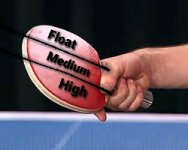
It does! For example a backspin serve. If you brush the ball from the very bottom of the rubber, it rolls a longest distance and produces the highest rotation. You'll get medium rotation from the middle and a floating ball if you brush from the top (a fake action).

20250118_153714.jpg

This applies to other variations of serve.

IMO.
 
This user has no status.
Active Member
Oct 2018
585
587
2,518
Does the rubber has something to do with this? For example a fast hard tensor rubber with minimum grip (grip like a AK47) compared to a "slower" tacky rubber like H3Neo ?

I believe the the truth is somewhere between these two and has to do with the rubber/blade and the kind of service.
 
Last edited:
This user has no status.
🏆 Top 1% Commenter
Well-Known Member
Aug 2016
3,172
2,521
6,086
Read 3 reviews
Does the rubber has something to do with this? For example a fast hard tensor rubber with minimum grip (grip like a AK47) compared to a "slower" tacky rubber like H3Neo ?

I believe the the truth is somewhere between these two and has to do with the rubber/blade and the kind of service.

Yup. With my Hao 2 5-ply wood with H3, I could feel the ball "stays" much longer when I serve. ANd it's true the service is very short and spinny.
 
This user has no status.
🏆 Top 1% Commenter
Well-Known Member
Sep 2013
13,139
15,419
36,968
Read 3 reviews
The official term is called sweat spot.
every rackets weight and sweat spot position varies.
hitting it in the sweat spot not only gives it more power, but also more spin.

There are both correct in terms of where to hit it, in fact, the highest level, you won't even hit it below the ball, because its too obviously, you will only hit it behind the ball (on the sweat spot), and that is really strong wrist action to allow underspin.


Basically there is more than 1 way to skin the cat
 
says Pimples Schmimples
🏆 Top 1% Commenter
Well-Known Member
Sep 2022
2,038
2,057
8,332
Hemming's wrong, Hermann's right.
Incorrect
Contact time is about 1 millisecond
Incorrect.
A millisecond? Seriously. A millisecond. If this were true then nobody would ever put spin on a ball.
so the ball rolls only a tiny fraction of its circumference even with the fastest spin.
Incorrect.
Unless you want to define 'tiny fraction'. If tiny fraction is 1/50th you are incorrect. If tiny fraction is 1/8th then you are correct. Ever driven your FH topspin forward, contacting the top of the ball with high racket speed and a tacky rubber? You can actually feel the ball (dwell time) on the rubber and it's a lot longer
Contacting at different spots on the rubber is often used to change the amount of spin imparted
Correct
but it has nothing to do with rolling distance (contrary to what many even world class coaches believe).
Really?
So the constant talk about rubber hardness/softness, pimple structures, sponge density, sponge softness or lack thereof, blade stiffness and/or hardness, all impacting the Dwell time, has nothing to do with how much spin a player can get???
 
  • Like
Reactions: Kopp
This user has no status.
Active Member
Nov 2019
837
757
3,039
Read 1 reviews
Incorrect

Incorrect.
A millisecond? Seriously. A millisecond. If this were true then nobody would ever put spin on a ball.

Incorrect.
Unless you want to define 'tiny fraction'. If tiny fraction is 1/50th you are incorrect. If tiny fraction is 1/8th then you are correct. Ever driven your FH topspin forward, contacting the top of the ball with high racket speed and a tacky rubber? You can actually feel the ball (dwell time) on the rubber and it's a lot longer

Correct

Really?
So the constant talk about rubber hardness/softness, pimple structures, sponge density, sponge softness or lack thereof, blade stiffness and/or hardness, all impacting the Dwell time, has nothing to do with how much spin a player can get???

Super Slow Motion Table Tennis Ball and racket physics
Shot with 16000 fps. Impact between blade and ball (at 76 km/h ~21 m/s) and blade with long pimples and ball (44 km/h ~12 m/s). Contact time <= 1 ms

Impact prediction between ball and racket in table tennis
They measured 1.4 ms (impact velocity 22 m/s) to 1.6 ms (at 5 m/s) with 38 mm balls and Sriver rubbers.

The Physics of Juggling a Spinning Ping-Pong Ball.
They used Stiga Inspire with Magic rubbers and a Timo Boll Spirit with T05.
"The fact that there were trials with only a single image showing full contact places an upper limit for the contact time at 2 ms."
 
Last edited:
  • Like
Reactions: latej and lodro
This user has no status.
Active Member
Oct 2018
585
587
2,518
Super Slow Motion Table Tennis Ball and racket physics
Shot with 16000 fps. Impact between blade and ball (at 76 km/h ~21 m/s) and blade with long pimples and ball (44 km/h ~12 m/s). Contact time <= 1 ms

Impact prediction between ball and racket in table tennis
They measured 1.4 ms (impact velocity 22 m/s) to 1.6 ms (at 5 m/s) with 38 mm balls and Sriver rubbers.

The Physics of Juggling a Spinning Ping-Pong Ball.
They used Stiga Inspire with Magic rubbers and a Timo Boll Spirit with T05.
"The fact that there were trials with only a single image showing full contact places an upper limit for the contact time at 2 ms."
This is when the ball travels fast to the blade. When serving (heavy upper/under spin) the motion of the hand follows the ball's trajectory, to increase dwell time and add to this the small deformation of the rubber and ball (big impact area) that happens at that time.
 
says Pimples Schmimples
🏆 Top 1% Commenter
Well-Known Member
Sep 2022
2,038
2,057
8,332
Super Slow Motion Table Tennis Ball and racket physics
Shot with 16000 fps. Impact between blade and ball (at 76 km/h ~21 m/s) and blade with long pimples and ball (44 km/h ~12 m/s). Contact time <= 1 ms

Impact prediction between ball and racket in table tennis
They measured 1.4 ms (impact velocity 22 m/s) to 1.6 ms (at 5 m/s) with 38 mm balls and Sriver rubbers.

The Physics of Juggling a Spinning Ping-Pong Ball.
They used Stiga Inspire with Magic rubbers and a Timo Boll Spirit with T05.
"The fact that there were trials with only a single image showing full contact places an upper limit for the contact time at 2 ms."
None of those incorporate the physics of a fast moving racket head that makes a rolling contact a cross the top of the ball though. That contact is definitely longer than a millisecond, it's possible to feel the difference when you do this versus say a flat smash or soft bounce where the ball obviously spends less time on the rubber.
One thousand of a second is too small of an estimation for this contact otherwise none of us would notice any difference between hard 9ply wooden blade A with 50° rubbers and soft flexy 5ply blade B with 38° rubbers.
Also, just take the FH drive as an example, the racket is not stationary as the ball hits it, the racket if following the ball upon impact and 'driving' it, this has an impact on the contact time also.
Bringing it back to the original Q from the Op, I actually can't say if it's 10 mili seconds or 20 or 30 or whatever but I do know that racket speed, rubber softness, angle of contact, point of contact etc all have a direct impact on the spin you achieve.
 
This user has no status.
🏆 Top 1% Commenter
Active Member
Dec 2018
925
1,370
3,479
Read 1 reviews
1 millisecond is too shoort. The ball just drops instantly. Even your eye blink takes about 100 to 150 milliseconds.

The contact time depends on what type of serve you want to get.


It does! For example a backspin serve. If you brush the ball from the very bottom of the rubber, it rolls a longest distance and produces the highest rotation. You'll get medium rotation from the middle and a floating ball if you brush from the top (a fake action).

View attachment 34274

This applies to other variations of serve.

IMO.
“You are entitled to your opinion. But you are not entitled to your own facts.” (DP Moynihan) It's well established that contact time is on the order of 1 millisecond. Easy enough to check with Google or ChatGPT, so I'll leave that to you. Then a few simple calculations will give you a clear idea of rolling distance (ChatGPT o1 can even lay this out for you step by step).
 
  • Like
Reactions: latej
says I'm still learning Table Tennis.
Member
Nov 2022
432
381
1,339
Read 1 reviews
Even though the video says it was recorded at 16,000 or 32,000 FPS, only videos of up to 60 FPS can be uploaded to YouTube. Therefore, you cannot actually see how many milliseconds the ball contacted or rolled on the racket by simply watching YouTube videos.

A 1-millisecond contact time is practically impossible. Even if you drop the ball on a very hard surface, the ball compresses at the moment of impact. Before the ball rebounds to its original shape and bounces, it remains in contact with the surface for longer than 1 millisecond. This contact time is undoubtedly longer on a table tennis racket, especially when you brush the ball. You can test this yourself.
 
This user has no status.
Active Member
Jan 2019
798
647
4,524
The official term is called sweat spot.
every rackets weight and sweat spot position varies.
hitting it in the sweat spot not only gives it more power, but also more spin.

There are both correct in terms of where to hit it, in fact, the highest level, you won't even hit it below the ball, because its too obviously, you will only hit it behind the ball (on the sweat spot), and that is really strong wrist action to allow underspin.


Basically there is more than 1 way to skin the cat
Hitting the ball on the sweat spot gives the ball more bouncing power/speed, but it can not create more spin. It is actually the opposite. Quick bouncing means less dwell time and thus less spin. That is why you need to use the edge of the paddle to create more spin. ANd for slow spinny loop, you want to contact the ball on the edge of the paddle as well.
 
  • Like
Reactions: Kopp
This user has no status.
🏆 Top 1% Commenter
Well-Known Member
May 2020
1,680
858
3,118
Read 1 reviews
The further up you hit, the greater the lever effect and angular velocity at the blade's tip, so in theory, the higher the point of contact, the more spin and speed you can generate. In practice, the difference is negligible because the variation in speed and spin from small changes in the contact point is minimal.
 
  • Like
Reactions: Kopp
This user has no status.
Active Member
Nov 2019
837
757
3,039
Read 1 reviews
Even though the video says it was recorded at 16,000 or 32,000 FPS, only videos of up to 60 FPS can be uploaded to YouTube. Therefore, you cannot actually see how many milliseconds the ball contacted or rolled on the racket by simply watching YouTube videos.

A 1-millisecond contact time is practically impossible. Even if you drop the ball on a very hard surface, the ball compresses at the moment of impact. Before the ball rebounds to its original shape and bounces, it remains in contact with the surface for longer than 1 millisecond. This contact time is undoubtedly longer on a table tennis racket, especially when you brush the ball. You can test this yourself.

Of course this slow motion video was shot with 16 kfps otherwise we would not be able to see any of the blade's vibrations. The blade tested is afaik an Avalox BT555. Some measured this with around 1300 Hz (16k / 1.3k ~ 12.3) and this is what we see + some faster vibrations of the blade.

On a hard surface the contact time is around 0.6 ms (glass plate)
Dynamical buckling of a table-tennis ball impinging normally on a rigid target: experimental and numerical studies
https://hal.science/hal-03718994/document

STUDY ON THE PERFORMANCE OF TABLE TENNIS RACKET MADE OF CARBON FIBER BY NUMERICAL SIMULATION, Xin-Yue Li, 2022
Measurements showed contact times between 0.6 ms (20 m/s) to 0.8 ms (2 m/s) for an allwood blade depending on impact velocity and around 50% of that for a carbon blade.

Butterfly / Fan Zhendongs FH tutorial
Just stop the video and count frames (one can use comma and dot on the keyboard to step through the frame)
 
  • Like
Reactions: latej
This user has no status.
Super Slow Motion Table Tennis Ball and racket physics
Shot with 16000 fps. Impact between blade and ball (at 76 km/h ~21 m/s) and blade with long pimples and ball (44 km/h ~12 m/s). Contact time <= 1 ms

Impact prediction between ball and racket in table tennis
They measured 1.4 ms (impact velocity 22 m/s) to 1.6 ms (at 5 m/s) with 38 mm balls and Sriver rubbers.

The Physics of Juggling a Spinning Ping-Pong Ball.
They used Stiga Inspire with Magic rubbers and a Timo Boll Spirit with T05.
"The fact that there were trials with only a single image showing full contact places an upper limit for the contact time at 2 ms."
The study you are linking states very clearly that it is only measuring contact time on a stationary, standstill paddle not taking into account acceleration, which would obviously extend the contact time. At least read and understand what you are linking man.
 
  • Like
Reactions: NetProphet and Kopp
This user has no status.
Active Member
Nov 2019
837
757
3,039
Read 1 reviews
None of those incorporate the physics of a fast moving racket head that makes a rolling contact a cross the top of the ball though. That contact is definitely longer than a millisecond, it's possible to feel the difference when you do this versus say a flat smash or soft bounce where the ball obviously spends less time on the rubber.
One thousand of a second is too small of an estimation for this contact otherwise none of us would notice any difference between hard 9ply wooden blade A with 50° rubbers and soft flexy 5ply blade B with 38° rubbers.
Also, just take the FH drive as an example, the racket is not stationary as the ball hits it, the racket if following the ball upon impact and 'driving' it, this has an impact on the contact time also.
Bringing it back to the original Q from the Op, I actually can't say if it's 10 mili seconds or 20 or 30 or whatever but I do know that racket speed, rubber softness, angle of contact, point of contact etc all have a direct impact on the spin you achieve.
It doesn't matter if the racket is stationary or not (we are not talking about relativistic velocities ;)). What matters is the impact velocity either this is only the ball or it is v_ball + v_racket.
I agree that we might have a slightly longer contact time or rolling contact when we loop backspin with a thin contact and match the angular velocity.

Trying out Sony RX100 v at 1000 fps - impact of a table tennis ball

Contact on an incoming top spin ball - speed, rotation and angles at 1500 fps
"... Contact is very short - our tests show significantly less that 1/1000 sec -, but during that time a lot of energy is transferred - first from the ball into the rubber and then from the whole racket back into the ball..."

What our senses can perceive is quite remarkable e.g.:
https://en.wikipedia.org/wiki/Pacinian_corpuscle
"The Pacinian corpuscle (also lamellar corpuscle, or Vater-Pacini corpuscle)[1] is a low-threshold mechanoreceptor responsive to vibration or pressure, found in the skin and other internal organs.[2] In the skin it is one of the four main types of cutaneous receptors... The corpuscles are especially sensitive to vibrations, which they can sense even centimeters away.[7] Their optimal sensitivity is 250 Hz, and this is the frequency range generated upon fingertips by textures made of features smaller than 1 μm.[10][11]"

"Merkel nerve endings are the most sensitive of the four main types of mechanoreceptors to vibrations at low frequencies, around 5 to 15 Hz. Merkel nerve endings are extremely sensitive to tissue displacement, and may respond to displacements of less than 1 μm."

1 um was state of the art when manufacturing semiconductors around 1984. 0.8 um was used for the first Intel Pentium in 1993.

 
  • Like
Reactions: latej
Top