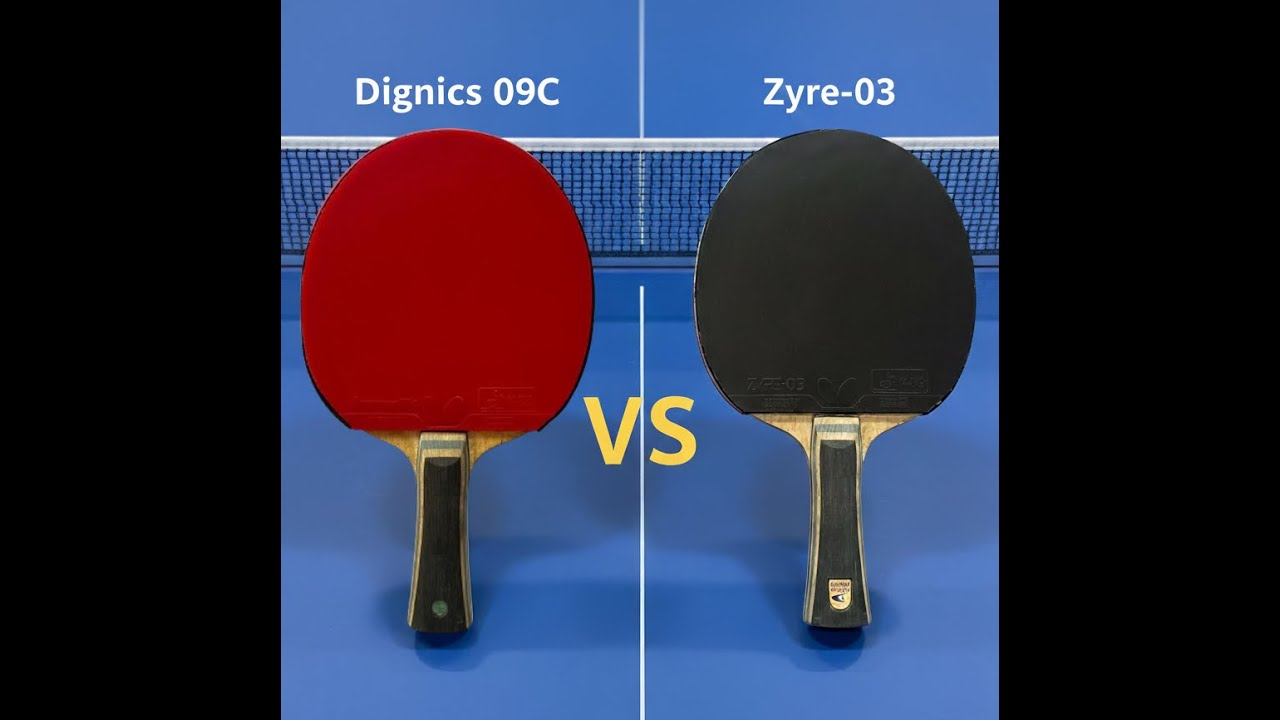
Zyre 03 2.5 mm Vs 2.7

This user has no status.
Member
Jul 2018
182
47
478
Today I played zyre 03 2.5 on friends Jun mizu super zlc

Previously I played 2.7 on harimoto alc , and felt totally different

2.7 mm felt more dwell and feeling,

I feel, that 2.7 mm is better option than 2.5

What others opinions?
 
This user has no status.
Member
Jul 2018
182
47
478
To compare you kind of need at least similar blades, like one blade is outer super zlc and the other an inner alc, those probably had much more to do with your impressions than the rubbers.
I agree , still I felt that sinking effect in 2.7 was more ,

Did anyone felt the same in their experiences?
 
This user has no status.
Today I played zyre 03 2.5 on friends Jun mizu super zlc

Previously I played 2.7 on harimoto alc , and felt totally different

2.7 mm felt more dwell and feeling,

I feel, that 2.7 mm is better option than 2.5

What others opinions?
Do you compare new rubbers or one used and one new? I.e. my 9 month old zyre-03 feels significantly softer than when it was new, so if you are comparing new 2.5 to significantly used 2.7, you might feel the difference not only in blades and rubber thickness, but also in the time they were in use.
 
This user has no status.
Member
Jul 2018
182
47
478
Do you compare new rubbers or one used and one new? I.e. my 9 month old zyre-03 feels significantly softer than when it was new, so if you are comparing new 2.5 to significantly used 2.7, you might feel the difference not only in blades and rubber thickness, but also in the time they were in use.
Ya i played two 2.7 mm , 1 was really used , 1 was moderately used, on Harimoto,

but I feel since the total length in 2.5 mm, is less compared to 2.7 , ball hitting the rubber surface, will reach to the blade surface faster and hence may be feeling less dwell, compared to 2.7 mm,

also the new 2.5 mm being on Mizu Super Zlc , may also have played its part.

But not sure, I am really thinking of putting 2.7 mm on my Maze compared to 2.5, as maze, is old, and more controlled than Mizu Super zlc?

views?
 
This user has no status.
The whole point of the Zyre rubber design was to max out sponge thickness by trading in top sheet thickness. 2.5 defeats the purpose. Pros go out of the way to boost to the point of getting caught with a violation in thickness. There is no reason for 2.5. You take the whole deal, which is the way it was designed minimal top sheet with max sponge, or you go with some other rubber for control. Getting 2.5 is like getting a Ferrari SUV. Pointless.
 
This user has no status.
🏆 Top 1% Commenter
Well-Known Member
Moderator
Oct 2014
20,764
27,500
73,266
Read 17 reviews
The whole point of the Zyre rubber design was to max out sponge thickness by trading in top sheet thickness. 2.5 defeats the purpose. Pros go out of the way to boost to the point of getting caught with a violation in thickness. There is no reason for 2.5. You take the whole deal, which is the way it was designed minimal top sheet with max sponge, or you go with some other rubber for control. Getting 2.5 is like getting a Ferrari SUV. Pointless.
I beg to differ, some pros boost and that creates a difference. Also, some players just won't max out the potential of the sponge and will prefer 2.5. While I don't always feel a difference, I get the impression my feeling with 2.5 is better.
 
  • Like
Reactions: Souther
This user has no status.
I beg to differ, some pros boost and that creates a difference. Also, some players just won't max out the potential of the sponge and will prefer 2.5. While I don't always feel a difference, I get the impression my feeling with 2.5 is better.
Perhaps there are other uses for the 2.5 version for those who have a different need and still want to utilize the thin top sheet. AI also gave a similar response including additional reasoning:

While the core innovation of the Butterfly Zyre 03 revolves around its ultra-thin "Ricosheet" top sheet (1.3 mm) paired with an unprecedented 2.7 mm extra-thick sponge, offering a 2.5 mm version is not just a marketing gimmick to expand customer reach. Even for the target professional and advanced players, the choice between 2.7 mm and 2.5 mm comes down to specific tactical, equipment, and physiological trade-offs. [1, 2, 3]


1. Equipment Synergy (Blade Matching)
Table tennis rubbers do not exist in a vacuum; they must harmonize with the blade. [1]
    • The 2.7 mm version has massive catapult potential and an exceptionally long dwell time. When paired with stiff, outer-carbon blades (like a Viscaria or Super Viscaria ALC), it acts as a cushion that makes an otherwise unforgiving setup more controllable. [1, 2, 3]
    • The 2.5 mm version is highly preferred by professionals who use all-wood or inner-carbon blades. If you put a 2.7 mm sponge on a flexible, high-dwell inner blade, the setup becomes overly mushy, losing the crisp feedback and structural stability needed for precise counter-looping. [1, 2]

2. Backhand vs. Forehand Dynamics
Many touring professionals prefer asymmetrical setups. A common configuration emerging with this rubber is 2.7 mm on the forehand and 2.5 mm on the backhand. [1]
    • Forehand strokes are typically longer, more full-body movements that have the time and power required to fully engage and compress a 2.7 mm hard sponge. [1, 2]
    • Backhand strokes are shorter, more compact, and rely on quick wrist acceleration. A 2.5 mm sponge allows for a quicker, more direct engagement of the blade on the backhand. This prevents the ball from getting "buried" in too much sponge during rapid close-to-the-table backhand exchanges or active blocking. [1, 2, 3]

3. Tactile Feedback ("Linearity" vs. "Gears")
While a 2.7 mm sponge technically offers "more potential" at peak performance, it alters the linearity of the rubber. [1]
    • A thicker sponge functions like an automatic transmission—it absorbs impact and introduces an immense catapult effect.
    • Some elite players despise this "trampoline" feel because it makes the short game (touch pushes, drop shots, and service receives) highly unpredictable. The 2.5 mm variant reduces that excessive bounciness, giving the player a more linear, predictable 1:1 relationship between their physical effort and the ball's output. [1, 2, 3, 4]

4. Rule Book and Environmental Margins
The ITTF strict rule limit for total rubber thickness (top sheet + sponge + glue) is exactly 4.0 mm. [1, 2]
    • 2.7 mm Sponge + 1.3 mm Ricosheet = 4.0 mm exactly.
      This leaves zero margin for error. If a professional player likes to use multiple layers of water-based glue, or if the rubber naturally expands slightly under humid conditions or when stretched during application, a 2.7 mm setup risks failing an ITTF umpire's post-match thickness test. The 2.5 mm version provides a safe cushion for custom gluing preferences without sacrificing the core advantages of the low-profile pimple design. [1, 2, 3, 4]

 
This user has no status.
🏆 Top 1% Commenter
Well-Known Member
May 2011
2,562
3,097
7,324
AI has no idea what it's talking about. Zyre most certainly does not feel like it has "exceptional dwell time" :ROFLMAO: Its short game is actually pretty good, and it's not a very bouncy feeling rubber until you really hit with it. Also, pretty sure Harimoto uses 2.7mm Zyre...on an inner carbon blade.
 
  • Like
Reactions: Coolsta Connor
This user has no status.
🏆 Top 1% Commenter
Well-Known Member
Moderator
Oct 2014
20,764
27,500
73,266
Read 17 reviews
AI has no idea what it's talking about. Zyre most certainly does not feel like it has "exceptional dwell time" :ROFLMAO: Its short game is actually pretty good, and it's not a very bouncy feeling rubber until you really hit with it. Also, pretty sure Harimoto uses 2.7mm Zyre...on an inner carbon blade.
Haha - it very much does when you get used to it - you can feel like you are holding the ball forever.
 
This user has no status.
AI has no idea what it's talking about. Zyre most certainly does not feel like it has "exceptional dwell time" :ROFLMAO: Its short game is actually pretty good, and it's not a very bouncy feeling rubber until you really hit with it. Also, pretty sure Harimoto uses 2.7mm Zyre...on an inner carbon blade.
I always thought thicker sponge = more dwell time and softer sponge = more dwell time. (hard bat = least dwell time)
And wouldn't you say its short game is actually pretty good because it has some dwell time?

The inner/outer carbon 2.5/2.7 matchup really depends on user preference.
 
This user has no status.
🏆 Top 1% Commenter
Well-Known Member
May 2011
2,562
3,097
7,324
I always thought thicker sponge = more dwell time and softer sponge = more dwell time. (hard bat = least dwell time)
And wouldn't you say its short game is actually pretty good because it has some dwell time?

The inner/outer carbon 2.5/2.7 matchup really depends on user preference.
You can't simply reason your way to understanding an equipment's performance. The rubber works as a whole between the topsheet and the sponge. The thicker sponge may provide more dwell time...if the topsheet remains the same, but Zyre has a thinner topsheet. Even then it might not be true, as the racket works as a whole between the rubber and the blade. H3 2.2 sure doesn't feel like it's got more dwell time than H3 2.1, as it's way harder to hit through and feel the dwell from the blade.

This is why AGI is some time away. There are lots of questions that can't be answered by reason alone. You need real world experiences, physical inputs. AI needs embodied AI to be much more mature in order to make a quantum leap.
 
  • Like
Reactions: Souther
This user has no status.
Idk, I tried it on both FH and BH. The harder I hit the less dwell it feels like it has. I had to really shorten my swing because of that.
I felt the extra dwell time when I first used it comparing to H3N. But then I was overshooting. To compensate, I shortened my swing like you, which is a natural reaction, but not the correct way to use it. After a few months of use, I learned that the difference is the mechanical grip compared to the H3N tacky spin. Strokes actually needed commitment to impart the mechanical grip which loads the ball causing it to dip at the far end of the table. My shots were equally spinny compared to H3N but landed deeper.
 
This user has no status.
🏆 Top 1% Commenter
Well-Known Member
Moderator
Oct 2014
20,764
27,500
73,266
Read 17 reviews
Idk, I tried it on both FH and BH. The harder I hit the less dwell it feels like it has. I had to really shorten my swing because of that.
Many players who uses Zyre without a transition period say it feels too quick. But when you use it for a longer time and do certain things with it, you learn that the sponge can feel like the ball stays on it forever. It is something that for some players, you can't just take your feelings and approach to your current rubber and expect to feel the same with Zyre. But give yourself 10 days with it and your views will become more nuanced because your contact points will change and your feeling will adapt.
 
Top