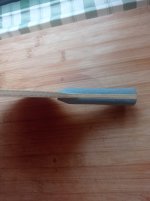
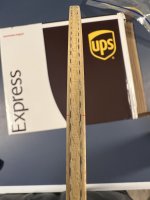
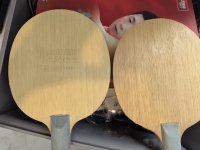
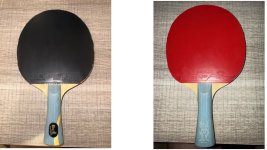
I fully understand your point. But honestly, what do people expect when they buy a 25$ blade. Real Kiso Hinoki that has grown for 100+ years? If so, these people also believe in Easter Bunnies distributing eggs

I don't know if this refers to the Kokutaku blade shown but there a two companies with this name. One from China and one from Japan. Btw my Cornilleau Hinotec (hinoki outer ply) also had such an issue. None of the several 729 Z-1 (limba outer ply) but a Fextra and one of my TSP Swats (the newer Victas Swat did not) also had this issue. Loki factory seals their Telson blades.
What DHS says about this issue...

drive.google.com
Handbook of DHS T.T. Products (in Chinese language) page 65 (76 in the PDF)
"How should a blade be maintained? How can I prevent the blade from showing signs of chipping or shedding?
The blade should be stored in a cool, dry, and well-ventilated place, avoiding high temperature or humidity, and preventing it from being subjected to heavy pressure or breakage. During play, pay special attention to collisions between the blade and the table surface and the ground. For multi-ball training, a spare blade can be used. Players using a chopping style should maintain an appropriate distance from the ground during practice, and should avoid bad habits such as deliberately smashing the racket, hitting the table with the racket, or hitting the block due to frustration after losing.
It is recommended to remove the rubber immediately after each game and store the blade properly to extend its lifespan.
Wood chipping generally occurs in two forms: a minor one is "splitting," and a more serious one is "peeling." Splitting is mainly caused by burrs on the blade. When a burr starts, the wood fibers connected to it are pulled up when the rubber is removed (a phenomenon known as "stress concentration" in materials mechanics, so removal of the rubber usually starts from the horizontal direction of the wood grain). Burrs on the blade are difficult to see directly, but can be felt by touch. Peeling is mainly caused by the softness of the wood on the board surface, resulting in high bonding strength with the adhesive. Therefore, to avoid this problem, the bonding strength needs to be appropriately reduced.
For example, limba is a material prone to stringing. Double Happiness has specifically produced a wood protectant; applying it to the board according to the instructions effectively prevents stringing.
In 2020, Double Happiness added a high-polymer coating to the surface of the boards, significantly reducing the likelihood of stringing.
If you don't have the wood protectant, you can try the following simple method:
Step 1: Sand the board appropriately. Find one or two pieces of blank kraft paper or white printing paper, crumple them into a ball, and vigorously rub them evenly on the board surface for a few minutes. For used boards, clean off any residual adhesive first before rubbing. Note that some boards have a thin surface layer; excessive sanding can damage the surface and impair the board's performance. Therefore, sanding should be done moderately.
Step 2: Reduce Adhesion Strength Appropriately. Find some paper with a waxed surface, such as the backing paper of self-adhesive labels or some candy wrappers.
Wipe it on the blade surface until it feels even. Note that you should not apply wax directly to the blade surface, as too much wax will prevent the blade and rubber from adhering properly.
Step 3: Post-Use Maintenance.
After each use, the rubber should be removed from the blade and stored separately.
This correct method of removing the rubber also effectively protects the blade—remove the rubber slowly from the sides of the blade towards the center."
And on the next page:
"How to use wood sealant? Is it necessary to use it before each rubber application?
Some surface materials, such as limba, are quite delicate and prone to stringing when peeling off the rubber. In 2014, DHS launched wood sealant, which was used by the national team to reduce surface stringing.
1. Use the brush provided with the wood sealant to quickly and evenly apply it to the blade surface; estimate the amount of sealant accurately; if unsure of the amount, practice on a similar piece of wood first;
2. After applying the wood sealant, do not do any further treatment. Place it in a cool, ventilated place to dry completely before applying the rubber.
Note: Wood sealant should be applied thinly; too much will affect the blade's performance. Furthermore, wood sealant does not need to be used before each rubber application. One application can be used for a long time."
(Google Translate)
















![WhatsApp_Image_2026-05-25_at_08.32.36[1].jpeg](/forum/data/attachments/36/36789-5109deab52ace2458e875ae60ec03dfe.jpg)
![WhatsApp_Image_2026-05-25_at_08.32.37[1].jpeg](/forum/data/attachments/36/36792-b60c263c030f8b13247aff6979d11962.jpg)
![WhatsApp_Image_2026-05-25_at_08.32.37_(1)[1].jpeg](/forum/data/attachments/36/36793-5ae69d1deb21132671dd5f6582370d77.jpg)
![WhatsApp_Image_2026-05-25_at_08.32.37_(2)[1].jpeg](/forum/data/attachments/36/36794-8b4a02bb52a0c3285c6ee4be0eeb4ebb.jpg)
![WhatsApp_Image_2026-05-25_at_08.32.37_(3)[1].jpeg](/forum/data/attachments/36/36795-c9ec608c1da472439b9df03c10c7205b.jpg)
![WhatsApp_Image_2026-05-25_at_08.32.37_(5)[1].jpeg](/forum/data/attachments/36/36797-bc938a14951e074aca5663c4851ab72c.jpg)
![WhatsApp_Image_2026-05-25_at_08.32.37_(7)[1].jpeg](/forum/data/attachments/36/36798-65787e5f5f295f9007085293e87360fc.jpg)