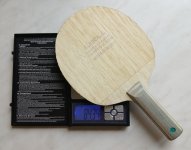
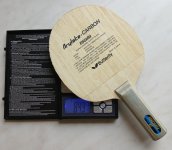
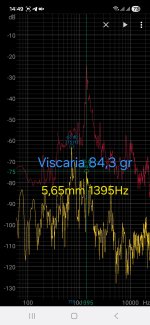
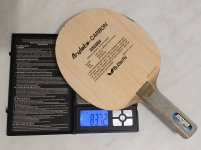
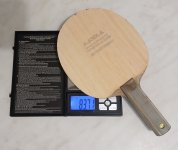
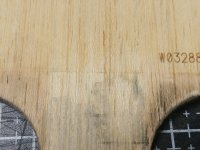
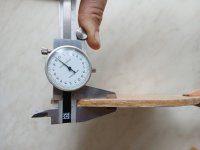
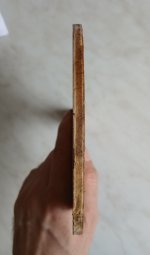
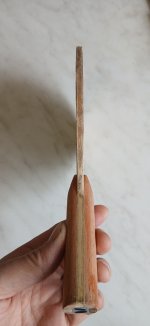
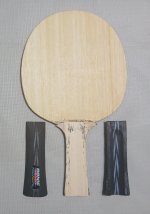
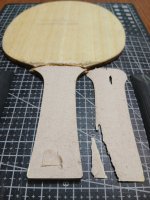
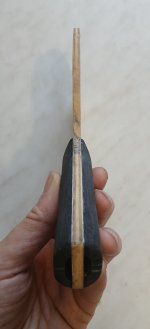
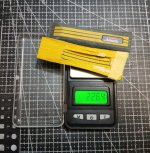
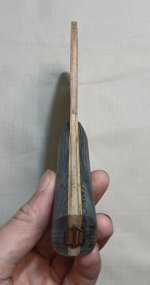
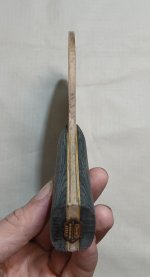
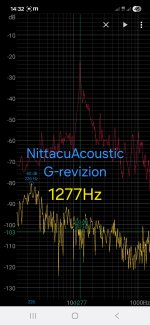
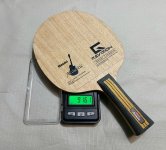
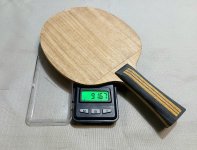
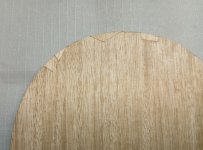
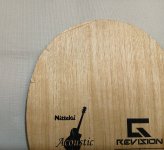
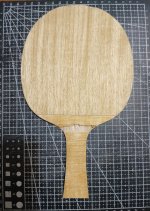
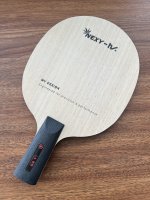
The information on the thickness (as far as it was possible to measure) and arrangement of the wood layers is as follows:
1) the central longitudinal layer of ayous - approximately 2.9 mm.
2) two transverse layers of koto approximately 0.8 mm each.
3) two longitudinal layers of wood on the surface - 0.7 mm. This is more accurate data, because we installed inserts of veneer with a thickness of 0.7 mm and they perfectly fit in thickness.
It's hard for me to say about the glue...
I'll add a few more photos, maybe it will help you. In the photo of the side view of the blade you can see the pattern characteristic of the end of the koto.
I would be very interested to know what kind of wood is on the surface, in order to completely put together this puzzle.
Thank you in advance!
Egon my brother, you are an absolute legend -- thank you so much!
Re: the veneering glue -- thanks anyway mate, just thought I'd ask anyway. Telling what glue was originally used to build a blade is always the hardest bit.
As for what the JSH's outer wood is...
(...hoo boy - here we go 😆😆...)
=============
TL/DR ANSWER:
(Written for the merely curious -- blademakers however should skip to the next bit)
The wood has dozens of different names in several different languages. This is
part of the reason why its such a hard wood to find.
In Australia the wood is sometimes called Lauan or Philippine Mahogany.
The name most commonly used by wood workers or the wider timber industry however is
Meranti**
==================
**THE PROPER BLADEMAKER'S ANSWER:
(Which contains Vital timber information for anyone wanting to find, buy, use, and actually make a blade out of this material. If this subset doesn't include you, then stop reading now or risk being bored stupid).
Meranti is not a species of timber.
Its actually an entire timber
category.
More specifically: Meranti is a name the timber industry uses, for any timber derived from trees in the
shorea genus.
This particular genus contains over 300 different species of timber that come in a huge variety of different weights, colours, densities, hardnesses, and grain styles.
Shorea is a tropical genus that grows in various countries across SE Asia (Papua New Guniea, The Philippines, or Malaysia).
Officially
only about 40 to 50 shorea species* are harvested for their timber.
(* Most likely the real figure is much higher, but don't quote me on that.)
So
which species of meranti
exactly did Butterfly use in the JSH??
Well, nobody really knows... including Butterfly themselves.
Timber companies don't examine each individual shorea tree to determine its exact species, prior to them cutting it down.
(Admittedly, telling one species of shorea from another is quite difficult -- even trained botanists can have trouble with it at times).
Instead, they just cut down all the shorea trees within a given geographical area Oncer-style, then sort the resulting timber into different subcategories, based on their colour, density, and apparent strength. 🙄🙄🙄
So if you want to find or use the timber in a 'typical' Butterfly JSH, you need look for
Light Red Meranti.
(NB: 'light' here refers to both "light weight" and "light red in colour". Sometimes this timber is also called
Light Pink Meranti, but its still the exact same stuff).
Well that sounds easy enough, right? Mystery over, problem solved?
Well, ...not really.
PART 2: HOW TO SPOT LIGHT RED AND/OR LIGHT PINK MERANTI... WHEN ITS NOT REALLY RED, NOR PINK, NOR LIGHT, NOR MERANTI
Light Red Meranti ('LRM') is officially (supposedly 🙄) made up of 5-8 different low density species of shorea.
LRM used to be sold seperately in Australia and was pretty distinct from
Dark Red Meranti, and
White Meranti, and
Yellow Meranti, and Balau, and Lauan, and Philippine Mahogany, and so on...
Increasingly however, retailers don't bother with this whole "accurately describing a product they're selling" nonsense.
Instead, they just lump all of it together, call it 'Meranti' and whatever wood they end up sending you, that's what you're stuck with.
(This is an insane way of selling anything IMO. I mean -- can you imagine ever buying a piece of meat for human consumption if it were sold to you like this?? Honestly, it's just pathetic 🙄🙄).
Point being my fellow blade-makers, you should
never buy LRM sight unseen, if you're going to make a blade from it!
The variances in hardness, weight, density, MoR and MoE you can end up with (even when its actually labelled as LRM) turns buying it into a genuine Forrest Gump style gamble -- i.e.: you NEVER know what you're gonna get!! 🤦♂️🤦♂️🤦♂️🤦♂️🙄🙄🙄
As it is sourced from up to 8 or so different timber species, LRM ranges in colour from light powder pink, to light brown, to ash grey, to a kind of grey-ish, speckled yellowy off-white colour.
Officially the average density of LRM varies from 400 to 520 kg per cubic meter, but I've bought lengths of it in the past which weighed 232 kg a cube (that's lighter than kiri!)
Wood grain is anywhere from quite closed to very open. Fibers are anywhere from coarse to fine. Sometimes the grain is interlocked, sometimes its not.
Porosity varies widely, janka varies moderately.
Stability is generally reasonably good, but keep a close eye on the humidity levels in your storage facility anyway
I say this because in my experience, LRM can warp, cup and twist pretty easily... ...except of course, for the times it doesn't 🙄🙄🙄🙄🤦♂️🤦♂️🤦♂️🤦♂️🤷♂️🤷♂️🤷♂️
(...Gee 🤔 I wonder why Butterfly stopped using the stuff? 🤔😆)
PART 3: A REALISTIC GUIDE FOR BLADEMAKERS
As far as colour goes: Think pink. Think grey. Think slight pinky-peach like hues. Think moderate to high lustre -- go looking for the shiny stuff. That's the key to finding good wood more consistently IMO.
I find the best stuff to use as an outer, has powder-pink sapwood and light greyish heartwood (or vice versa).
If it's the
exact same colour as the JSH in Egon's pics above, then grab it as you've hit paydirt (err... pay-wood).
Look for timber that's very closed grained. Thin red flecks in amongst soft pink wood is just fine, but avoid anything too white, yellow, or coarser grained.
If it's grey looking with very coarse grain and fibers, then run the other way. (Don't even know why they bother selling that stuff. )
Some of the grey-ish wood has small, birdseye-shaped swirls in the grain (note I said swirls, not knots!) This stuff is quite stiff and light, and makes for a lovely core, so long as the swirls aren't so tight or plentiful that you get density shifts.
The pink stuff is definitely denser than the grey, but is wonderfully soft, and when sanded on a drum sander, its wood dust looks an awful lot like balsa dust... very light and fluffy... almost like cotton candy / fairly floss.
The pink wood species in the JSH outer makes for a great defensive outer layer, due to its softness (well duh! 🤣🤣 )
In terms of bounce speed, the grey shiny stuff is neither a shock absorber, nor terribly 'poppy' -- its kind of neutral, neither adding speed, nor absorbing it.
The pink wood absorbes ball impact forces better than the grey. (If it were more bouncy, it would probay be a perfect like for like substitute for ayous.)
While all the other species that make up LRM have a fair few attractive properties, they also fall down when used in a blade in one way or another.
It's these particular pink and grey types of LRM timbers I'm drscribing that tick all the right boxes best... especially when used in a defensive blade.
CREDIT WHERE CREDIT IS DUE
In all honesty, I onlt first identified LRM as being the outer wood of a JSH several months back, and I didnt do so on my own.
Many other people (including Sergio) volunteered and/or discovered bits and pieces of information that helped both them and I to narrow it down.
All I did really here was recognise the outer wood and put a name to it. And while I've known of and used that particular outer wood in my blades for years now, cloning a JSH has still proved difficult prior to today, as I was still not completely sure of the inner woods involved, or the type of veneering adhesive involved, or even if the ply layers themselves had a typical orientation.
So as a result, I've been barking up the wrong tree entirely in my efforts to clone the bugger (groan, what a God awful pun 🤣🤣).
Now that Egon however has confirmed a few final internal details for me with his own eyes (God bless you for that mate!) then hopefully my own efforts to clone the JSH can bear a bit more fruit.
Sourcing ayous for the core is also a bit troublesome, as its scarser then hens teeth down here.
But there's ways around that problem too especially if i use more LRM in its place. Like I said earlier, LRM is a great substitute for ayous in a blade, structurally speaking. The only real problem is it just doesn't have the same amount of 'pop' to it that ayous does.
🤔 Hopefully... substituting 1 thick koto medial, with 1 thin koto layer + 1 thin high- rebound softwood layer, might solve that problem nicely.
Eh... I'll give it a shot and see how it goes...
That's me done -- thanks for reading folks🙂🙂
PS: if any other bladesmith's out there knows of a
better way to solve my "lack of popping catapult" problem (than what I've suggested above) please reach out and let me know.
If there's
any blade-dev projects out there, that truly call for taking a collaborative approach, then cloning the original JSH is definitely one of them.... the original blade was just too good to let the design die of neglect.