
Counterloop practice

This user has no status.
🏆 Top 1% Commenter
Well-Known Member
Oct 2022
5,612
2,820
8,886
Totally logical, since you have less time to adjust.

Counterspin should be practiced at this distance (first seconds of the video), you hit the ball before the highest of its trajectory :

Can you see how close to the table she is ?
View attachment 32953

This seems like a worthwhile shot to learn. But it also seems really hard... I'm not sure if it will be more achievable for me than the big-swing counter shot I was doing.
 
This user has no status.
🏆 Top 1% Commenter
Well-Known Member
Oct 2022
5,612
2,820
8,886
Btw have you tried this drill at lower power? %50-70 percent of the current on the video.
Not yet. That video was my first time trying the drill. I just wanted to see in theory if I could hit the shot. I was able to hit the shot, just not with enough consistency.

I was thinking next time we might try the drill with less power and also just have my partner loop the ball out of his hand. When I serve to him, he loops with too much spin, and the placement tends to be all over.
 
This user has no status.
Active Member
Nov 2023
842
601
1,485
This seems like a worthwhile shot to learn. But it also seems really hard... I'm not sure if it will be more achievable for me than the big-swing counter shot I was doing.
Doing what you want means that you are already far from the table. Because you can't go backwards to play a move, unless it's last resort. And the closer to the table you are, the less you can be overtaken by the angle of the shot of your opponent. Counter looping mean cutting the trajectory of the ball.
And if you hit the ball after the highest point of its trajectory, it's not a counter loop.
 
This user has no status.
🏆 Top 1% Commenter
Well-Known Member
Sep 2024
1,576
2,076
5,571
Totally logical, since you have less time to adjust.

Counterspin should be practiced at this distance (first seconds of the video), you hit the ball before the highest of its trajectory :

Can you see how close to the table she is ?
View attachment 32953
I hadn't gotten around to replying to this thread but glad someone said it. The shot that OP is practicing is a counterspin off of a push opening and generally you are going to be close to the table for this shot. Was confusing to see why everyone was suggesting to be farther off the table.

Though I generally agree that there isn't much of a need to practice this shot yet at OPs level
 
  • Like
Reactions: blahness
This user has no status.
🏆 Top 1% Commenter
Well-Known Member
Oct 2022
5,612
2,820
8,886
I hadn't gotten around to replying to this thread but glad someone said it. The shot that OP is practicing is a counterspin off of a push opening and generally you are going to be close to the table for this shot. Was confusing to see why everyone was suggesting to be farther off the table.

Though I generally agree that there isn't much of a need to practice this shot yet at OPs level
Makes sense. I just tried it out to see if it is possible in theory.
 
This user has no status.
Active Member
Nov 2023
842
601
1,485
Though I generally agree that there isn't much of a need to practice this shot yet at OPs level
It can be practiced, not for application during games, but to develop sense of timing, work the hand out, improve the small footwork,...

Yesterday, we worked for 30 minutes the same thing but for BH. No one in my club does that in a game (except me because it's the way my coach trained me when I was a kid and I'm like Gauzy, beauty over efficience). But it makes players improve the work of they wrist, compels them into on the tip of their foot, always ready to move lateraly, etc... No one will try a BH top spin in the next 6 months in a real game, but still it will be useful for the development of the players. Our coach is someone who was n°30 french in 1990 with a very aesthetic play-style, someone you could call an artist/entertainer.
 
This user has no status.
Active Member
Nov 2023
842
601
1,485
Well like I said multiple times in the past, the rating I am referencing is for our local league. I don't know if it's calibrated to the same level you are thinking of.

I already posted some sample video against Victor, so you can see how I play there. But, here is a video against a player rated 2011 in our LOCAL LEAGUE. When he has a few strong weeks, he even goes up to 2050 or higher. I don't know what he would be rated in your part of the world. I would say I win about 20-25% of our matches.

Unsolicited opinion on the video : you play too often like a "victim". You push long and high (None of your serve return is short), you step back from the table and you let your opponent do whatever he wants. It could be okay if your game was to counter back, but you oppose your racquet inactively, which makes you enable to earn the initiative back, and pray for your opponent to miss. It makes me wonder why love to boost so much, whereas you have a very high need of control to be able to undergo the massive amount of attacks you undergo.

Wanting to integrate counter spin to your game would be part of a more global change of your whole style. Even when you take the initiative, you step back from the table. Counter attacking is the opposite, the purpose is to earning ground against your opponent.
 
  • Like
Reactions: PoppaChubby
This user has no status.
🏆 Top 1% Commenter
Well-Known Member
Oct 2022
5,612
2,820
8,886
Unsolicited opinion on the video : you play too often like a "victim". You push long and high (None of your serve return is short), you step back from the table and you let your opponent do whatever he wants. It could be okay if your game was to counter back, but you oppose your racquet inactively, which makes you enable to earn the initiative back, and pray for your opponent to miss. It makes me wonder why love to boost so much, whereas you have a very high need of control to be able to undergo the massive amount of attacks you undergo.

Wanting to integrate counter spin to your game would be part of a more global change of your whole style. Even when you take the initiative, you step back from the table. Counter attacking is the opposite, the purpose is to earning ground against your opponent.
Yes, I have been trying to evolve my game to be more active. I have been working on taking initiative more on the serve receive.

Short push is really hard for me right now....i've tried it here and there, but I can't do it against all serves.
 
This user has no status.
🏆 Top 1% Commenter
Active Member
Dec 2018
925
1,370
3,479
Read 1 reviews
Practice against spinny loops. Multiball is fine. First practice forehand blocking off the bounce. Then step back and do counters on the fall. Then step in for counters off the bounce. Then mix it up. Move your feet, footwork is key. Hands up, short swing, weight forward and down. Aim for balance, good contact and consistency. It helps to have a target spot on the table, deep elbow or wide.
 
This user has no status.
🏆 Top 1% Commenter
Well-Known Member
Moderator
Oct 2014
19,975
26,537
70,891
Read 17 reviews

Here is my first attempt at counterloop practice. Im terrible. No consistency and a ton of whiffs. I constantly overestimate the height of the ball and i swing above the ball.

Advice appreciated!
For all the flack you have gotten, the drill is decent. Try to shorten the stroke, you are backswinging with your arm, not your upper body. Play from the elbow not the shoulder - good luck.
 
This user has no status.
🏆 Top 1% Commenter
Well-Known Member
Oct 2010
2,860
2,798
10,530
Close table counterloop kill imo is a bad shot choice unless you are as precise as Ma Long. Even the pros dont have good percentages with this shot. Ive played with many, many players and because my FH opening loop is very spinny, i'm usually on the other side of this equation. I'm usually not afraid of ppl who attempt wild swings to counterkill my loop because they will miss more than 50% - the percentages work in my favour. Nor am I afraid of those who block passively because I can easily attack the next ball. But those who know how to use a compact stroke to stably borrow the spin to counter it close table (快带), are the scariest because the block will come with quite a bit of spin and you're often short of time. This is also the shot choice that top women TT pros use and it is imo the most solid choice for defeating opening loops.
 
  • Like
Reactions: turbozed
This user has no status.
Active Member
Sep 2023
764
607
2,963
What I see you do, what I did too and am trying to let go now.. you lean on your right leg when hitting.
Grumss wrote it.. you lean to the right having all your weight on the right leg. You can't use your hips like that.
you have to jump or step with both feet in position and then you can hit with your legs, hips, shoulder and arm.
It is really a good feeling when you are in position and can make the same swing (almost) every time.
Too many time your body goes backwards, one of your legs is often not touching the ground at the hand of your stroke (mainly resulting from the first point), too wide movement. You should begin with another drill. Close to the table, work on bloc spins. It will compell you to go forward and to make compact movements.
 
  • Like
Reactions: turbozed
This user has no status.
🏆 Top 1% Commenter
Well-Known Member
Moderator
Oct 2014
19,975
26,537
70,891
Read 17 reviews
On people saying there is no need to practice this shot, in my experience, you would be surprised by the people whose blocks suck who are actually monsters at this. It is actually one of the things I would encourage someone to try because if they can do it pushing long becomes a weapon not a weakness.
 
This user has no status.
🏆 Top 1% Commenter
Well-Known Member
Nov 2022
2,022
3,248
7,959
On people saying there is no need to practice this shot, in my experience, you would be surprised by the people whose blocks suck who are actually monsters at this. It is actually one of the things I would encourage someone to try because if they can do it pushing long becomes a weapon not a weakness.
This describes me well (except the being a monster at it part). I have more success with countering with my FH against loops rather than blocking.

Thinking about the reasons why, it may be because committing to a FH counter forces me to play into the ball, which helps me get on top of it. On a block I'm a bit too passive waiting for it to come to me and by that time kicks up and goes longif I don't have the right bat angle. I also have a tendency to hit early anyway so what's usually an bad habit becomes a plus for this specific shot.

I'll eventually need to learn how to block by rubbing on top of the ball when I run into players that loop low and spinny, but right now it's just too satisfying whacking them with counters instead.
 
This user has no status.
Active Member
Apr 2013
710
603
1,587
Read 1 reviews
Yes, that may be true.

What are some lower hanging fruit?
Table tennis is about making the least mistakes.

So instead of jumping straight into the counterloop kill off the first topspin, I would practice this instead (stable active block:

So you pretty much try to put pressure on the opening attack of the opponent by blocking. Then it will be really hard for the opponent to attack continuously without having to 'let off the gass' a little bit. This will be your oppertunity to take over or kill the rally. This might not be as satisfying as imidiately killing the first topspin, but this can get you a long way. If you get good at this, you could get to 2300, maybe even higher.

I would also reccommend you let your practice partner serve, so you get into the habbit of stepping in for a push, and then step back for an incoming attack.

So the drill will look like this:
1. Opponent serves short backspin
2. You step in to push
3. Opponent opens up against backspin
4. You step out and actively block his attack
5. Opponent will try to continue topspinning but will most likely not be able to hit strong because you applied extra pressure.
6. You get a weaker ball that you can take over or even kill the rally.
 
says Shoo...nothing to see here. - zeio
🏆 Top 1% Commenter
Well-Known Member
Jan 2018
12,914
12,860
28,959
What exactly is a "counterloop"?
That is a limitation of the term in English. In Chinese, a distinction is made between 反拉 and 對拉, both of which would translate to counterloop in English, but the former refers to the one the OP is attempting here in which a fast loop against a slow loop ends the point, whereas the latter refers to the other one where both players engage in looping exchanges.

Fang Bo has given a tutorial on how to practice the former, 正手搓接正手反拉/FH push followed by FH counterloop (loopkill-on-a-loop).

意识系列:正手防守快带和反拉的训练方法,业余提升必看【字幕】
https://www.youtube.com/watch?v=IqR0r-93dnc
 
Last edited:
This user has no status.
Member
Feb 2017
318
261
1,136
Read 1 reviews
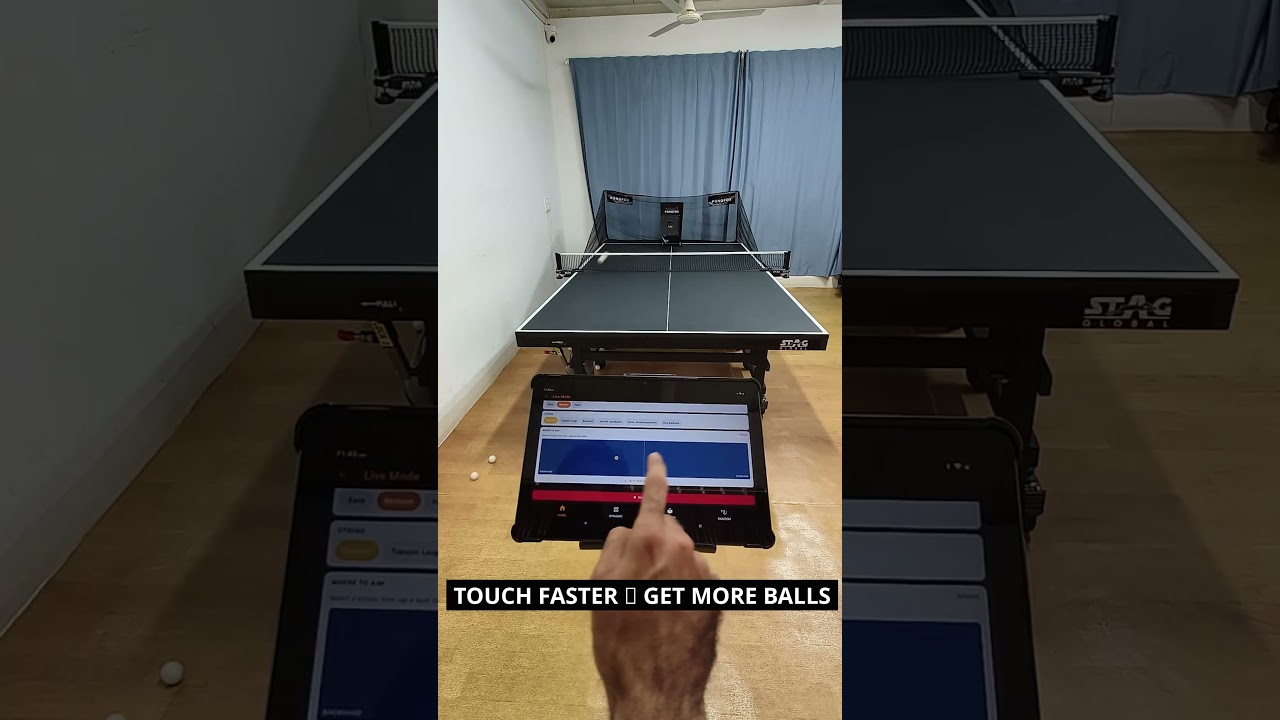
I had an idea for multiball practice.

Bring a pips recreational paddle for the feeder to practice looping junk balls. This might help improve play against pips and anti-spin.
images

then you may try to get feed with something like this 😉
 
Top