Daily Table Tennis Chit Chat

says what [IMG]
says what [IMG]
🏆 Top 1% Commenter
Well-Known Member
Feb 2016
2,470
1,521
5,099
Read 2 reviews
@NextLevel

Just based on the sound alone I'd reckon that was a pretty good shot.


I didn't play much today, but I coached some first years.

I was feeding basic backspin to one first year, working on his forehand. Another comes up, lower level than the guy I was working with. My partner was leaving in a minute, and the other guy asked if he can get some help as well, so I obliged.

I fed him light backspin, and he either netted them all or threw them way out due to a mishit. I didn't advise him at all yet, just gave him a problem to solve.

He has a very bad pushing habit and his form is all over the place, and he doesn't seem to understand core concepts too well, or at least, he isn't very aware of his own technique and why it doesn't work. He can't deal with backspin at all, except by pushing.

I explained some basic theory about pushing vs lever action, how spin works etc. and I just made him do some shadows by swinging only from the elbow.

Once he could do the movement decently and his swing plane was straight and in a more correct orientation, I showed him how to do double bounce self hitting on the table and I blocked for him. One ball at a time.

He kept netting the ball due to pushing it, and I kept correcting his form. "End higher!" I said multiple times, and I showed him with a shadow what I want him to do. I told him to start low below his hips closer to his knee, and to end closer to his eyes or forehead.

After some minutes, he actually started ending his swing higher and swinging in a more straight plane, and he started producing some spin too opposed to his completely flat balls prior.

We kept at it and did some simple rallies where I block for him and he "loops", and he started understanding that he can swing harder and he will get more spin and more speed. Some of his shots had somewhat decent spin, enough to throw them out if you don't angle your bat at all. They're nothing threatening and I could counterloop them myself easily, but they're much more threatening than what his strokes were like before.

His consistency also became quite good, and he commented how the ball leaves the bat so differently and how much safer it is, "like you can put the ball where you want" he said. We weren't hitting at a too fast pace, fast enough to be able to block well but not fast enough to rush him.

I didn't expect him to improve so much, but he has played before, so it's not like he's a bare beginner. His attitude was also good and he seemed to grasp some basic things well once he tried them out. I think it benefited him to learn better technique and understand the game a bit more.


What is everyone's view on this kind of coaching? Am I too low level of a player that I should just refrain from teaching anyone anything, or is this okay?
 
Last edited:
  • Like
Reactions: Boogar
says Spin and more spin.
🏆 Top 1% Commenter
Well-Known Member
Moderator
Dec 2010
16,640
18,535
56,964
Read 11 reviews
I used to have a total of 20 - 25 balls at my disposal, and I just shoved them in a spare racket case and used it as the "bucket".

I remember trying to feed multiball with a good bucket on a stand, on wheels, where you could put the bucket right where you want it so you can reach in and grab. The bucket would have somewhere between 144-200 balls in it depending on the day.

The skill of grabbing and feeding without losing the rhythm is definitely not easy and takes practice. As the bucket had fewer balls it became harder and harder.

I can't imagine trying that with only 30 balls in that racket case: and yes, I remember your photo of the racket case with the balls in it. It was when I was trying to convince you to practice self-hitting with more than 1 ball.

When a friend and I used to try to do multiball, we did it to practice looping backspin. It was really more like one ball at a time than a multiball footwork drill. But, I guess I should drop it. You will be who you are. And if you are trying to do stuff like multiball with friends/training partners, it is good. Even if I might not call it multiball.

And having been fed multiball from Michael Landers, Paul David, Matthew Khan and Mark Croitoroo, I guess I am on the lucky side of the equation. I wish I could do an hour of multiball a day 5-6 days a week for the next year. That would be a lot of fun.


Sent from The Subterranean Workshop by Telepathy
 
Last edited:
  • Like
Reactions: OldschoolPenholder
says what [IMG]
says what [IMG]
🏆 Top 1% Commenter
Well-Known Member
Feb 2016
2,470
1,521
5,099
Read 2 reviews
@UpSideDownCarl

I only really call it multiball because there's, well, multiple balls.

In reality, I've only really done "one ball at a time" style drills, but to different placement at a normal pace. We need a multiball kind of feed for that to work. 20 - 25 balls is somewhat low, but it sure is better than picking up and counting 100 balls, and trying to find the missing one from somewhere!

However, I haven't really done any "proper" multiball that gets you sweating. No one I know can feed well enough.
 
says Spin and more spin.
🏆 Top 1% Commenter
Well-Known Member
Moderator
Dec 2010
16,640
18,535
56,964
Read 11 reviews
@UpSideDownCarl

I only really call it multiball because there's, well, multiple balls.

In reality, I've only really done "one ball at a time" style drills, but to different placement at a normal pace. We need a multiball kind of feed for that to work. 20 - 25 balls is somewhat low, but it sure is better than picking up and counting 100 balls, and trying to find the missing one from somewhere!

However, I haven't really done any "proper" multiball that gets you sweating. No one I know can feed well enough.

Okay. Fair enough.


Sent from The Subterranean Workshop by Telepathy
 
  • Like
Reactions: OldschoolPenholder
This user has no status.
What is everyone's view on this kind of coaching? Am I too low level of a player that I should just refrain from teaching anyone anything, or is this okay?

There is absolutely nothing wrong with this kind of coaching. If you are confident enough in your knowledge of basic technique, there is no reason why you cannot pass this knowledge on. Also, just because someone is a better player, doesn't mean they cannot learn from a lower player who is perhaps more knowledgeable on a certain area of TT. It's great that you are using your time to help others improve.

I coach juniors on a Sunday and find it very rewarding, especially when you tell them to change something and it works! :)
 
says what [IMG]
says what [IMG]
🏆 Top 1% Commenter
Well-Known Member
Feb 2016
2,470
1,521
5,099
Read 2 reviews
There is absolutely nothing wrong with this kind of coaching. If you are confident enough in your knowledge of basic technique, there is no reason why you cannot pass this knowledge on. Also, just because someone is a better player, doesn't mean they cannot learn from a lower player who is perhaps more knowledgeable on a certain area of TT. It's great that you are using your time to help others improve.

I coach juniors on a Sunday and find it very rewarding, especially when you tell them to change something and it works! :)
Well, here's the thing. I don't want to be naively confident in my technical ability.

I'm not teaching super advanced things for obvious reasons, but I still fear that my advice about arm mechanics and body mechanics could be incorrect for someone.

I'm pretty sure my understanding of basic things is sound enough to be able to pass it on and not make anyone hurt themselves, but I really don't know what is right for what kind of people. If you understand what I mean.

I've done some things like remove pushing from peoples' strokes, and stop them arching their back on their backhand and make them use more legs with the back relatively static, and I think I understand the basis behind those things. But then again I could just be giving people hip problems if they listen to me.
 
This user has no status.
Well, here's the thing. I don't want to be naively confident in my technical ability.

I'm not teaching super advanced things for obvious reasons, but I still fear that my advice about arm mechanics and body mechanics could be incorrect for someone.

I'm pretty sure my understanding of basic things is sound enough to be able to pass it on and not make anyone hurt themselves, but I really don't know what is right for what kind of people. If you understand what I mean.

I've done some things like remove pushing from peoples' strokes, and stop them arching their back on their backhand and make them use more legs with the back relatively static, and I think I understand the basis behind those things. But then again I could just be giving people hip problems if they listen to me.

As I say to most people, it is up to the receiver of the advice as to whether they take it/stick with it. If someone starts to feel hip pain/back problems or something from your advice, chances are they will just stop doing it. Ultimately, it is good that you are trying to help and you've been involved with TT long enough to give sound advice, especially to new players. And sure, feel free to check with the forum whether your advice is good, we are all happy to help where we can.

You seem to be on the right lines so keep it up :)
 
Last edited:
says Spin and more spin.
🏆 Top 1% Commenter
Well-Known Member
Moderator
Dec 2010
16,640
18,535
56,964
Read 11 reviews
In our club we call it "Bucket-ball" which seems like a clearer way of defining it :)

Yep. My main point was that, until you have been fed multiball by someone skilled at feeding and adjusting the feed to your level, it is not quite the same thing. But the impulse to try is definitely a good thing.

I like the term bucket ball. Every so often Atanda Musa has me hit with one of his students for an hour. Often I will feed them "Bucket Ball" to work on a particular shot. These players are usually at the lowest level possible. So just making an actual stroke and getting the racket on the ball is a big improvement for them.

With these people, when I am helping them, my main view of it is that I am getting them to have fun and get many more reps then they would with someone their own level. As I do that, I try to get them to improve a few simple things. But for what I am doing, fun and reps come first.


Sent from The Subterranean Workshop by Telepathy
 
says Spin and more spin.
🏆 Top 1% Commenter
Well-Known Member
Moderator
Dec 2010
16,640
18,535
56,964
Read 11 reviews
Last weekend I played pretty well. I was moving to the ball and adjusting to placement better than usual. Also, I got to play 3 days in a row which has been really rare and hard to do since my wife got sick.

I miss those days when I used to play 5-6 days a week, 3-8 hours a pop.

Saturday I played 2 hours but the training was good and focused. 3rd ball attack and serve and receive training.

Sunday I hit with my friend the lefty tennis pro so it was all mid-distance blasting. But so much fun.

Monday was MLK day so I did not have as much work as normal. I got a 1 hour coaching session with Paul David. Then did 1.5 hours game simulation drills with the guy I trained with Saturday. Then did 1.5 hours serve receive drills with Mark Croitoroo.

I played more than I have played, in probably a year. And I am confident I played better than I ever have.

I'll take it when I can. Looking forward, I am confident I will have less and less time to play. But this is still a great community to be a part of.


Sent from The Subterranean Workshop by Telepathy
 
This user has no status.
🏆 Top 1% Commenter
Well-Known Member
Aug 2016
1,007
1,403
3,392
chroniclesofgossima.blogspot.com

Effect of Sponge Hardness

I have two older rubbers needing replaced on my Clipper. Before you say "whoa, whoa, whoa. What about no more EJing?" I'll have you know I've been doing great with that. Purely short pip/Long pip combo for some time now. But the truth of the matter is that my long-time used long pips has several pips broken and my custom short pips topsheet is separating from the sponge where my finger rests. So I did some testing last night preparing for options.


Friendship 802-40 on an Air super soft 30 degree sponge (2.0 thickness). Blade: Stiga Clipper Classic Cpen
vs
Friendship 802-40 on the stock 35 degree sponge (2.0 thickness). Blade: Nittaku Airuline 8.8 Jpen


I should note that I have always felt for some reason I hit with more spin with Cpens & more speed with Jpen. There must be something about my natural angle with Jpen that hits more flat. That being said, i did my best to be sure I had the same blade angle & swing pattern with each vs topspin.


The difference wasn't huge but I did notice that the arc of the ball curved & dropped more on the 30 degree sponge. Additionally, the ball trajectory was flatter and ever so slightly faster with the Jpen.


These findings are not surprising when you think about it. The softer sponge is wrapping around the ball more thus grabbing it allowing the spin capability to be slightly greater. But because there is more give & cushion, the speed is reduced.


Conversely, the harder sponge wraps less around the ball and there is less cushion. The ball flies off the surface quicker with more speed.


So there you have it. As far as I'm concerned... (and this doesn't even address the tuned aspect yet. so there are still several factors)


Softer sponge - more spin, less speed. Most likely safest and more consistent. Probably the better answer for most recreational players where usually the more consistent player wins.


Harder sponge - less spin, more speed. Not as safe but more potential for devastating shots.

If nothing else, watch the ball jump off Valdimir Samsamonov's racket this last Olympics. I was watching and kept wondering at his age how he was getting so much power. I realize he's a professional and one of the very best but he was noticeably hitting with even more power than his younger competitors as far as I could see. I later found out that he apparently had something in the 50+ degree range. :eek:


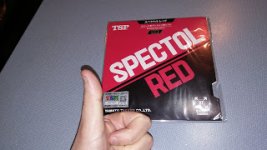
Going back to my original point about needing to replace my rubbers, I'm excited to try out what should be my highest quality rubber yet. TSP Spectol Red.
20170118_191743.jpg


This takes the classic Spectol topsheet and puts it on a new sponge for the plastic ball. pre-Tuned and 40 degrees. Without a doubt it should be faster.


I will have to accommodate for the speed and slightly less arc. This is not a bad thing. I never wanted my short pips to curve too much and behave like regular inverted. I think that defeats the purpose, or certainly one of the advantages, of playing with short pips in the first place.


I will have a full review of TSP Spectol Red soon along with a well known hitting long pip Dawei 388-D1 on a 1.5 sponge.

 
Last edited:
  • Like
Reactions: OldschoolPenholder
says Spin and more spin.
🏆 Top 1% Commenter
Well-Known Member
Moderator
Dec 2010
16,640
18,535
56,964
Read 11 reviews
Also, it was nice that Tuesday I got an hour to workout after I finished work. I outlined the workout in the exercises for TT thread.

Actually, it was an an hour and fifteen min of workout. Then 15 min of practicing floor serves; Practicing delaying the backswing till the ball is almost finished dropping; but making the backswing full with the hips included.

Backspin serves. When I got the rhythm, the ball reversed back to me on the floor waaaaayyyyyyy faster than my normal serves.

NextLevel will know why I practiced that. [emoji2] But it actually came from Mark. Or, Mark saw me try it that way with the backswing delayed till the last moment and said: "Yeah, that's the one. Practice that. That looks like a pro serve." And the reason I was trying it was that I watched Mike Landers serve a few weeks ago and he is definitely doing the backswing as the ball is dropping from his toss. That is what made me think I should try delaying the backswing. And as soon as Mark saw it he realized that was part of what I needed in order to improve my serve.

Also, in my session with Paul David, I got him to net a few serves. The first one, his eyes opened and he said: "Heavy! That is a good serve!"

As a 2500 level player, it was more that he was expecting my serves to be more in line with how they were the last time we hit. But Mark has helped me make my serves much better over the last few months.


Sent from The Subterranean Workshop by Telepathy
 
This user has no status.
🏆 Top 1% Commenter
Well-Known Member
Moderator
Oct 2014
19,979
26,544
70,909
Read 17 reviews
Suds79,

Your spin and speed analysis is not quite complete. The key thing is how much the ball is wrapped by the pips and that depends on a number of things, especially the stroke speed and the sponge hardness. While it is easier to get more spin from softer sponge, it is easier to hit into a point in the wood where ball gets forced out less tangentially to the stroke path and with less spin than optimal for looping. This is what some mean by bottoming out. For a harder sponge, this bottoming out point will be harder to reach and in that context, the harder sponge can be considered to have more spin. The trade off of course is that you need to swing harder to get this output. But this also makes the rubber harder to deform at slower impact speeds and may help the short game.

So in theory you can get higher levels of speed and spin with harder sponge. It just places a premium on how fast you swing and slow swings will not get it done.
 
This user has no status.
🏆 Top 1% Commenter
Well-Known Member
Moderator
Oct 2014
19,979
26,544
70,909
Read 17 reviews
Also, it was nice that Tuesday I got an hour to workout after I finished work. I outlined the workout in the exercises for TT thread.

Actually, it was an an hour and fifteen min of workout. Then 15 min of practicing floor serves; Practicing delaying the backswing till the ball is almost finished dropping; but making the backswing full with the hips included.

Backspin serves. When I got the rhythm, the ball reversed back to me on the floor waaaaayyyyyyy faster than my normal serves.

NextLevel will know why I practiced that. [emoji2] But it actually came from Mark. Or, Mark saw me try it that way with the backswing delayed till the last moment and said: "Yeah, that's the one. Practice that. That looks like a pro serve." And the reason I was trying it was that I watched Mike Landers serve a few weeks ago and he is definitely doing the backswing as the ball is dropping from his toss. That is what made me think I should try delaying the backswing. And as soon as Mark saw it he realized that was part of what I needed in order to improve my serve.

Also, in my session with Paul David, I got him to net a few serves. The first one, his eyes opened and he said: "Heavy! That is a good serve!"

As a 2500 level player, it was more that he was expecting my serves to be more in line with how they were the last time we hit. But Mark has helped me make my serves much better over the last few months.


Sent from The Subterranean Workshop by Telepathy

So when NL says it, he is just making noise. But when Mark says it and Michael Landers does it, it is the best thing since sliced bread! Now I get it...:rolleyes:
 
Last edited:
This user has no status.
🏆 Top 1% Commenter
Well-Known Member
Aug 2016
1,007
1,403
3,392
Suds79,

Your spin and speed analysis is not quite complete. The key thing is how much the ball is wrapped by the pips and that depends on a number of things, especially the stroke speed and the sponge hardness. While it is easier to get more spin from softer sponge, it is easier to hit into a point in the wood where ball gets forced out less tangentially to the stroke path and with less spin than optimal for looping. This is what some mean by bottoming out. For a harder sponge, this bottoming out point will be harder to reach and in that context, the harder sponge can be considered to have more spin. The trade off of course is that you need to swing harder to get this output. But this also makes the rubber harder to deform at slower impact speeds and may help the short game.

So in theory you can get higher levels of speed and spin with harder sponge. It just places a premium on how fast you swing and slow swings will not get it done.

One of the better explanations of bottoming out I've read. I knew it meant that you hit the actual wood of your blade but never took into account how that ball reacts hitting that angled surface which is different from the path of your rubber grazing the ball. I believe is what you mean by "less tangentially to the stroke path". That is fascinating.

While I'm not a heavy spin based player playing short pips, this is still good knowledge to have and I'll take that into my evaluation of the TSP Spectol Red.
 
says Spin and more spin.
🏆 Top 1% Commenter
Well-Known Member
Moderator
Dec 2010
16,640
18,535
56,964
Read 11 reviews
So when NL says it, he is just making noise. But when Mark says it and Michael Landers does it, it is the best thing since sliced bread! Now I get it...:rolleyes:

Exactly! [emoji2]

But, wait, wasn't it Brett who said it and didn't you use him as a reference! [emoji2]

And you know, the truth is, my serves have always been "good enough" to think I don't have to think too much about them. And I know I get okay spin and I think I am using my wrist.

But way back, the first time I saw Brett's videos on delaying the backswing, I tried it and it is hard to coordinate. That is not easy to adjust to that timing. It is something I would have to practice for, say, 30-60 min.

Saying it, it sounds ridiculous. I wish I could get to a table and practice serves. But that has been kind of low on my priority list. Besides, with Mark telling me what to work to improve my serves, with no separate serve practice, just him telling me what he sees, my serves have been really improving.

How he is having me work is very different than how Brett works. The backswing is big. Very big. Way bigger than what I would ever have tried on my own. In part the backswing is big because he is getting me to get my hips into the serve more. So it just felt like a different system.

But it was cool, maybe entertaining, when Mark saw the one with the delayed backswing and said, "Yeah, that's the one! Practice that! etc."

So yeah, sometimes I do pick and choose. [emoji2] No disrespect. [emoji2] If Archo said it, I would listen. But NextLevel and Der_Echte: no way! [emoji2]


Sent from The Subterranean Workshop by Telepathy
 
This user has no status.
🏆 Top 1% Commenter
Well-Known Member
Moderator
Oct 2014
19,979
26,544
70,909
Read 17 reviews
One of the better explanations of bottoming out I've read. I knew it meant that you hit the actual wood of your blade but never took into account how that ball reacts hitting that angled surface which is different from the path of your rubber grazing the ball. I believe is what you mean by "less tangentially to the stroke path". That is fascinating.

While I'm not a heavy spin based player playing short pips, this is still good knowledge to have and I'll take that into my evaluation of the TSP Spectol Red.

Thanks. The effect is present in all sponged play and while it is not as pronounced in short pips as it is in inverted, the fact that you are using sponged pips means that your stroke relies upon it more than you might realize.

It's more complicated than my explanation obviously as both the rubber and the wood in subtle ways contribute to spin and speed, but if we say the rubber is 100% spin and the wood is 100% speed, the rubber is trying to create rotation and the wood is trying ti shoot the ball forward, and if the ball goes deeply into the wood, the forward component may dominate more than optimally and if the stroke is too tangential, the ball may slip off and not go forward at all or just get bumped upwards. It's one of the reasons why bottoming out is a pretty lame explanation for not being able to use a rubber at the amateur levels.
 
  • Like
Reactions: OldschoolPenholder
says what [IMG]
says what [IMG]
🏆 Top 1% Commenter
Well-Known Member
Feb 2016
2,470
1,521
5,099
Read 2 reviews
Today was a pretty nice table tennis day. Didn't play too much and barely practiced serves, most of the day went into working on my form in self hitting and coaching/blocking.

I worked on a first year's forehand loop today. The same guy who I was feeding backspin to. I tried to make him understand the difference between pushing and swinging, and he caught on fast.

I made him do some self hitting, and he kept slipping the ball into the net, but with some instruction and time, he got the idea of spinning the ball. Then I blocked his loop and he kept slightly increasing the pace and spin until he reached a nice stage where it's looking more like a real spin shot. The real development came when I instructed him to get just an inch or two lower and widen his stance a little bit and push a little bit more with his legs. I even blocked one loop off the table, which was a bit surprising.

I then blocked for him, and when he could consistently nail groups of 5, I started moving him around a little bit and gave some instruction on footwork.

We worked on his forehand footwork by me showing him some instruction, then I made him stand in his backhand corner and I fed light backspin to his forehand corner, a pretty light and slow long ball, and he practiced taking proper footwork steps to get to the ball and loop it.

He said it was quite hard, but he made some progress. Before this he'd only really been leaning, but I know he can move. We did this for some time. At times he was too far off, sometimes too close to the ball, but he started getting the idea of the timing and the coordination.

Then I self-hit looped into his side of the table cross-court into his forehand, with very light spin, and I taught him some very basic counterlooping against weaker shots. He kept hitting over the ball at first or contacting badly, but he got it after a good period of time. I adjusted his stance, body orientation and stroke just a little bit at a time until it was more correct. I just wanted him to feel what it's like to loop into topspin, and I didn't move him around or feed him real spin yet.

Then we played a few games. I took it easy on him and mostly blocked and looped very light spin and slow shots, and his consistency was much better than usual. I was most impressed when he moved in towards a half-long ball and "looped" it when normally he would have pushed it or just netted it. I really commended him for that.

Again, I stress that these aren't huge developments, and the spin level isn't suddenly increasing, but it is still a noticeable improvement. In games, they fall back on their habits, but in drills and practice games where I set them up to play well with what kind of shots I give them, they can play a more correct and good game sometimes.
 
Last edited:
  • Like
Reactions: Yecats Encerwal
Top