


This user has no status.

This user has no status.
🏆 Top 1% Commenter
Well-Known Member
Well-Known Member




ok. So the frequency actually doesn't mean that much?You can try using Advanced Spectrum Analyzer PRO if you got Android (it's free to use).
1. Top right of app tap on option to"Enable peak hold"
2. Bounce ball on empty blade
3. Hit pause.
4. It'll show you the curve of the highest frequency achieved. Drag along the line and get to the first peak.
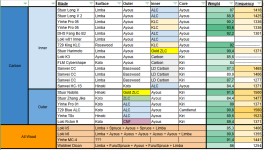
Sanwei 75 Inner was around 1400 hz too. Sanwei Fextra was around 1313 hz to 1336 hz. Nittaku Acoustic Inner was 1313 hz. Stuor Harimoto was 1421 hz.
I don't think the frequencies accounts for the flex of the blade much, and it's more of a measure of the hardness of the material composition. Because we're just bouncing the ball on a naked blade, the force is small and the impact point is smaller, which doesn't really resemble actual play at all.
With the rubbers on, and on harder hits or counters, the force is multipled by many fold and the impact force is spread out over a wider surface area since it's absorbed then transferred through the rubber. This is when the flex of the blade will come into play and why one 1400 hz blade may feel much softer than another.
For example, my Fextra feels way more stiff and less soft than the Acoustic NAIC in gameplay (especially blocks) despite being the same hardness. Makes sense as it's way thinner (5.5 mm vs 6.0mm) so on many shots the blade will flex and this will soften the feel.
With that in mind, it's debatable how useful measuring frequencies like this really is. Some people may be sensitive or advanced enough to discern between the softness of the impact point versus the overall 'softness' of the blade feeling. I certainly can't.