
How to measure blade frequency?

This user has no status.
🏆 Top 1% Commenter
Well-Known Member
Oct 2022
5,612
2,820
8,886
You can try using Advanced Spectrum Analyzer PRO if you got Android (it's free to use).

1. Top right of app tap on option to"Enable peak hold"
2. Bounce ball on empty blade
3. Hit pause.
4. It'll show you the curve of the highest frequency achieved. Drag along the line and get to the first peak.

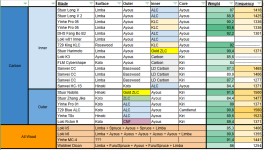
Sanwei 75 Inner was around 1400 hz too. Sanwei Fextra was around 1313 hz to 1336 hz. Nittaku Acoustic Inner was 1313 hz. Stuor Harimoto was 1421 hz.

I don't think the frequencies accounts for the flex of the blade much, and it's more of a measure of the hardness of the material composition. Because we're just bouncing the ball on a naked blade, the force is small and the impact point is smaller, which doesn't really resemble actual play at all.

With the rubbers on, and on harder hits or counters, the force is multipled by many fold and the impact force is spread out over a wider surface area since it's absorbed then transferred through the rubber. This is when the flex of the blade will come into play and why one 1400 hz blade may feel much softer than another.

For example, my Fextra feels way more stiff and less soft than the Acoustic NAIC in gameplay (especially blocks) despite being the same hardness. Makes sense as it's way thinner (5.5 mm vs 6.0mm) so on many shots the blade will flex and this will soften the feel.

With that in mind, it's debatable how useful measuring frequencies like this really is. Some people may be sensitive or advanced enough to discern between the softness of the impact point versus the overall 'softness' of the blade feeling. I certainly can't.
ok. So the frequency actually doesn't mean that much?
 
This user has no status.
🏆 Top 1% Commenter
Well-Known Member
Nov 2022
2,022
3,248
7,959
ok. So the frequency actually doesn't mean that much?

It'll tell you the hardness of the blade component 'sandwich' at low impact speed. This is an important part of the mixture that makes a complete racket do what it does.

TTgearlab has an article which explains what would need to be measured to get a very simple model of how a racket might actually play.


In comments, TTgearlab had the following reply when asked about a commenter measuring 1300 Hz OSP Virtuoso- on his phone:

The 1,300 Hz is probably the 4th frequency. And, in fact we need more data to determine the elasticity of blade. For example the 1st frequency which is much lower than 4th frequency.

I can only guess at the meaning of this so maybe someone with more knowledge can chime in.
 
  • Like
Reactions: Egon
This user has no status.
Active Member
Nov 2023
841
600
1,482
Btw, which long5 style blades do you have now? Pro5? B2, Stuor Long5?

How do they compare to each other
Those are my blades. I have a lot of Long 5 style blades !

1731574935093.png

I did not test enough the 729 King and the Loki K3 to have an opinion. Stuor Harimoto would deserve another try with my favorite rubbers, it was already quite nice with a Moon 12 on the FH. I'll test that maybe during winter break. Pro 05 is really my favorite, I don't know what I could expect more.
 

Attachments

  • 1731574602877.png
    1731574602877.png
    70.6 KB · Views: 145
This user has no status.
🏆 Top 1% Commenter
Well-Known Member
Oct 2022
5,612
2,820
8,886
Those are my blades. I have a lot of Long 5 style blades !

View attachment 33141
I did not test enough the 729 King and the Loki K3 to have an opinion. Stuor Harimoto would deserve another try with my favorite rubbers, it was already quite nice with a Moon 12 on the FH. I'll test that maybe during winter break. Pro 05 is really my favorite, I don't know what I could expect more.
What do you like about Pro5 over the B2?
 
This user has no status.
Member
Nov 2021
276
258
874
I have an app Sonic Tools SVM that I can configure only to record the highest pitch measured. And only that is showed.
(installed it again, and it's a button [Peak Hold]
If you only see the live frequency it goes too fast.
Had to install a bunch of apps to finally find something that was free and showed the frequency measured.
Cool! I have downloaded the app and pressed "peak hold" but I can´t see the highest Hz? Its to quick? Do you know what I am doing wrong?
 
This user has no status.
🏆 Top 1% Commenter
Well-Known Member
Mar 2023
1,090
1,060
7,515
A very interesting feature. When we make a blade and check the frequency by simply tying the handles with a rope, the measured frequency is lower than after a groove is made in the handle. The frequency is also lower for an untreated blade. The blade frequency is affected by the blade size in addition to its thickness and composition.
 
says Shoo...nothing to see here. - zeio
🏆 Top 1% Commenter
Well-Known Member
Jan 2018
12,911
12,854
28,945
How reliable is this frequency thing compared to the feeling and flex of the blade?

Since I have some new blades coming in: I was thinking maybe I test the frequency and if it is too high/too stiff then I just return the blade.
Folks need to understand what is being measured here.

What you're hearing and the mic is picking up the most is the 1st membrane mode, which involves the blade head almost exclusively, since the node runs through the handle from top to bottom (which means that part doesn't vibrate and the blade essentially acts like a gong). As long as you bounce the ball in the dead center of the blade head, you can be pretty certain most of the energy goes into the excitation of that mode. A potential issue that can cause the frequency of that mode to shift is mass-loading caused by fingers touching the blade head, namely the thumb and index finger, which can dampen the vibration and lower the frequency unlike in other racket sports. How hard you grip with the rest of the fingers will also have some effect on the frequency of that mode but to a much less extent. Another issue is mass-loading caused by the rubber(s), which would shift the entire frequency response downward.

As for feeling and flex, those are mostly dictated by the bending (AKA flexural) modes and torsional modes, which are not as easy to capture by microphones. The membrane modes play a much less prominent role (supplementary if you will) as explained above.

For more:
https://www.tabletennisdaily.com/forum/topics/what-is-sweet-spot-really.21676/post-285789
 
Last edited:
  • Like
Reactions: turbozed
says Fair Play First
🏆 Top 1% Commenter
Well-Known Member
Jan 2012
2,193
727
3,077
BLESSED THOSE BELIEVERS.

Within a brand of a table tennis paddle no two species are alike, considering the fact that manufacturers using different wooden logs with different moisture content.
Hence, you will get from a deaUler not what you expected for.
And Yes,, measuring impact vibration on a plywood will give you a lot of rewarding engineering experience to your better selfestimation 😋
Be an advanced polymath of table tennis equipment, have a happy day everyday.
 
This user has no status.
Member
Mar 2024
135
148
322
Folks need to understand what is being measured here.

What you're hearing and the mic is picking up the most is the 1st membrane mode, which involves the blade head almost exclusively, since the node runs through the handle from top to bottom (which means that part doesn't vibrate and the blade essentially acts like a gong). As long as you bounce the ball in the dead center of the blade head, you can be pretty certain most of the energy goes into the excitation of that mode. A potential issue that can cause the frequency of that mode to shift is mass-loading caused by fingers touching the blade head, namely the thumb and index finger, which can dampen the vibration and lower the frequency unlike in other racket sports. How hard you grip with the rest of the fingers will also have some effect on the frequency of that mode but to a much less extent. Another issue is mass-loading caused by the rubber(s), which would shift the entire frequency response downward.

As for feeling and flex, those are mostly dictated by the bending (AKA flexural) modes and torsional modes, which are not as easy to capture by microphones. The membrane modes play a much less prominent role (supplementary if you will) as explained above.

For more:
https://www.tabletennisdaily.com/forum/topics/what-is-sweet-spot-really.21676/post-285789
all true. but still, bouncing the ball on the blade and recording the sound with a mic is a metric that correlates with the eventual paddle mechanical performance. it's not a useless metric, but it can mislead you if you don't understand what it means.
 
This user has no status.
🏆 Top 1% Commenter
Well-Known Member
Oct 2022
5,612
2,820
8,886
all true. but still, bouncing the ball on the blade and recording the sound with a mic is a metric that correlates with the eventual paddle mechanical performance. it's not a useless metric, but it can mislead you if you don't understand what it means.
So what does the frequency tell you, and what does it not indicate?
 
This user has no status.
You can try using Advanced Spectrum Analyzer PRO if you got Android (it's free to use).

1. Top right of app tap on option to"Enable peak hold"
2. Bounce ball on empty blade
3. Hit pause.
4. It'll show you the curve of the highest frequency achieved. Drag along the line and get to the first peak.

Sanwei 75 Inner was around 1400 hz too. Sanwei Fextra was around 1313 hz to 1336 hz. Nittaku Acoustic Inner was 1313 hz. Stuor Harimoto was 1421 hz.

I don't think the frequencies accounts for the flex of the blade much, and it's more of a measure of the hardness of the material composition. Because we're just bouncing the ball on a naked blade, the force is small and the impact point is smaller, which doesn't really resemble actual play at all.

With the rubbers on, and on harder hits or counters, the force is multipled by many fold and the impact force is spread out over a wider surface area since it's absorbed then transferred through the rubber. This is when the flex of the blade will come into play and why one 1400 hz blade may feel much softer than another.

For example, my Fextra feels way more stiff and less soft than the Acoustic NAIC in gameplay (especially blocks) despite being the same hardness. Makes sense as it's way thinner (5.5 mm vs 6.0mm) so on many shots the blade will flex and this will soften the feel.

With that in mind, it's debatable how useful measuring frequencies like this really is. Some people may be sensitive or advanced enough to discern between the softness of the impact point versus the overall 'softness' of the blade feeling. I certainly can't.
You will also have the sound from the ball not to forget. There will probably be different frequencies coming from the longitudinal as well as the latitude of the racket. Further it is also the question how fast the vibrations are being damped also what amounts of overtones are being produced. Anyhow I am not a practical expert of measuring table tennis rackets just know a little bit about vibrations.
 
  • Like
Reactions: Tyce
This user has no status.
Member
Mar 2024
135
148
322
So what does the frequency tell you, and what does it not indicate?
a higher frequency response measured this way = stiffer blade which typically means, a faster blade. meaning ball has higher speed when struck with equal force compared with a blade with a lower frequency response.

that said, higher Hz measured this way does not equate a faster blade, it's just a good rule of thumb. to find out more about how a blade plays without actually playing it, you would need to more thoroughly measure dampening(which you can by measuring the frequency response decay as you let a ball bounce until it stops), measure different modes, tt specific mass load modeling, bla bla, bla bla, bla bla bla.
 
  • Like
Reactions: riemsesy and Egon
This user has no status.
🏆 Top 1% Commenter
Well-Known Member
Oct 2022
5,612
2,820
8,886
a higher frequency response measured this way = stiffer blade which typically means, a faster blade. meaning ball has higher speed when struck with equal force compared with a blade with a lower frequency response.

that said, higher Hz measured this way does not equate a faster blade, it's just a good rule of thumb. to find out more about how a blade plays without actually playing it, you would need to more thoroughly measure dampening(which you can by measuring the frequency response decay as you let a ball bounce until it stops), measure different modes, tt specific mass load modeling, bla bla, bla bla, bla bla bla.
So in the spreadsheet, there are 1370 Viscaria and 1550 Viscaria. Does this mean the 1550 Viscaria is faster and stiffer? And by quite a lot?
 
says Shoo...nothing to see here. - zeio
🏆 Top 1% Commenter
Well-Known Member
Jan 2018
12,911
12,854
28,945
I downloaded the Spectroid app as suggested, but I don't know really what I am looking for.

1) How hard am I supposed to bounce the ball on the blade? Does bouncing harder or softer make a difference in the frequency?

2) When I bounce the ball, I see a long wavy line from left to right. Where am I supposed to measure the frequency? at the peak of the wave?
Forgot to address the first question in my last post.

When a ball hits or is dropped on a blade, all corresponding modes below the impact duration (AKA contact time) would get excited as long as the ball doesn't fall on the node(s) of a specific mode. While the natural frequency of the different modes remain unchanged to the level of force (unlike the amplitude), you want to excite only the modes of most interests and reduce the noise in your input as much noise as possible. Try to bounce just hard and close enough for the mic to capture the sound wave without clipping (it comes down to your mic/phone and the software/app), which could cause distortion to the original sound wave.
 
Last edited:
This user has no status.
Member
Mar 2024
135
148
322
So in the spreadsheet, there are 1370 Viscaria and 1550 Viscaria. Does this mean the 1550 Viscaria is faster and stiffer? And by quite a lot?
if it's not user input error than probably yes. but you obviously don't know if both blades had the same water content when measured, same ball, normally working mics, etc. whenever you use that spreadsheet to interpret the frequency response of a blade, take the mean of the measurements like you did in physics class.

if i had to guess, the 1370 vis, is a 3-4 year old blade, used a lot by someone with sweaty hands, that has never been dehydrated.
 
This user has no status.
🏆 Top 1% Commenter
Well-Known Member
May 2020
1,680
858
3,118
Read 1 reviews
Open a string tuner app for guitar and bounce a ball on the bare blade and you got your frequency. It's that simple.
 
Top