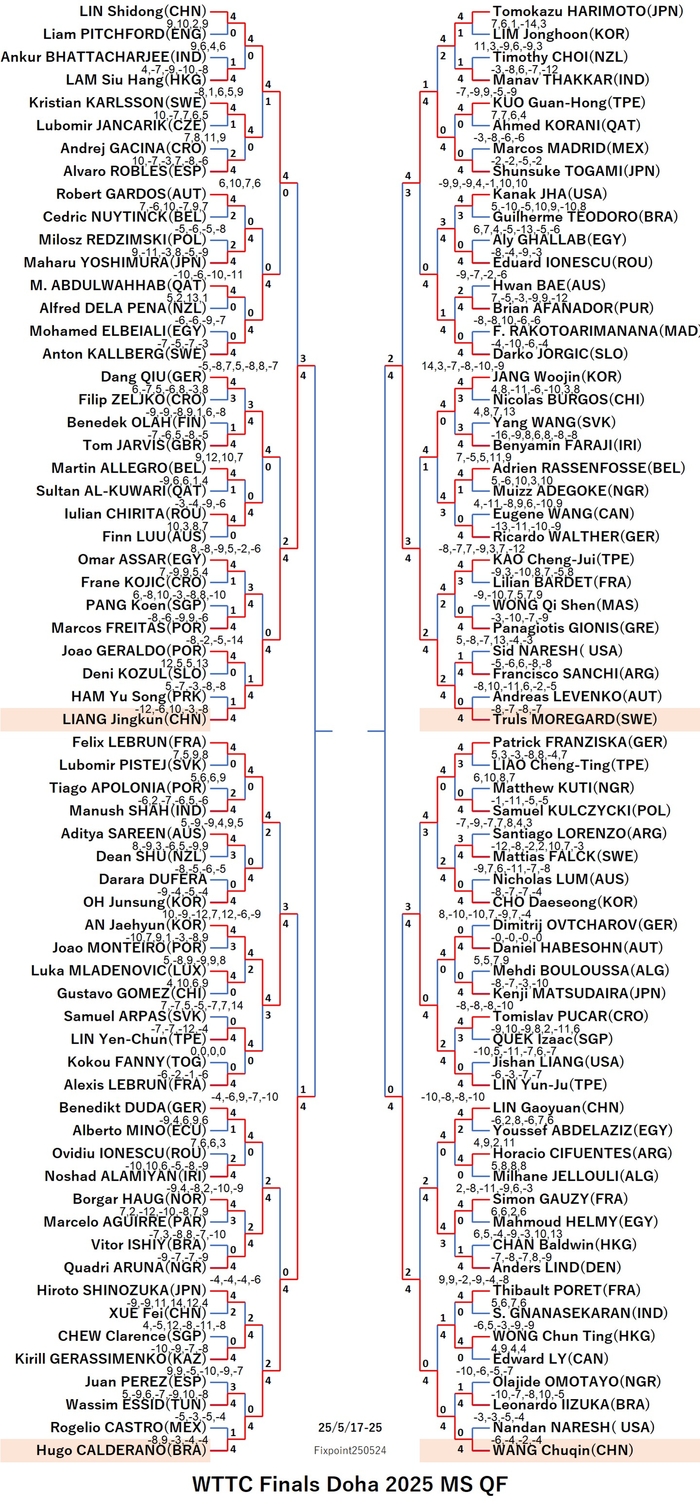
They should work on the fine detail of the serve and 3rd ball and vice versa the receive and 4th ball, like what
Harimoto has touched on, when to push (to rein others in) and when to loop (to rein yourself in). In Chinese, 前三板處理粗糙 (rough handling of the first 3 strokes).
Still far from KNT players when it comes to that aspect.
This point at 7:8 of G6 (notwithstanding the ball clipping the net) is what Harimoto talked about. Moregard won those crucial points over the table. Togami couldn't hold back and pushed the ball instead of dropping it short. And Togami had to push to Moregard's BH rather than his middle to make him hesitate to use his FH (do I commit to FH or use BH?). Same issue at 9:9. Compare that to Moregard at 9:10, a mirror-image point where he pushed to Togami's middle instead. Togami did the right thing at 8:9 and Moregard missed the FH step-around. He needed more of that.
https://youtu.be/Wx7zLHZZbwU?t=10321
Togami dominated in the 大路球, literally big-road balls or open game, but Moregard more than made up in the 小路球, literally small-road balls or closed game. As long as Togami does not overcome this deficiency, he will be stuck in this vicious circle.
Below is a short article on the topic by
national sports senior coach 戴临中 from 2007.
谈大路球与小路球 (On big-road balls and small-road balls)
https://blog.sina.com.cn/s/blog_5517216a0100094u.html
就业余球手来说,我们可以从练习的角度通俗的把技术分成两类,一类是大路球,另一类是小路球。
大路球是指单一的技术动作和基本的结合技术,比如,拉、攻、推、突、扣、削等,结合技术包括连续的拉打、左右两边的摆速技术、推挡侧身、下旋起球与相持技术的衔接等。
小路球是指那些需要在旋转、节奏、落点、力量、速度、步法等方面需要调整或修正的击球方式。
由此可以看出,大路球是小路球的基础,小路球是大路球的延伸。如果大路球的技术基础不好,小路球就失去了拓展的空间。要使自己的小路球有所提高,就需要先把大路球练好,但掌握了一定的大路球技术后,就要让大路球在小路球的练习中得到体现,这就是训练的一条基本的经验和规律。
我们可以发现,我们常说的“练习型”的选手,大多是大路球好而小路球差,练习起来球十分漂亮,但一到比赛,却怎么也发挥不出来,最根本的原因,就是大路球与小路球之间缺乏联系,少有对接。
我们所说的基本功,不要理解为就是指大路球,而同样也包括小路球。没有小路球的过渡,大路球就谈不上发挥。业余球手与专业球手的区别,不仅仅是在大路球的差距上,更主要的还是在小路球的处理上。
大路球需要的是协调、速度和力量,更多的是依赖技能,小路球靠的是意识、反应和灵性,突出表现的是技巧。只有当技能转化为技巧,你的技术水平才算跃上了一个新的台阶。
我发现大家在讨论技术动作的时候对动作的外部特征十分注意,当然这是无可非议的,但是,在讨论什么情况下使用什么样的技术,或在变化中使用某一种技术,究竟这种技术需要有什么样的变化时,就显得明显的不足。要树立这样一个观点,任何一种已经定型技术,在不同的情况下运用起来,都会发生一些必须的变化。没有变化的技术动作,在比赛中是根本不存在的。如果你没有任何变化或不会变化,就说明你的基本功还没有达到炉火纯青的地步。
有了上述认识,回过头来反思一下我们的练习,是不是有重视大路球的练习,而忽略了小路球的练习呢?
For amateur players, we can generally divide the skills into two categories from the perspective of practice, one is the big-road ball and the other is the small-road ball.
Big-road balls refer to the individual technical strokes and basic combo skills, such as the loop, drive/hit, TPB, thrust [an old-school type of drive against backspin balls], smash, chop, etc. Combo skills include the linking of: continuous loop and hit, left-and-right transitioning skills, TPB and step-around, and backspin openers and rallying skills.
Small-road balls refer to those impact methods that need to be adjusted or corrected in terms of rotation, rhythm, placement, strength, speed, footwork, etc.
From this, it can be seen that big-road balls are the basis of small-road balls, and small-road balls are the extension of big-road balls. If the technical foundation of big-road balls is not good, the small-road balls will lose the room for expansion.
To improve your small-road balls, you need to practice big-road balls first, but after mastering certain skills of big-road balls, you must let big-road balls be reflected in the practice of small-road balls. This is a basic experience and principle of training.
We can find that most of the so-called "practice-type" players are good at big-road balls but poor at small-road balls. They play beautifully in practice, but they can't play well in competitions. The most fundamental reason is that there is a lack of connection and little bridging between big-road balls and small-road balls.
The basic skills we mentioned should not be understood as referring to big-road balls, but also include small-road balls.
Without the transition of small-road balls, big-road balls cannot be put to use. The difference between amateur players and professional players is not only in the gap between big-road balls, but more importantly in the handling of small-road balls.
Big-road balls require coordination, speed and strength, and rely more on capabilities. Small-road balls rely on consciousness, reaction and flash of inspiration, and highlight skillfullness. Only when capabilities are transformed into skillfulness, can your technical level be regarded as a leap to the next level.
I found that when discussing technical strokes, most people pay great attention to the external characteristics of the strokes. Of course, this is beyond reproach. However, when discussing what kind of skills to use in what situation, or using a certain skill as a variation, what kind of variations this skill needs, it becomes apparently insufficient. We need to establish such a view that any established skill will undergo some necessary variations when used in different situations. Technical strokes without variations do not exist in competitions. If you do not have any variations or cannot vary, it means that your basic skills have not reached the level of perfection.
With the above understanding, let's reflect on our practice. Have we emphasized the practice of big-road balls and ignored the practice of small-road balls?