
Rubber arc height and length discussion

This user has no status.
Hey guys,
I would like to discuss the arcs (throw angles) of table tennis rubbers. Butterfly has made an image for tenergy and dignics line, showing the arc differences between 05, 80 and 64 models.
dignics-3.png

tenergy_trajectory_throw.jpg


Yasaka also has this example with Rakza rubbers
Rakza%20Z%20graph%202%20white%20png.png


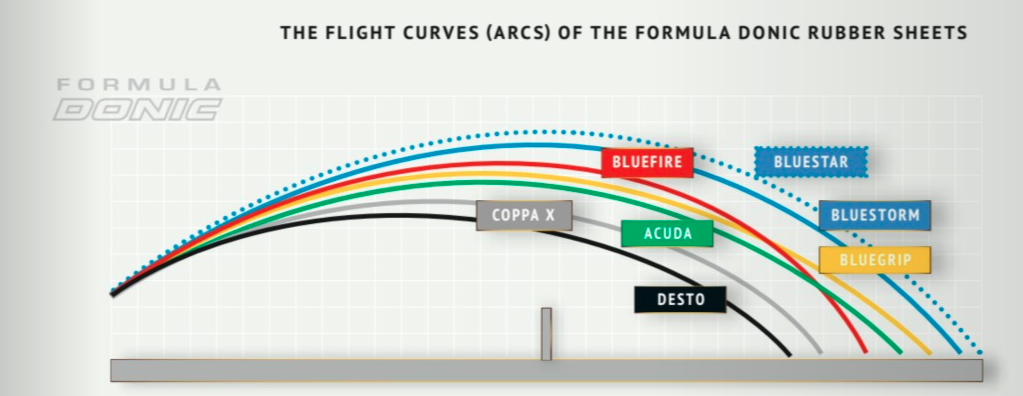
Donic has two graphs, but they show different information
belag-bluestorm-z-flugkurve.jpg

1769003110994-png.40072


From my understanding, rubbers with lower arcs are usually longer and the ones with higher arcs are shorter. Then we have rubbers like Zyre 03 that have both high arc and length.

Is it possible to choose an ideal rubber for your playstyle without having to go trough so many different models?

Both Dignics 80 and Rakza 7 are middle variants of their series, but are their arc heights similar?

Do you recommend starting off with medium throw rubbers and then pivoting based on your personal needs?

What would be a great starter rubber as benchmark? Rakza 7 perhaps?
 
This user has no status.
🏆 Top 1% Commenter
Well-Known Member
Mar 2015
1,462
1,178
4,321
Read 3 reviews
Normally it depends on the ratio of spin and speed generation response curves. A high throw rubber will generate spin easily on most contact while it's speed increase slope is flatter. You can't cheat physics, you can't generate high spin without a high arc. What we perceive as "very spinny" sometimes isn't actually very spinny, but have an uncomfortable spin/speed ratio.
 
This user has no status.
Member
Nov 2025
142
218
616
The graphs are a rough guide at best, but they are consistent with what most people seem to confirm anecdotally.

Tenergy 64/Rakza 9 are noticeably very fast and produce flatter shots compared to rubbers like Tenergy 05/Fastarc G1.

However there's going to be a lot of variance depending on the blade and your play level.

I agree it's reasonable to start off with fairly balanced rubbers like Rakza 7 and then evolving from there. For many people, Rakza 7 is a great rubber and suits them for many years (or forever, depending on playstyle).
 
  • Like
Reactions: Tyce
says what [IMG]
says what [IMG]
🏆 Top 1% Commenter
Well-Known Member
Feb 2016
2,477
1,528
5,109
Read 2 reviews
Throw angle is the difference between the ball's exit trajectory and the swing normal trajectory. It's related to the arc, but not really.

Arc is purely a function of the velocity and spin, but the depth and height will change based on the throw angle normalized to any given swing.

I think those example pictures are extremely exaggerated. I've never observed anything even remotely close to that.
 
says Shoo...nothing to see here. - zeio
🏆 Top 1% Commenter
Well-Known Member
Jan 2018
13,462
13,122
29,908
Hey guys,
I would like to discuss the arcs (throw angles) of table tennis rubbers. Butterfly has made an image for tenergy and dignics line, showing the arc differences between 05, 80 and 64 models.
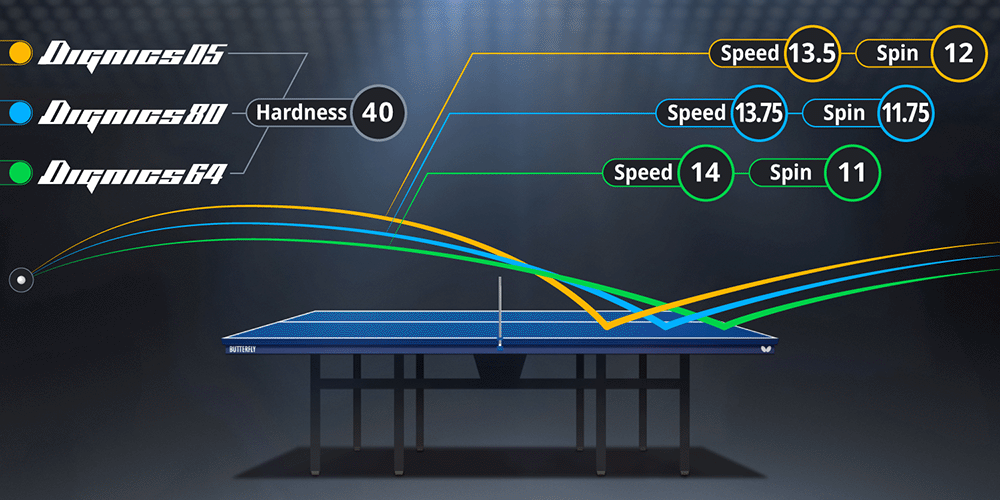
dignics-3.png

tenergy_trajectory_throw.jpg


Yasaka also has this example with Rakza rubbers
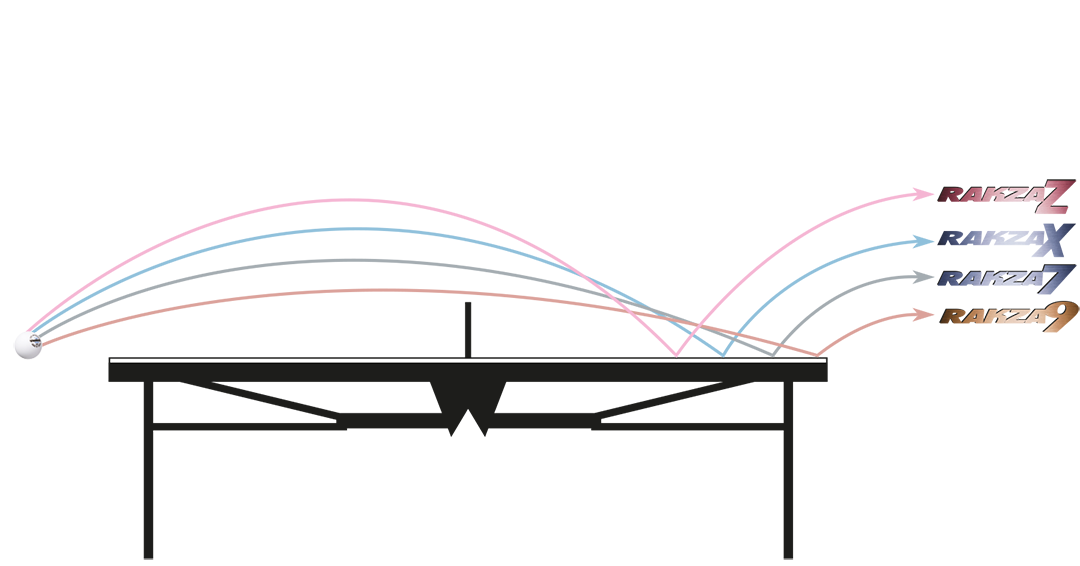
Rakza%20Z%20graph%202%20white%20png.png


Donic has two graphs, but they show different information
belag-bluestorm-z-flugkurve.jpg

1769003110994-png.40072


From my understanding, rubbers with lower arcs are usually longer and the ones with higher arcs are shorter. Then we have rubbers like Zyre 03 that have both high arc and length.

Is it possible to choose an ideal rubber for your playstyle without having to go trough so many different models?

Both Dignics 80 and Rakza 7 are middle variants of their series, but are their arc heights similar?

Do you recommend starting off with medium throw rubbers and then pivoting based on your personal needs?

What would be a great starter rubber as benchmark? Rakza 7 perhaps?
Start with spin/relatively close to the table (05) and move either way depending if you want speed/playing farther away (64) or balance/middle-of-the-road (80).

Practically all ESN offerings are copycats of that principle.
 
Top